What This Document Is
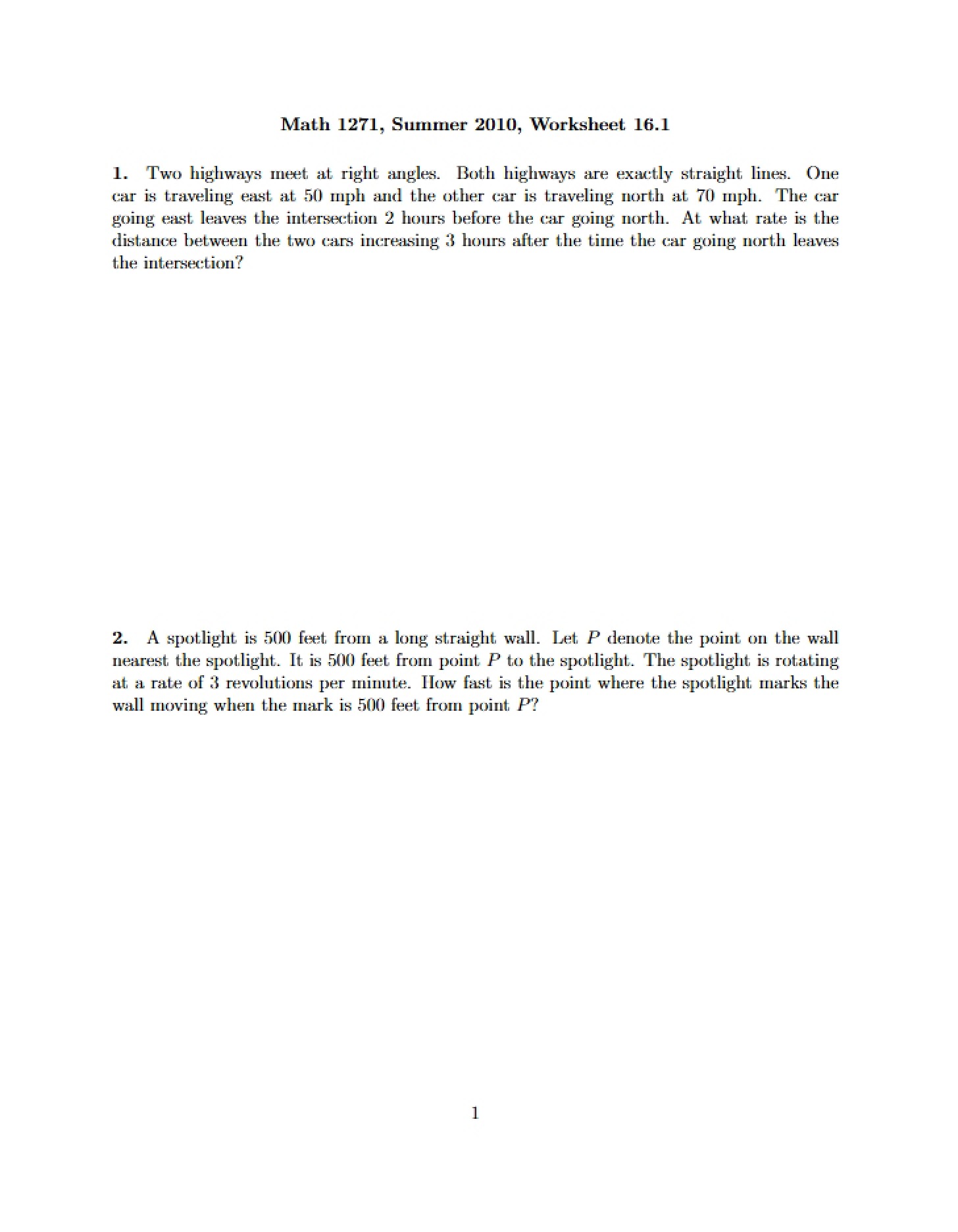
This is a midterm examination for MATH 1271 Calculus I, administered at the University of Minnesota Twin Cities in Fall 2011. It’s a closed-book, closed-notes assessment designed to evaluate a student’s understanding of core calculus concepts covered in the course up to that point in the semester. The exam emphasizes problem-solving skills and a conceptual grasp of differential calculus.
Why This Document Matters
This resource is invaluable for students currently enrolled in Calculus I, or those preparing to take the course. It’s particularly helpful for understanding the *types* of questions and the level of difficulty expected on a midterm exam at a major university. Studying similar exams is a proven method for test preparation, allowing you to identify areas where your understanding is strong and where further review is needed. It can also help you practice time management under exam conditions. Students who want to gauge their preparedness and familiarize themselves with the exam format will find this particularly useful.
Common Limitations or Challenges
This document represents *one* specific midterm from a past semester. While indicative of the course material and assessment style, it may not perfectly reflect the content or emphasis of your current course. The specific problems included are not representative of *all* possible questions. Furthermore, this resource does not include detailed explanations or solutions – it’s purely the exam itself. Access to the solutions is required for effective self-study.
What This Document Provides
* A variety of question types, including multiple-choice and free-response problems.
* Questions assessing understanding of fundamental calculus concepts like derivatives, limits, and function analysis.
* Problems requiring application of techniques such as logarithmic differentiation and implicit differentiation.
* Questions testing knowledge of critical points, intervals of increase/decrease, and optimization problems.
* An opportunity to practice applying calculus principles to solve mathematical problems under timed conditions.
* A section dedicated to evaluating understanding of key theorems and definitions related to derivatives and function behavior.