What This Document Is
This document provides a focused exploration of iterative reconstruction techniques within the field of medical imaging, specifically detailing the Maximum Likelihood – Expectation Maximization (ML-EM) algorithm. It’s designed for students and professionals seeking a deeper understanding of the mathematical and statistical foundations behind advanced image reconstruction methods. The material delves into the core principles of how observed data is related to underlying model parameters and unobserved data in medical imaging systems.
Why This Document Matters
This resource is particularly valuable for students enrolled in medical imaging courses, radiology programs, or related engineering disciplines. It’s ideal for those looking to move beyond basic reconstruction principles and grasp the complexities of statistically-driven methods. Understanding ML-EM is crucial for anyone involved in developing, implementing, or interpreting images from modalities like Positron Emission Tomography (PET) and Single-Photon Emission Computed Tomography (SPECT), where statistical noise is a significant factor. It will be most helpful when you are studying advanced reconstruction algorithms and their theoretical underpinnings.
Topics Covered
* The fundamental concept of iterative reconstruction.
* The relationship between observed data, unobserved data, and model parameters.
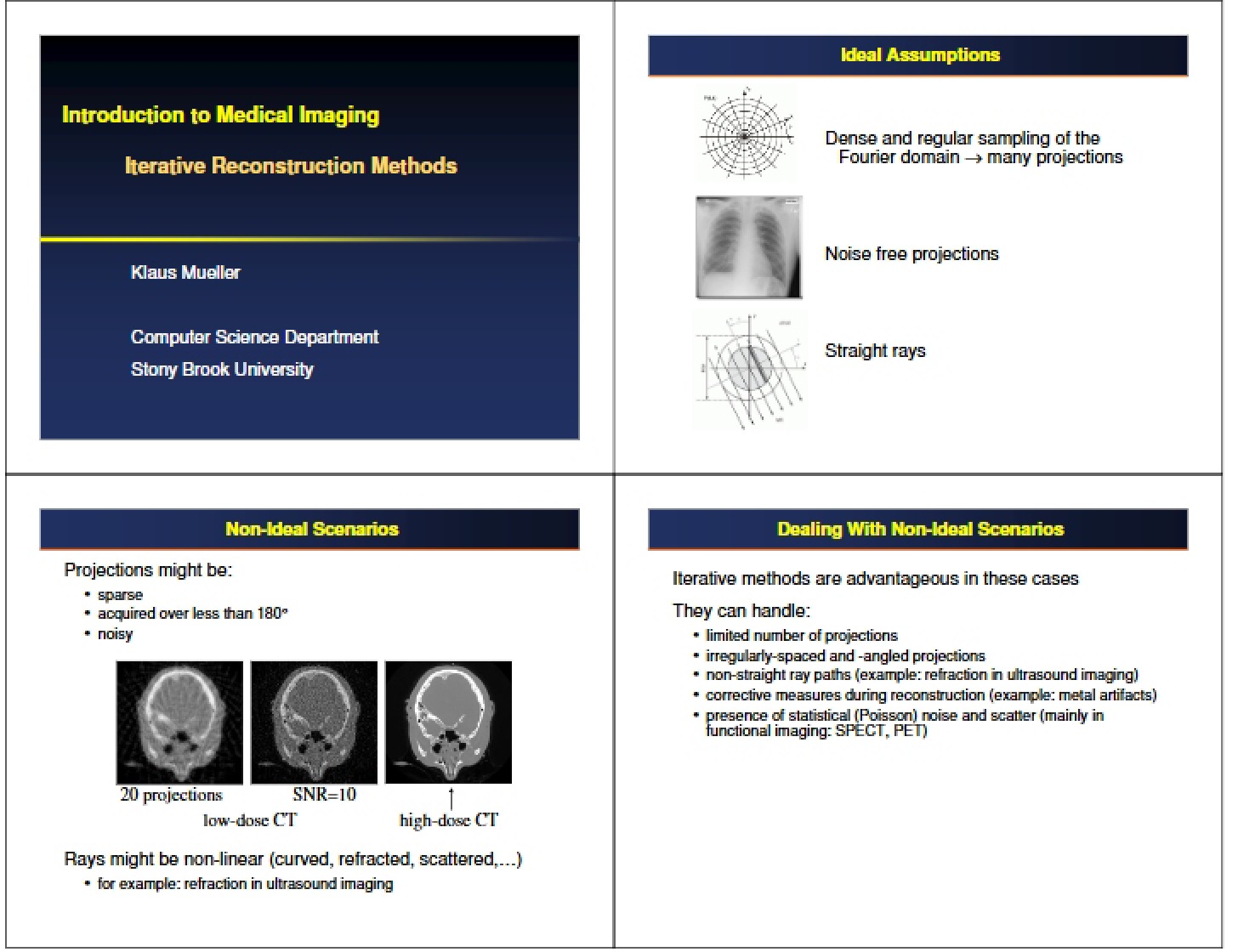
* Statistical considerations in medical imaging, particularly concerning noise and data acquisition.
* The principles of Maximum Likelihood estimation.
* The Expectation-Maximization (EM) algorithm and its application to image reconstruction.
* The Poisson distribution and its relevance to photon emission processes.
* The concept of a many-to-one mapping in image reconstruction.
What This Document Provides
* A detailed overview of the ML-EM algorithm’s iterative process.
* A framework for understanding the statistical basis of reconstruction methods.
* A discussion of the advantages of EM algorithms, such as stability and convergence.
* Definitions of key variables used in the reconstruction process, including image pixels and detector bins.
* An exploration of how mathematical models relate parameters, observed data, and unobserved data in medical imaging.