What This Document Is
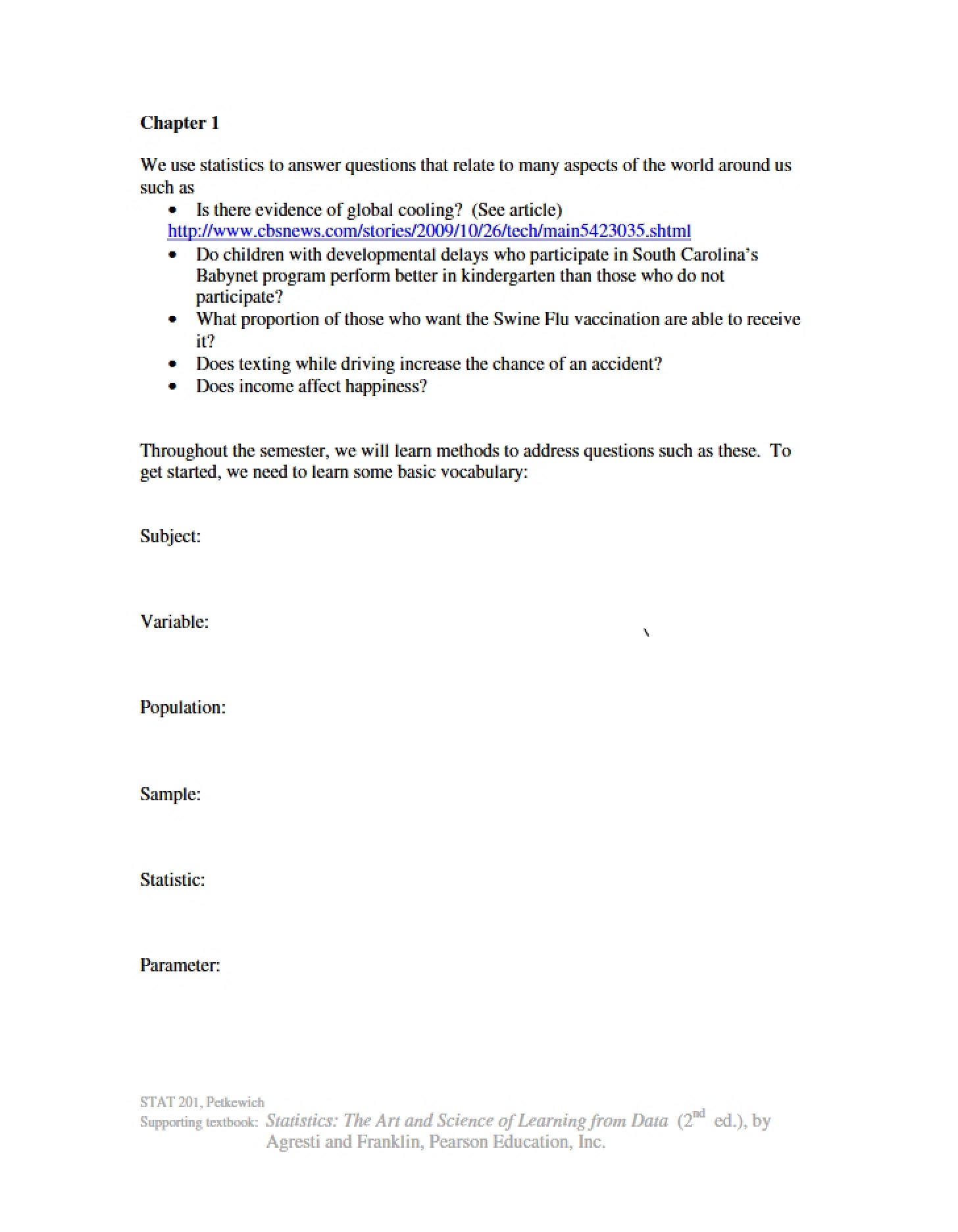
These are comprehensive study notes designed to help students prepare for an upcoming statistics exam, specifically within the context of a college-level introductory statistics course (STAT 201) at the University of South Carolina. The notes cover fundamental concepts and terminology essential for understanding statistical principles and their application. They appear to be compiled from lecture material and aim to consolidate key information for efficient review.
Why This Document Matters
This resource is invaluable for students enrolled in introductory statistics who are looking to solidify their understanding of core concepts before a test. It’s particularly useful for students who benefit from having a structured, written summary of course material. Utilizing these notes can help identify areas needing further review and improve overall exam preparedness. Students who struggle with the theoretical underpinnings of statistical methods will find this a helpful starting point for focused study.
Common Limitations or Challenges
These notes are intended as a *supplement* to course lectures and assigned readings, not a replacement. They do not include worked examples or detailed explanations of calculations. The notes also focus on conceptual understanding and may not cover every single topic discussed in the course. Access to the full document is required to gain a complete understanding of the statistical methods and their practical applications.
What This Document Provides
* Definitions of key statistical terms like individuals, variables, populations, and samples.
* An overview of different data collection methods, including observational studies and experiments.
* Discussion of potential biases in sampling and methods to mitigate them.
* Distinction between parameters and statistics and their respective roles in statistical inference.
* An introduction to sampling error and non-sampling errors.
* Explanation of stratified random sampling techniques.
* Key terminology related to experimental design, including treatments, response variables, and confounding variables.