What This Document Is
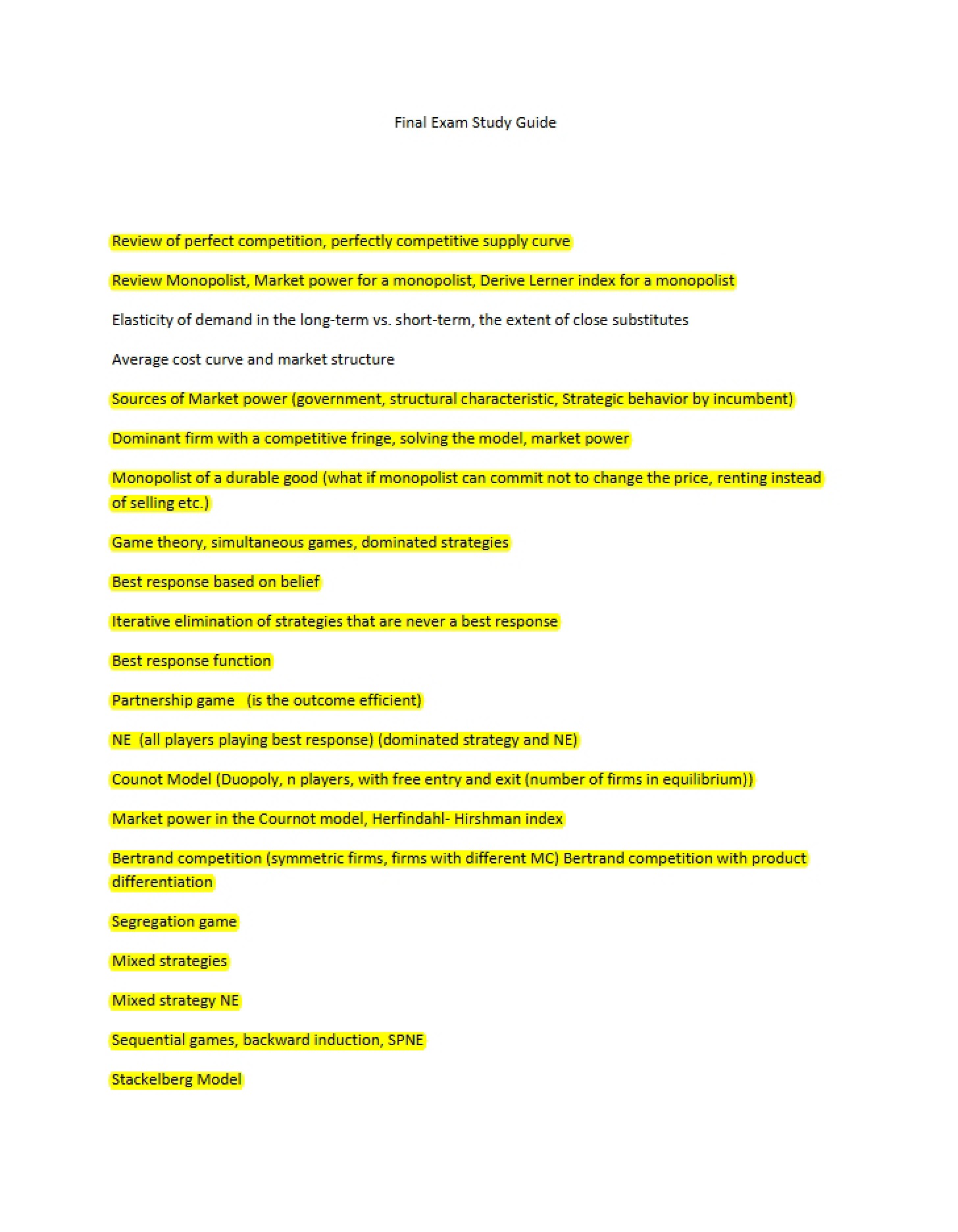
This study guide focuses on core concepts within the Economics of Industrial Organization (ECON 480) at the University of Southern California. It’s a collection of notes designed to aid in understanding complex models and scenarios frequently encountered in the course. The material appears to delve into strategic interactions between firms, market structures beyond perfect competition, and the implications of different firm behaviors. Expect a focus on mathematical representations of economic principles and problem-solving techniques.
Why This Document Matters
This resource is particularly valuable for students enrolled in ECON 480 who are looking to solidify their grasp of the course material. It’s ideal for use during exam preparation, when working through problem sets, or as a companion to lectures. Students who benefit most will be those comfortable with intermediate microeconomic theory and seeking a more detailed exploration of topics like game theory, pricing strategies, and market competition. It can help bridge the gap between theoretical concepts and their practical application in various industry settings.
Common Limitations or Challenges
This study guide is *not* a substitute for attending lectures or completing assigned readings. It’s designed to *supplement* your learning, not replace it. The notes are condensed and assume a foundational understanding of economic principles. It does not provide fully worked-out solutions to problems, nor does it cover every single topic discussed in the course. It also doesn’t offer alternative explanations or perspectives beyond those presented in the original notes.
What This Document Provides
* Detailed explorations of various firm behaviors within different market structures.
* Illustrative examples relating to strategic decision-making in oligopolistic markets.
* Notes on modeling techniques used to analyze firm interactions.
* Discussions of cost structures and their impact on firm profitability.
* Considerations of different technological scenarios and their effects on market outcomes.
* Frameworks for analyzing pricing strategies and output decisions.
* Key concepts related to market power and competitive advantage.