What This Document Is
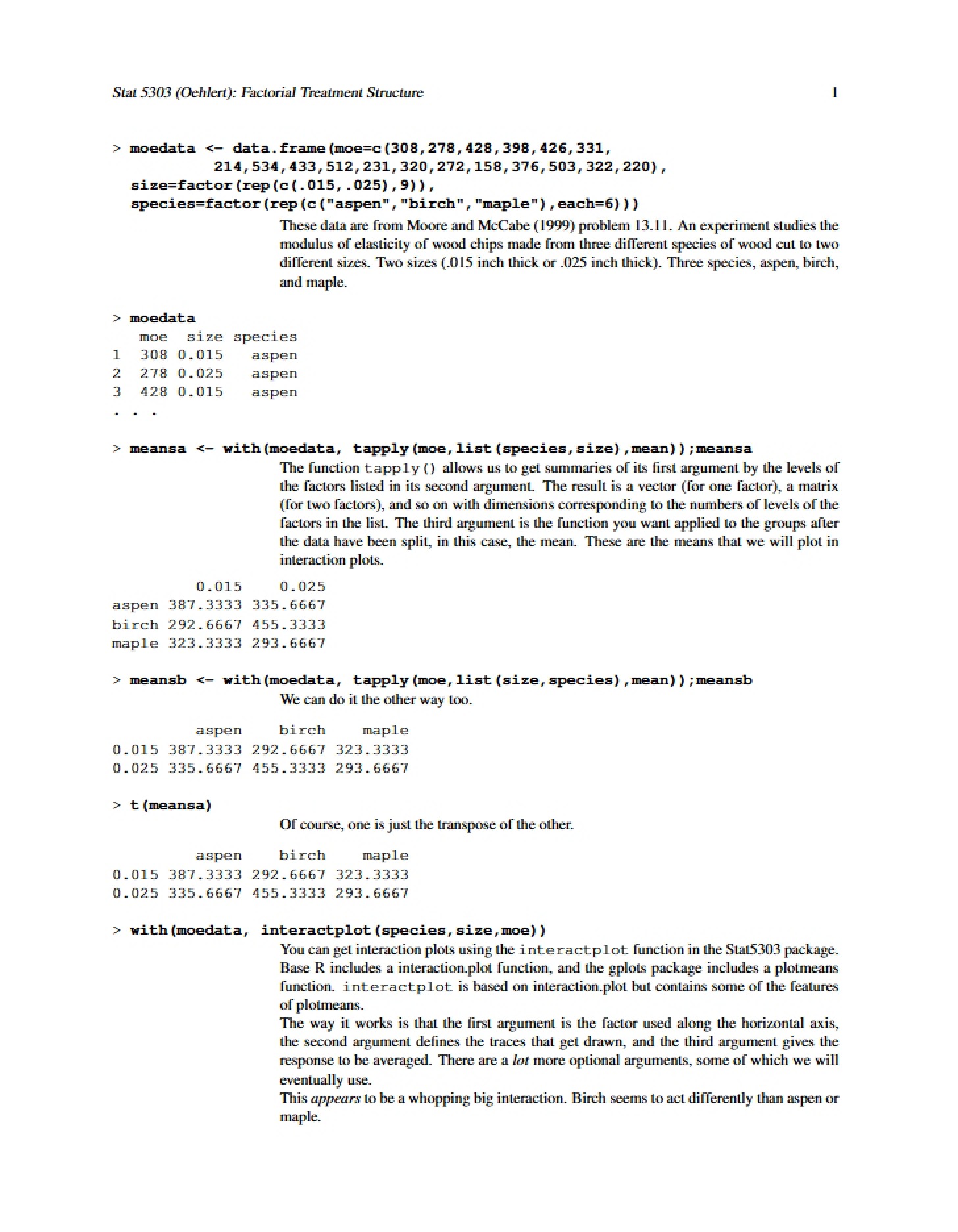
These are lecture notes from STAT 5303: Designing Experiments, taught at the University of Minnesota Twin Cities by Professor Oehlert. The material focuses on the statistical technique of split-plot designs – a powerful method for analyzing data when experimental units are structured in multiple layers, or when applying different levels of precision to different factors. This specific set of notes delves into the practical application of these designs, utilizing real-world examples and statistical software implementation.
Why This Document Matters
Students enrolled in advanced statistics courses, particularly those focused on experimental design, will find these notes exceptionally valuable. They are especially helpful for individuals who benefit from seeing statistical concepts illustrated with concrete examples and code. These notes can serve as a strong supplement to textbook readings and classroom lectures, aiding in comprehension and retention. Researchers planning or analyzing experiments with complex structures will also find the principles discussed here applicable to their work. This resource is most useful when studying the nuances of analyzing data from experiments where treatments aren’t applied uniformly across all experimental units.
Common Limitations or Challenges
These notes represent a specific instructor’s approach to the topic and may not cover all possible variations or theoretical derivations of split-plot designs. They are focused on *applying* the techniques, rather than providing a comprehensive theoretical foundation. The notes assume a prior understanding of fundamental statistical concepts like linear models, ANOVA, and the basics of R programming. They do not offer a substitute for completing assigned readings or actively participating in class.
What This Document Provides
* Illustrative examples using real datasets (e.g., gum emulsion breakage time).
* Demonstration of how to implement split-plot designs using statistical software.
* Discussion of diagnostic techniques for assessing model fit and identifying potential issues with the data.
* Exploration of variance patterns and their implications for experimental design.
* Consideration of data transformations and their effectiveness in addressing non-normality or heteroscedasticity.