What This Document Is
This document provides a focused exploration of optimization problems within a Calculus I context. It delves into techniques for finding maximum and minimum values of functions, and applies these concepts to a variety of real-world scenarios. The material builds upon foundational calculus principles, assuming a working knowledge of derivatives and function analysis. It’s designed to help students translate practical problems into mathematical formulations solvable using calculus.
Why This Document Matters
This resource is invaluable for students in a first-semester calculus course who are grappling with the application of derivatives. It’s particularly helpful when preparing for quizzes and exams focusing on optimization. Students pursuing degrees in physics, engineering, economics, or any field requiring mathematical modeling will find these techniques essential. If you’re struggling to set up optimization problems, understand constraints, or interpret the meaning of maximum/minimum values in context, this material will provide a solid foundation. It’s best used *after* mastering basic differentiation rules and curve sketching.
Common Limitations or Challenges
This document concentrates specifically on optimization techniques. It does not offer a comprehensive review of prerequisite calculus concepts like limits, continuity, or basic differentiation. It also doesn’t cover all possible optimization applications – it focuses on a curated set of problems to illustrate core principles. While the problems presented are diverse, they represent a subset of the challenges you might encounter. It assumes a level of mathematical maturity and problem-solving ability.
What This Document Provides
* A series of problems requiring the application of optimization principles.
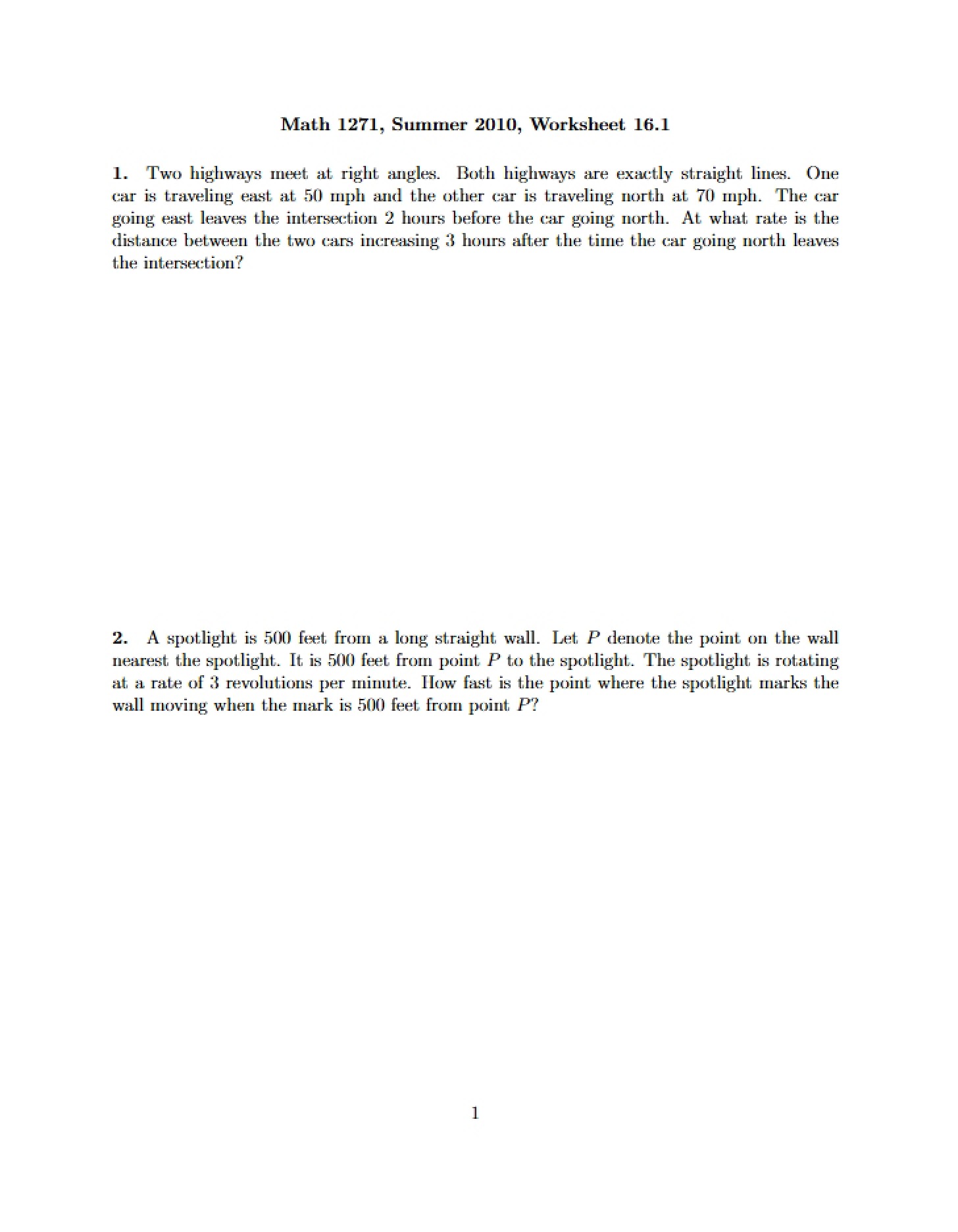
* Scenarios involving maximizing areas, volumes, and products under given constraints.
* Examples demonstrating how to formulate optimization problems from verbal descriptions.
* Problems involving geometric shapes like circles, rectangles, and cylinders.
* Applications relating to distance, speed, and cost minimization.
* Problems exploring optimization with both algebraic and geometric constraints.
* A challenge involving finding optimal paths and applying related trigonometric principles.