What This Document Is
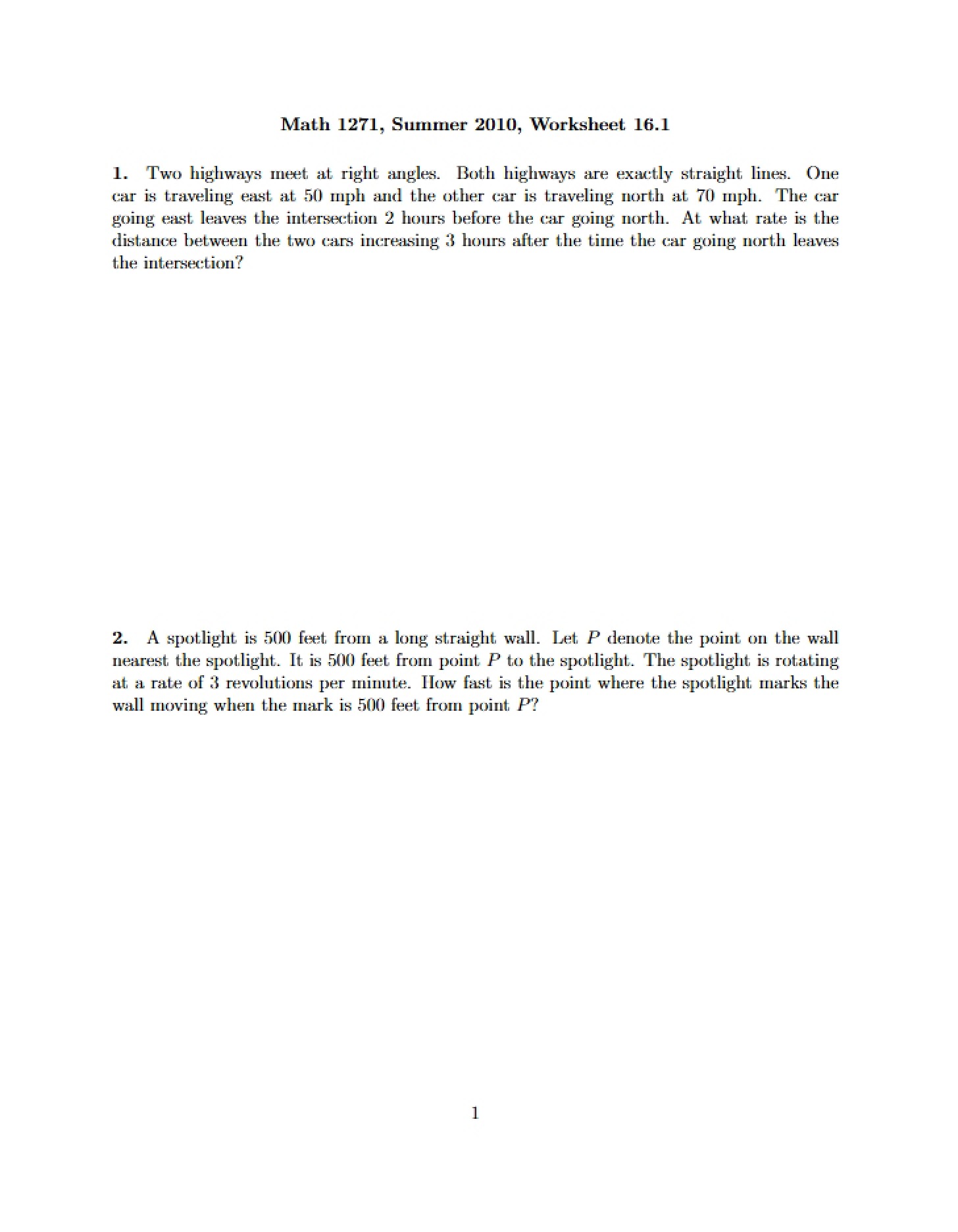
This is a collection of problem sets designed for students enrolled in Calculus I (MATH 1271) at the University of Minnesota Twin Cities. These sets focus on applying the core concepts of differential calculus to real-world scenarios and graphical analysis. Expect a strong emphasis on optimization problems, curve sketching, and understanding the relationship between a function, its first derivative, and its second derivative. The material appears to be drawn from Summer 2010 coursework, offering a solid foundation in fundamental calculus principles.
Why This Document Matters
This resource is invaluable for students aiming to solidify their understanding of Calculus I topics. It’s particularly helpful for those who learn best by *doing* – actively working through problems is crucial for mastering calculus. These problem sets are ideal for reinforcing lecture material, preparing for quizzes and exams, and developing problem-solving skills. Students who struggle with applying theoretical concepts to practical situations will find this particularly beneficial. Consistent practice with these types of problems will build confidence and improve performance in the course.
Common Limitations or Challenges
This document presents a series of problems *without* providing detailed step-by-step solutions. It assumes you have a foundational understanding of calculus concepts and are prepared to apply them independently. It does not offer comprehensive explanations of the underlying theory or alternative approaches to problem-solving. Furthermore, while representative of the course material, it doesn’t encompass *every* possible problem type covered in Calculus I. Access to lecture notes and textbook readings is highly recommended alongside this resource.
What This Document Provides
* A variety of application problems involving geometric shapes and optimization.
* Exercises focused on analyzing the characteristics of functions based on their derivatives.
* Problems requiring the interpretation of derivative information (sign, zero, undefined) to sketch function graphs.
* Practice in determining intervals where a function is increasing or decreasing.
* Opportunities to identify points of inflection and concavity.
* Problems designed to test understanding of function positivity and negativity.