What This Document Is
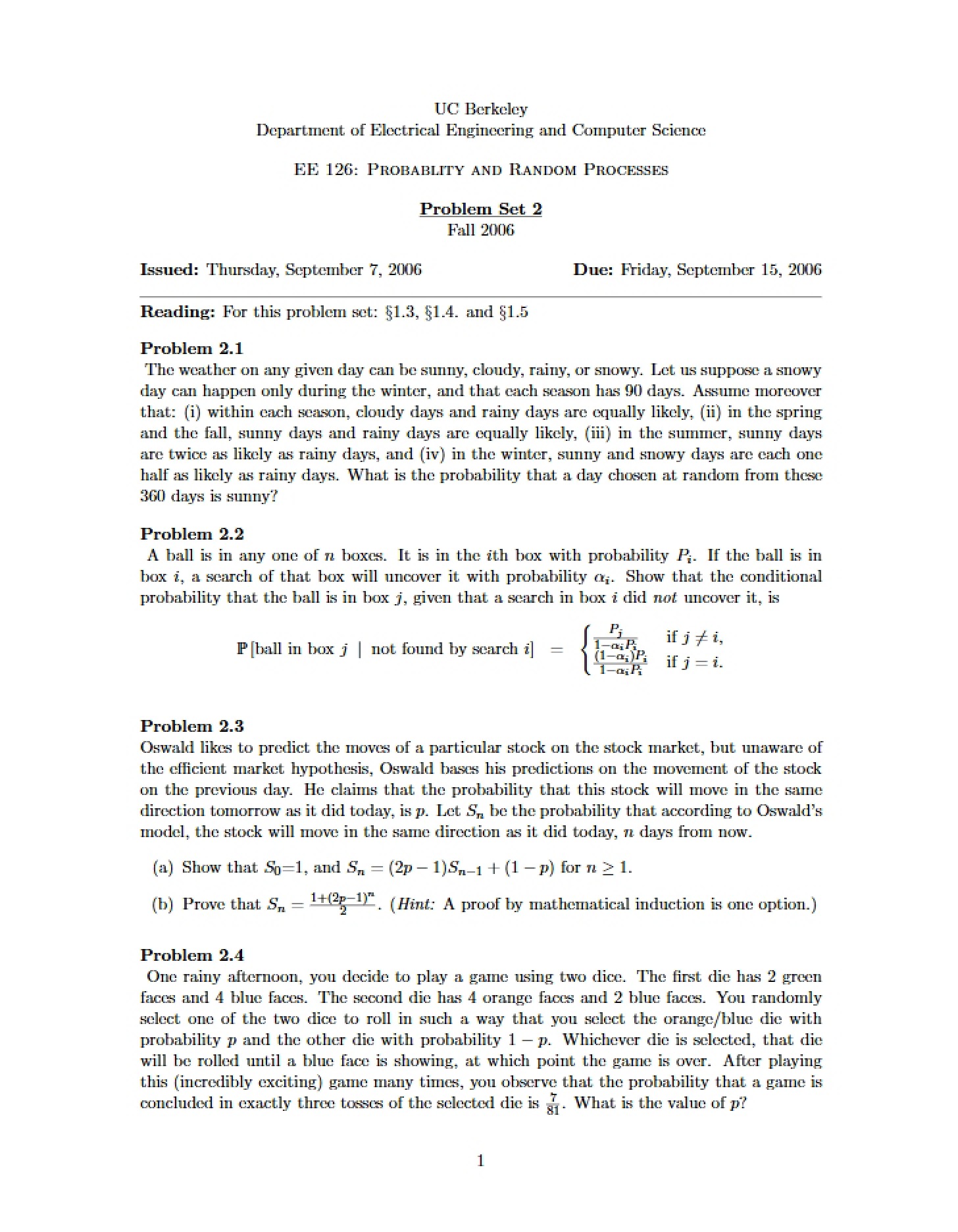
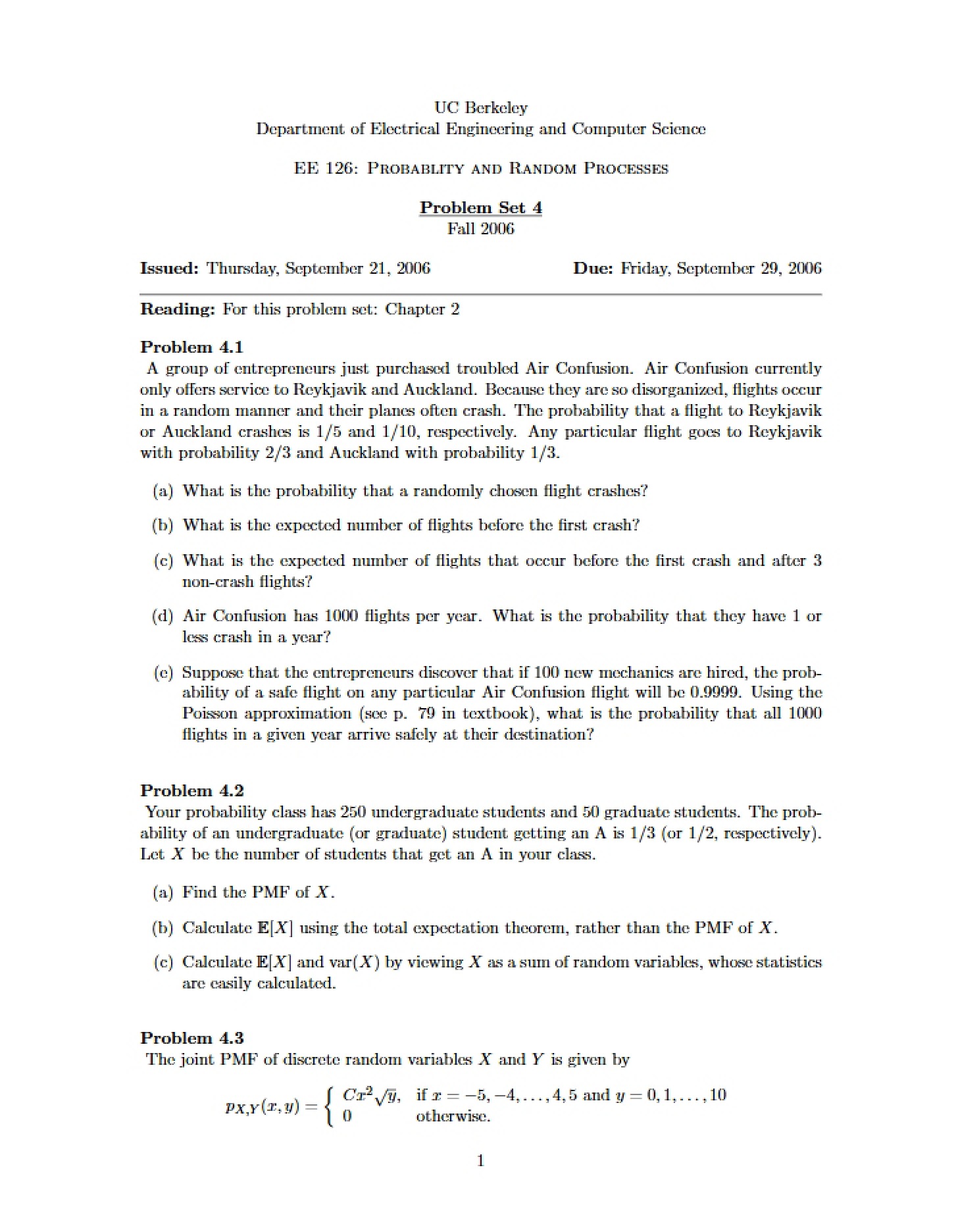
This is a problem set for EE 126: Probability and Random Processes, offered at the University of California, Berkeley. It’s designed to reinforce your understanding of core concepts through practical application. This particular assignment, Problem Set Nine, focuses on deepening your analytical skills in probability theory and random process analysis. It’s intended to be completed independently to assess your grasp of the material covered in lectures and readings.
Why This Document Matters
This problem set is crucial for students enrolled in an undergraduate probability and random processes course. Successfully working through these problems will solidify your ability to model real-world scenarios using probabilistic tools. It’s particularly valuable when preparing for exams or more advanced coursework that builds upon these foundational principles. If you're studying electrical engineering, computer science, or a related field requiring a strong mathematical background, tackling these challenges will be highly beneficial.
Topics Covered
* Joint Probability Density Functions (PDFs)
* Independence of Random Variables (and conditional independence)
* Conditional Probability and PDFs
* Estimation Theory & Minimizing Mean Squared Error
* Random Variables defined by functions of other Random Variables
* Discrete Random Variables and their distributions
* Gaussian Random Variables and Covariance Matrices
* Linear Least Squares Estimation
* Transforms of Random Variables
What This Document Provides
* A series of challenging problems designed to test your understanding of probability and random processes.
* Scenarios involving continuous and discrete random variables.
* Opportunities to apply theoretical concepts to practical situations, such as analyzing a fair three-sided die and a wheel of fortune.
* Problems requiring manipulation of covariance matrices and Gaussian distributions.
* Exercises focused on finding expected values, variances, and transforms of random variables.
* A framework for applying least-squares estimation techniques.