What This Document Is
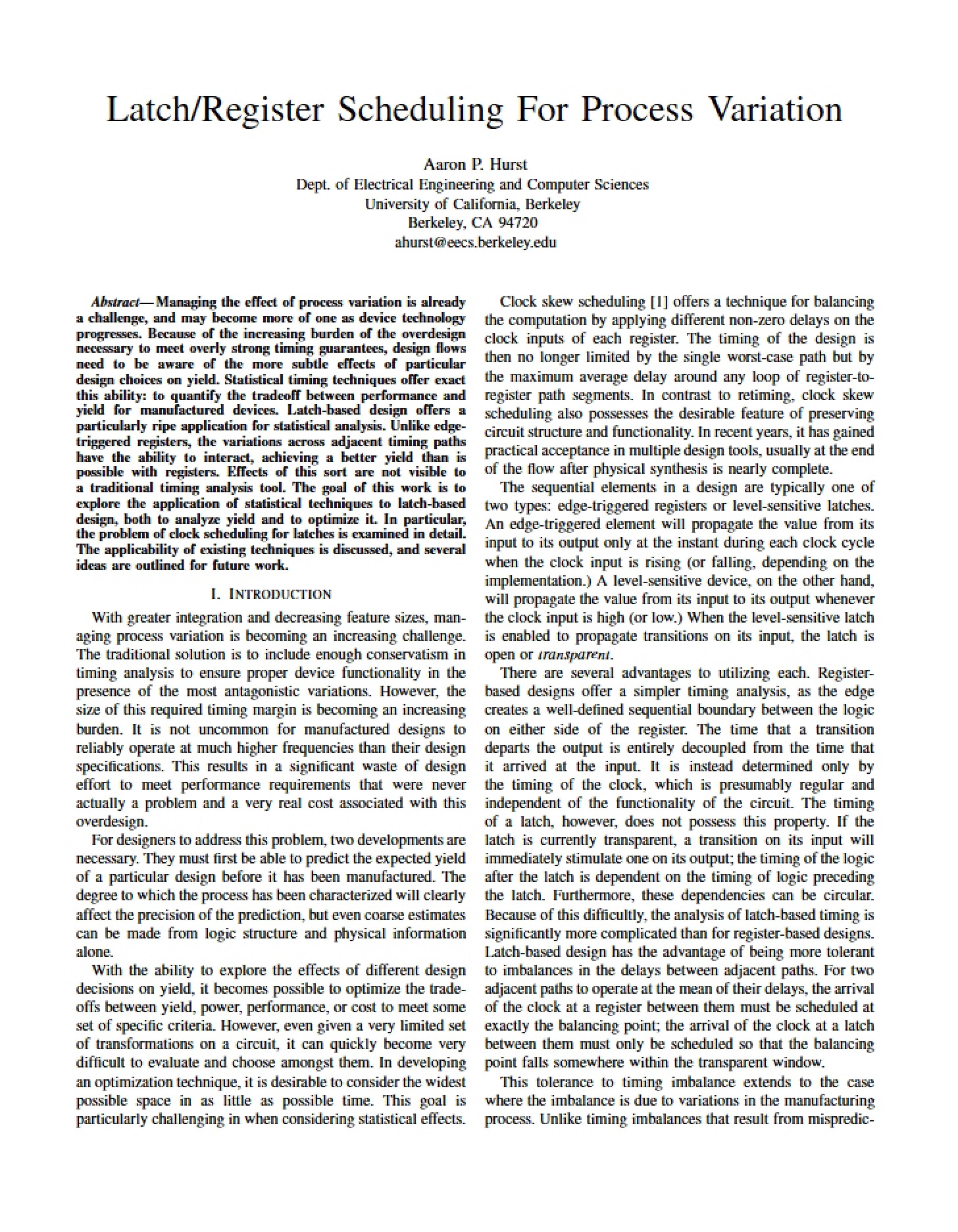
This is a focused exploration of advanced techniques within Computer-Aided Design, specifically addressing the challenges and methodologies surrounding process variation in latch-register scheduling. It delves into sophisticated mathematical and computational approaches used to analyze and optimize designs in the face of manufacturing uncertainties. The material builds upon foundational CAD principles and extends them into areas requiring a strong understanding of linear algebra and geometric analysis.
Why This Document Matters
This resource is ideal for advanced undergraduate and graduate students in electrical engineering and computer science tackling complex design problems. It’s particularly valuable for those specializing in VLSI design, integrated circuit development, or related fields where minimizing the impact of process variations is critical for reliable performance. Professionals seeking to deepen their understanding of robust design methodologies will also find this a useful reference. Access to the full content will equip you with the knowledge to approach real-world design challenges with greater confidence.
Topics Covered
* Generalized Principal Component Analysis (GPCA)
* Subspace Clustering techniques
* Algebraic Geometric approaches to data segmentation
* Applications of Principal Component Analysis (PCA) in various fields (image processing, biomedical imaging)
* Higher-order Singular Value Decomposition (SVD) and its extensions
* Analysis of polynomial fitting and differentiation in relation to data clustering
* The impact of dimensionality on subspace analysis
What This Document Provides
* A detailed examination of the theoretical underpinnings of GPCA.
* An overview of prior work in subspace clustering and related algorithms.
* A discussion of the challenges and potential solutions for identifying multiple intersecting subspaces within data.
* Insights into the relationship between algebraic methods and geometric interpretations of data segmentation.
* A foundation for understanding how to apply these techniques to improve the robustness of electronic designs.