What This Document Is
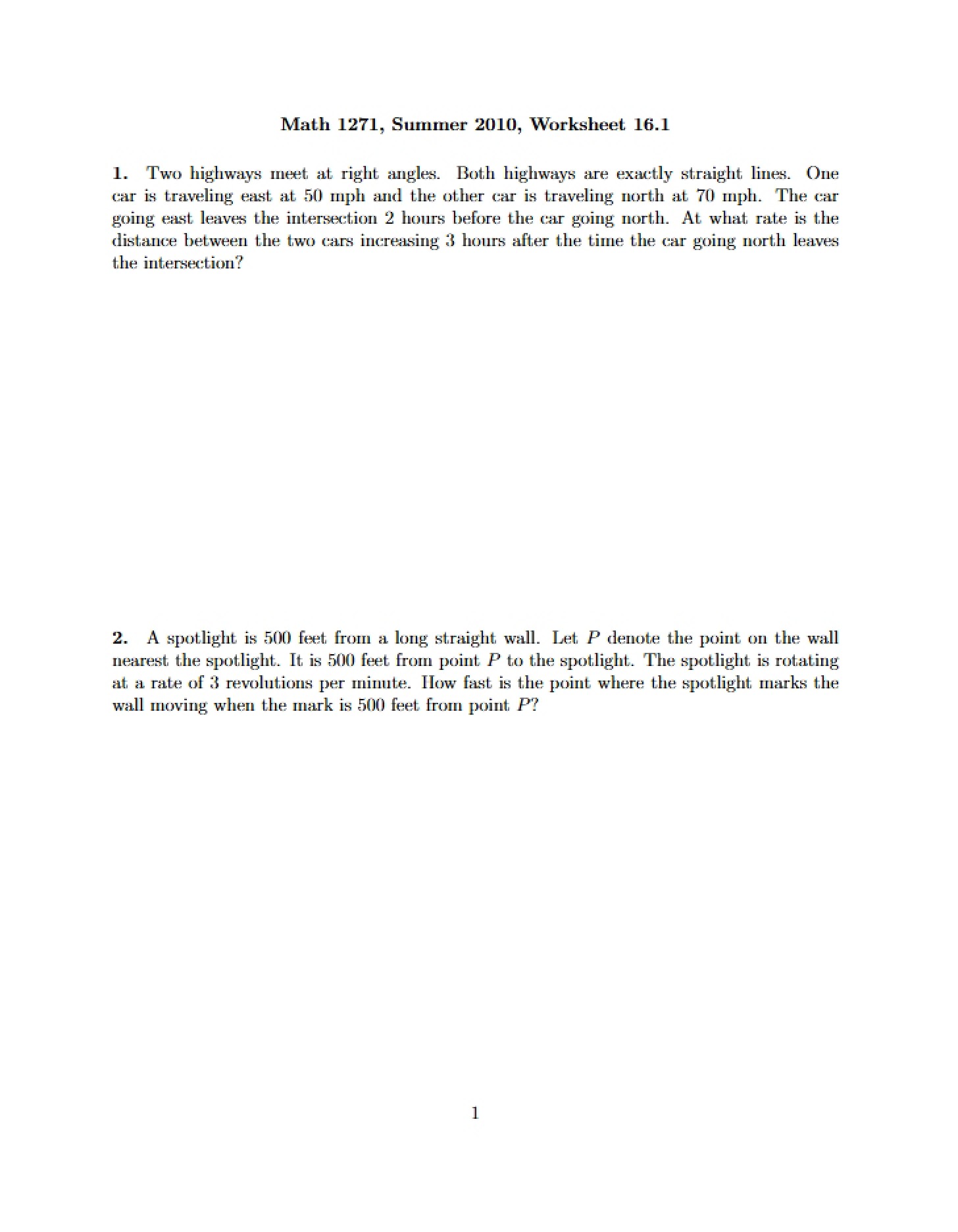
This resource is a focused collection of problems designed to build mastery of related rates in calculus. It delves into scenarios where you’ll need to determine the rate of change of one quantity given the rate of change of another – a core skill in differential calculus. The problems presented require a strong understanding of implicit differentiation and applying calculus principles to real-world dynamic situations. This isn’t a conceptual explanation of related rates; it’s a practice-focused tool for solidifying your ability to *apply* the concepts.
Why This Document Matters
This is an invaluable resource for students currently enrolled in a Calculus I course, particularly when tackling sections covering applications of derivatives. It’s ideal for students who have learned the foundational concepts and are now seeking extensive practice to improve their problem-solving speed and accuracy. It’s also helpful for students preparing for quizzes or exams where related rates problems are frequently featured. If you find yourself struggling to translate word problems into mathematical relationships and then solve for unknown rates, this collection will provide targeted practice.
Common Limitations or Challenges
This document focuses *exclusively* on practice problems. It does not offer detailed step-by-step solutions or extensive theoretical explanations of the underlying principles. It assumes you already have a foundational understanding of differentiation rules, implicit differentiation, and how to set up equations representing relationships between variables. It won’t walk you through the initial setup of each problem; you’ll need to apply your existing knowledge to get started. Access to this resource will not substitute for attending lectures or reading your textbook.
What This Document Provides
* A diverse set of related rates problems spanning geometric shapes (triangles, hexagons, tetrahedrons) and real-world applications.
* Problems involving rates of change related to distance, volume, and angles.
* Scenarios requiring the application of geometric formulas alongside calculus techniques.
* Problems designed to test your ability to identify relevant variables and their relationships.
* Practice applying related rates concepts to situations involving motion and changing dimensions.