What This Document Is
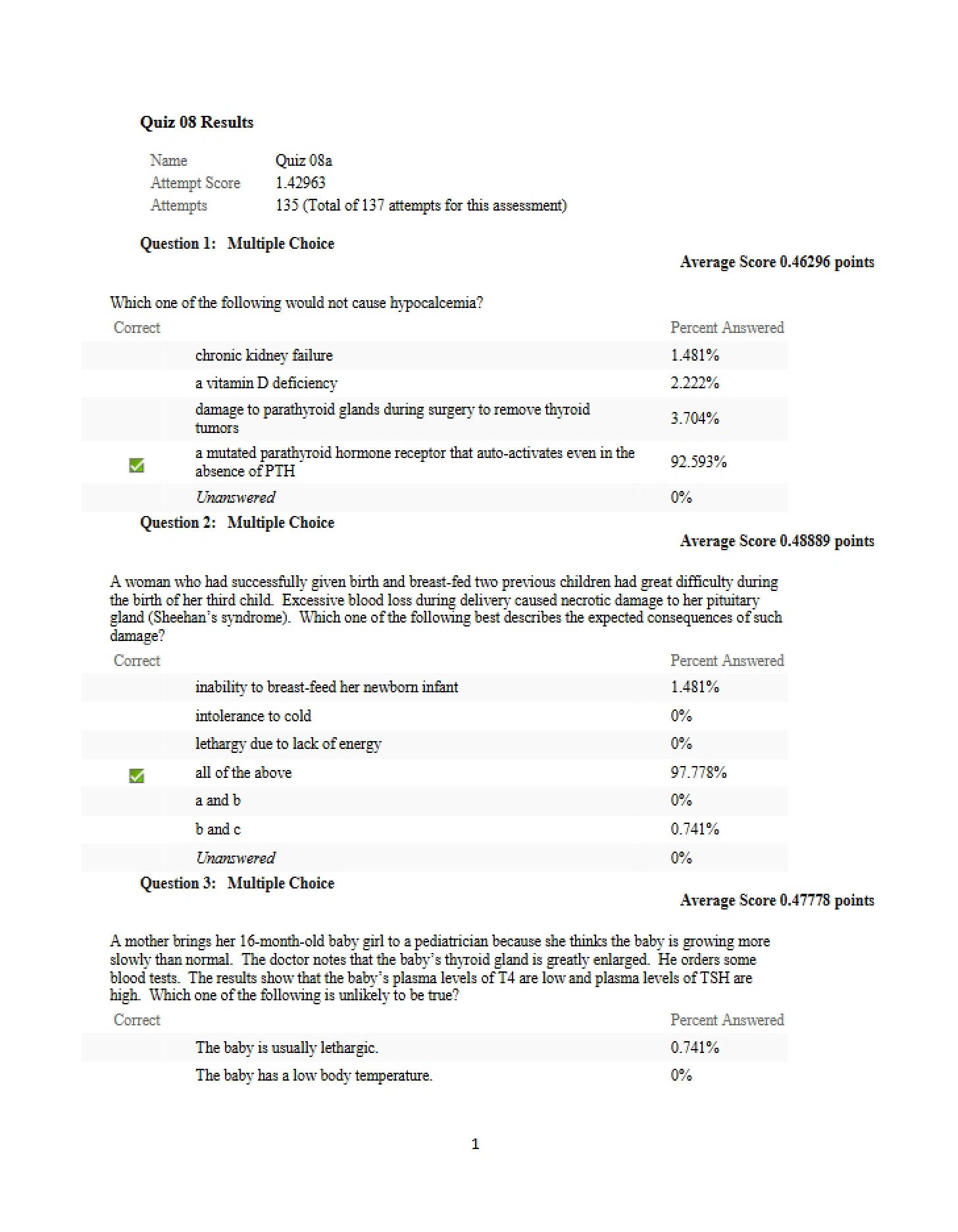
This document presents a detailed results analysis from the sixth quiz within the General Physiology (BISC 307) course at the University of Southern California. It’s designed to offer students a comprehensive overview of their performance on specific assessment questions, and the class’s overall understanding of key physiological concepts. The report breaks down scores and responses, providing insights into areas of strength and weakness related to smooth muscle physiology and metabolic processes.
Why This Document Matters
This results report is invaluable for any student seeking to maximize their learning in General Physiology. It’s particularly useful after completing Quiz 06 to identify specific topics needing further review. Understanding where you and your peers struggled can highlight crucial concepts for focused study. This is a powerful tool for self-assessment and targeted preparation for future exams or assignments, helping you refine your understanding of complex physiological mechanisms. It’s best used in conjunction with course lectures, textbooks, and other study materials.
Common Limitations or Challenges
This document *does not* contain the original quiz questions, nor does it provide correct answers or detailed explanations of the solutions. It focuses solely on the statistical outcomes of student responses. While it indicates areas where the class as a whole found difficulty, it doesn’t offer direct instruction or re-teaching of the material. It’s a diagnostic tool, not a learning resource in itself. Access to the original quiz and associated course materials is essential for effective use of this report.
What This Document Provides
* Overall quiz statistics, including the number of attempts made.
* Performance metrics for each individual question, including average scores.
* A breakdown of response distribution for multiple-choice questions, showing the percentage of students selecting each answer option.
* An overview of student responses to essay questions, showcasing different approaches and levels of detail.
* Insights into class-wide comprehension of topics related to caldesmon, Rho kinase, and metabolic adaptations during periods of food deprivation.
* Data related to understanding the application of smooth muscle relaxants in treating various conditions.