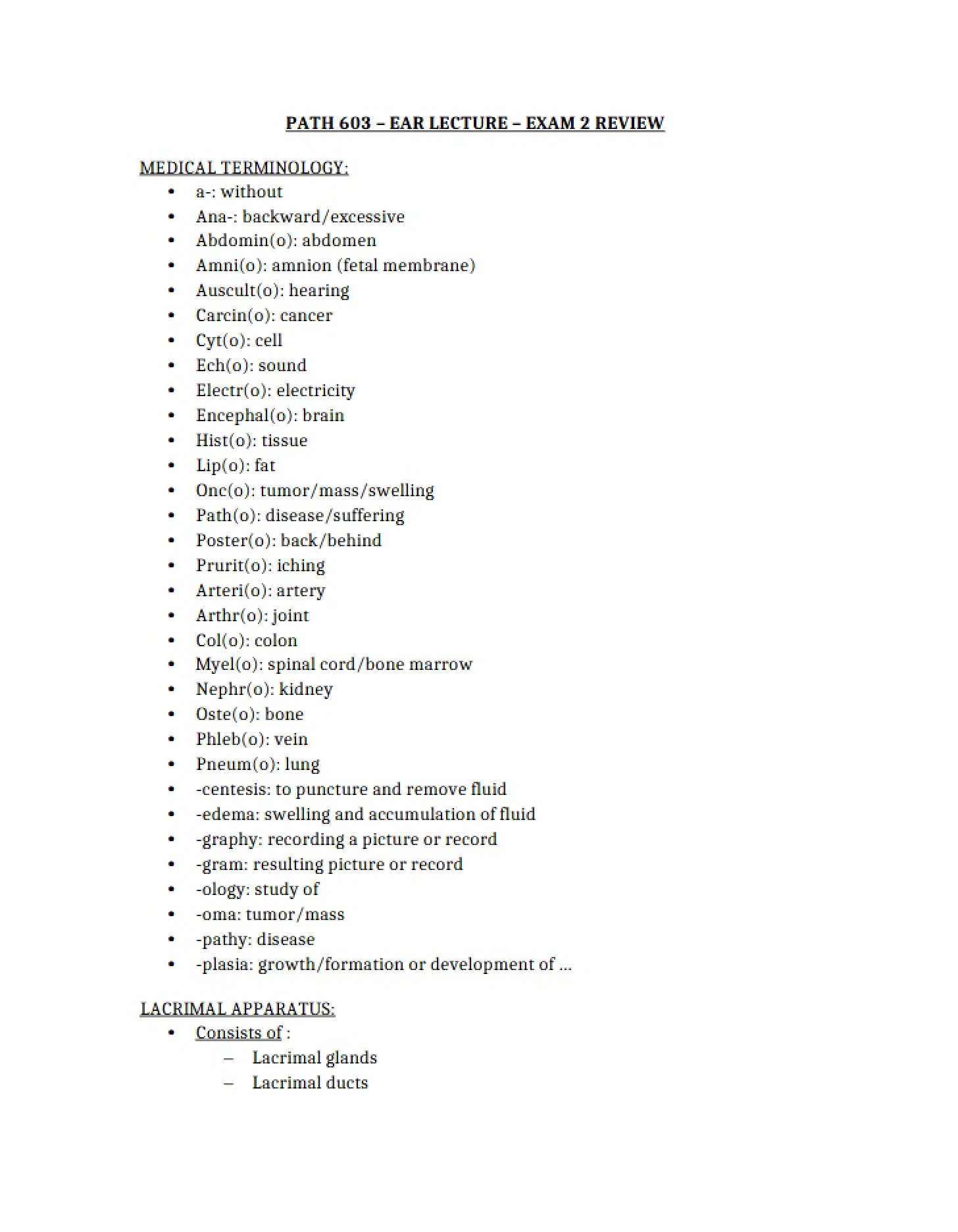
What This Document Is
This is a focused review resource designed to aid students preparing for the second exam in PATH 603: Pathology & Anatomy, specifically covering the Head and Neck region. It’s structured to help you consolidate your understanding of key anatomical structures, medical terminology, and clinically relevant landmarks within this complex area of the body. The material is presented in a format intended for efficient memorization and application of foundational knowledge.
Why This Document Matters
This review is invaluable for students aiming to solidify their grasp of head and neck anatomy and pathology before a high-stakes exam. It’s particularly useful for those who benefit from a concise, organized overview of essential terms and topographical relationships. Utilizing this resource can help identify areas needing further study and improve confidence when approaching exam questions related to this critical body region. It’s best used in the days leading up to the exam as a final check of core concepts.
Common Limitations or Challenges
This review is *not* a substitute for comprehensive course materials, lectures, or laboratory work. It does not include detailed explanations of pathological processes beyond their naming conventions. It also doesn’t provide in-depth coverage of surgical procedures, nor does it offer practice exam questions or detailed case studies. The resource focuses on foundational knowledge and landmark identification; a strong understanding of underlying physiological principles is assumed.
What This Document Provides
* A compilation of essential medical prefixes and suffixes commonly used in head and neck pathology.
* Key anatomical landmarks of the head and neck, organized by region.
* Important relationships between anatomical structures, particularly concerning the midline neck.
* Identification of specific vertebral levels and their corresponding anatomical significance.
* Focus on structures relevant to clinical assessment, such as pulse palpation and potential sites of obstruction.
* Emphasis on memorization of a key anatomical plate for comprehensive understanding.