What This Document Is
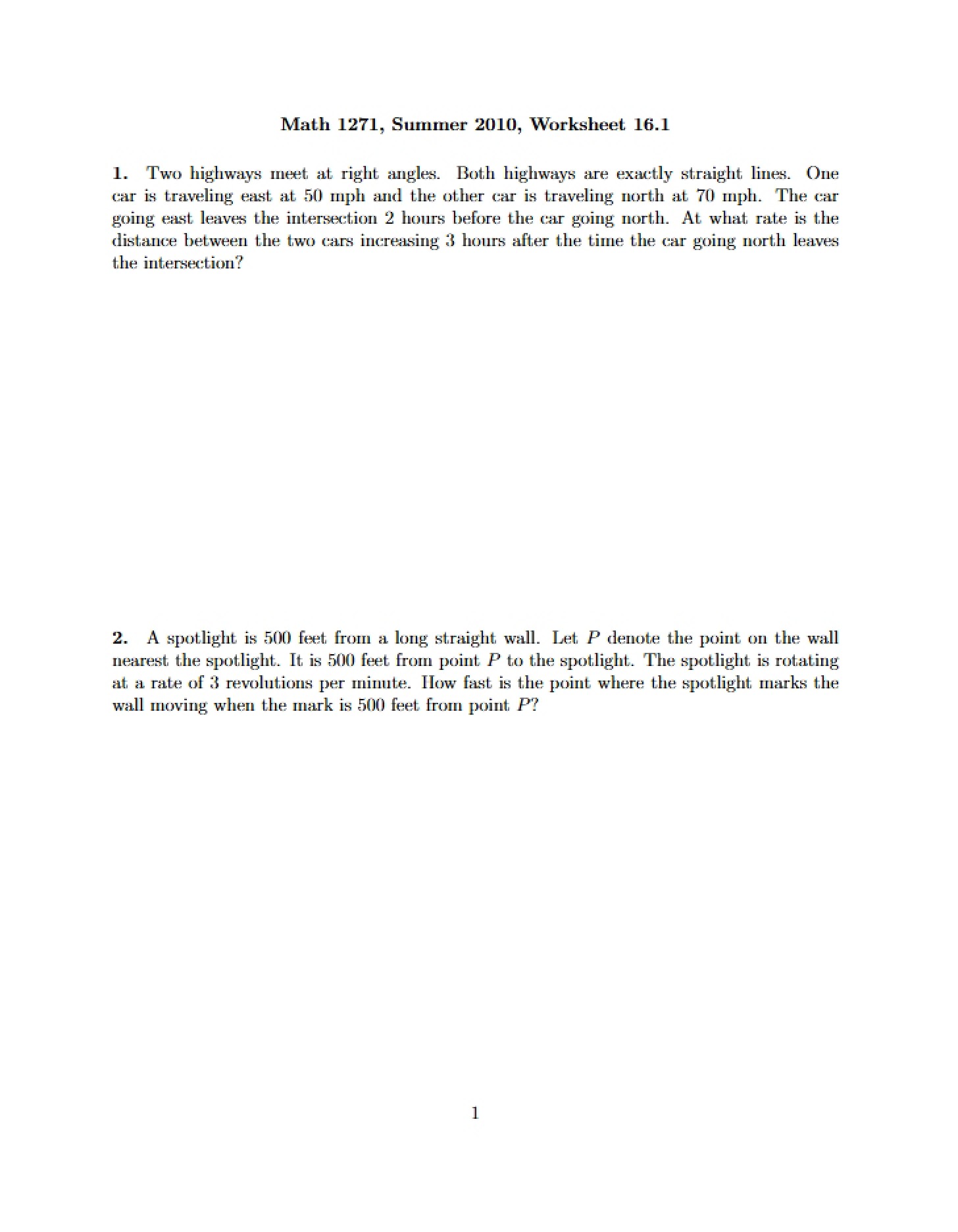
This is a focused review worksheet designed to reinforce core concepts from Calculus I (MATH 1271) at the University of Minnesota Twin Cities. Specifically, it targets your understanding of differential calculus – the branch of calculus concerned with the rate of change of functions. The worksheet is structured around applying theoretical knowledge to practical problems, testing your ability to analyze function behavior. It appears to cover multiple related topics within the broader scope of differentiation.
Why This Document Matters
This resource is ideal for students currently enrolled in Calculus I, or those preparing to take a similar course. It’s particularly useful for solidifying your understanding *before* a quiz or exam, or for identifying areas where you might need further review. Working through these types of problems will build confidence and improve your problem-solving speed. It’s best used *after* you’ve already been introduced to the concepts in class and are looking for practice. Students who struggle with applying theorems or interpreting function characteristics will find this especially helpful.
Common Limitations or Challenges
This worksheet is not a substitute for attending lectures, reading the textbook, or seeking help from a professor or teaching assistant. It assumes you have a foundational understanding of calculus principles. It does not provide detailed explanations of *how* to solve problems, but rather presents problems for you to tackle independently. It also doesn’t cover every single topic within Calculus I – it focuses on a specific set of related skills.
What This Document Provides
* Practice problems centered around identifying key features of functions.
* Exercises designed to test your understanding of the Mean Value Theorem.
* Scenarios requiring analysis of first and second derivatives to determine function behavior.
* Opportunities to apply derivative tests for locating critical points and inflection points.
* Problems focused on determining intervals of concavity.
* A series of function analyses based on provided derivative information.