What This Document Is
This material represents a focused session within an upper-level computer science course exploring the foundations of intelligent systems. Specifically, it delves into the core mechanisms by which computers can perform logical reasoning – a crucial component of building systems capable of problem-solving and decision-making. It examines various approaches to representing knowledge and utilizing that knowledge to answer questions or draw conclusions. The session builds upon prior understanding of formal logic and knowledge representation techniques.
Why This Document Matters
Students enrolled in advanced computer science courses, particularly those specializing in areas like machine learning, robotics, or knowledge systems, will find this session invaluable. It’s especially helpful when tackling projects that require automated reasoning or the development of expert systems. Professionals seeking a deeper understanding of the theoretical underpinnings of intelligent systems will also benefit. This material is best reviewed *after* establishing a solid foundation in propositional and predicate logic, and before moving onto more complex reasoning architectures.
Common Limitations or Challenges
This session focuses on the *principles* of logical reasoning systems. It does not provide a comprehensive, ready-to-implement code library or a step-by-step guide to building a complete reasoning engine. It also assumes a level of mathematical maturity and familiarity with data structures. While various system types are discussed, the material doesn’t offer comparative performance analyses or detailed implementation trade-offs. It’s a conceptual overview designed to build understanding, not a practical “how-to” guide.
What This Document Provides
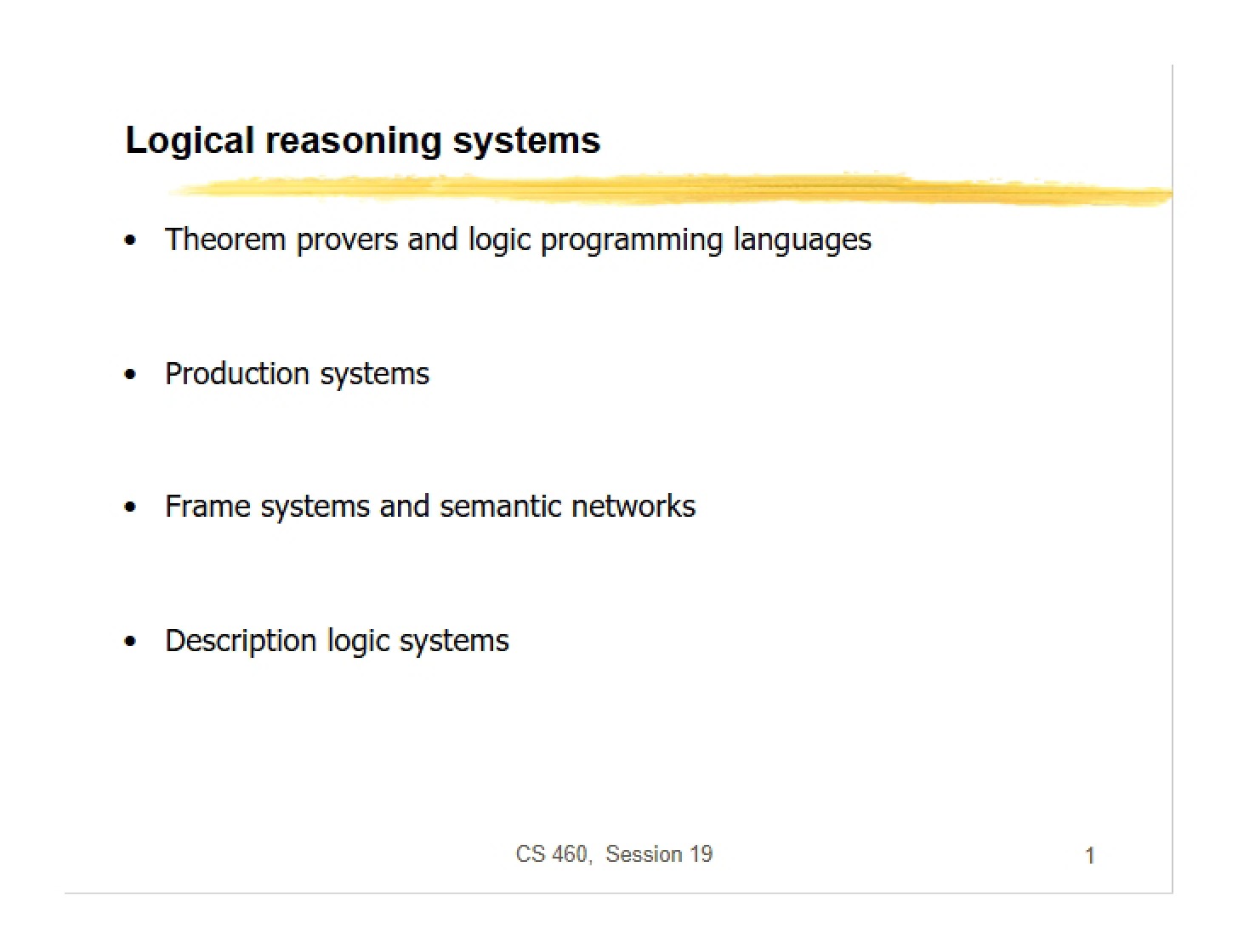
* An overview of different logical reasoning approaches, including theorem proving and production systems.
* Discussion of knowledge base manipulation – adding, removing, and querying information.
* Exploration of indexing techniques designed to improve the efficiency of reasoning processes.
* Examination of the computational complexity associated with different reasoning methods.
* An introduction to unification, a key process in logical inference.
* A contrast between traditional programming paradigms and logic programming.