What This Document Is
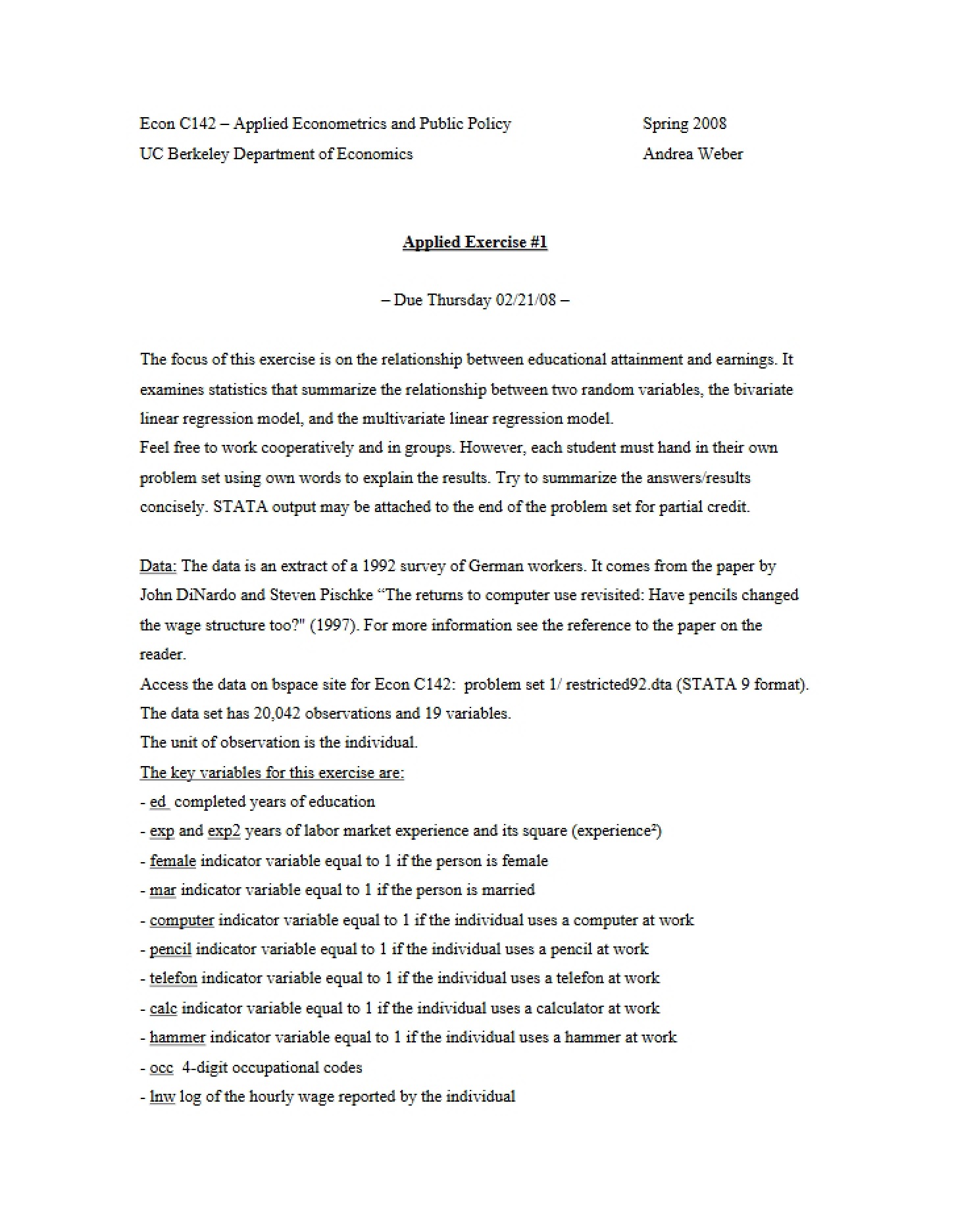
This is a problem set designed for students enrolled in an Applied Econometrics and Public Policy course (ECON C142) at UC Berkeley. It’s a practical exercise focused on applying econometric techniques to analyze the economic relationship between education and earnings. The assignment utilizes a real-world dataset derived from a German worker survey and requires students to perform calculations and interpret results.
Why This Document Matters
This problem set is ideal for students seeking to solidify their understanding of core econometric concepts through hands-on application. It’s particularly valuable for those preparing for exams or further study in econometrics, public policy, or related fields. Working through these problems will help you develop skills in data analysis, statistical inference, and the interpretation of regression results. It’s best used *after* initial lectures and readings on bivariate and multivariate regression models.
Topics Covered
* Relationship between educational attainment and earnings
* Bivariate linear regression models
* Multivariate linear regression models
* Covariance and correlation coefficients
* Conditional means and variances
* Assumptions underlying linear regression
* Data analysis using STATA (output interpretation)
What This Document Provides
* A detailed problem set with multiple parts, building in complexity.
* A description of a dataset containing information on individual workers, including education levels, experience, and wages.
* A list of key variables within the dataset, allowing you to focus your analysis.
* Guidance on summarizing statistical relationships and interpreting regression results.
* Opportunities to practice applying theoretical concepts to a real-world economic scenario.