What This Document Is
This document is a problem set designed to reinforce your understanding of key concepts within an Introduction to MEMS Design course. It focuses on the practical application of theoretical knowledge to a specific MEMS device – a gyroscope – and challenges you to analyze its operation and characteristics. It’s intended to be a substantial exercise, requiring detailed consideration of the device’s mechanics and electrical principles.
Why This Document Matters
This problem set is ideal for students enrolled in a MEMS design course, particularly those seeking to solidify their grasp of inertial sensors and micromachining processes. It’s most valuable when used *after* initial lectures and readings on gyroscopes, capacitive sensing, and bulk micromachining. Working through these problems will build confidence in your ability to apply fundamental principles to real-world MEMS designs and prepare you for more advanced coursework or project work.
Topics Covered
* Gyroscopic principles and operation
* MEMS gyroscope design and fabrication
* Bulk micromachining techniques (specifically, Silicon-on-Insulator (SOI) processes)
* Capacitive sensing mechanisms
* Coriolis force and its application in MEMS sensors
* Analysis of mechanical resonance and vibration
* Electrostatic actuation and sensing
* Geometric and dimensional analysis of MEMS structures
What This Document Provides
* A detailed description of a specific MEMS gyroscope design.
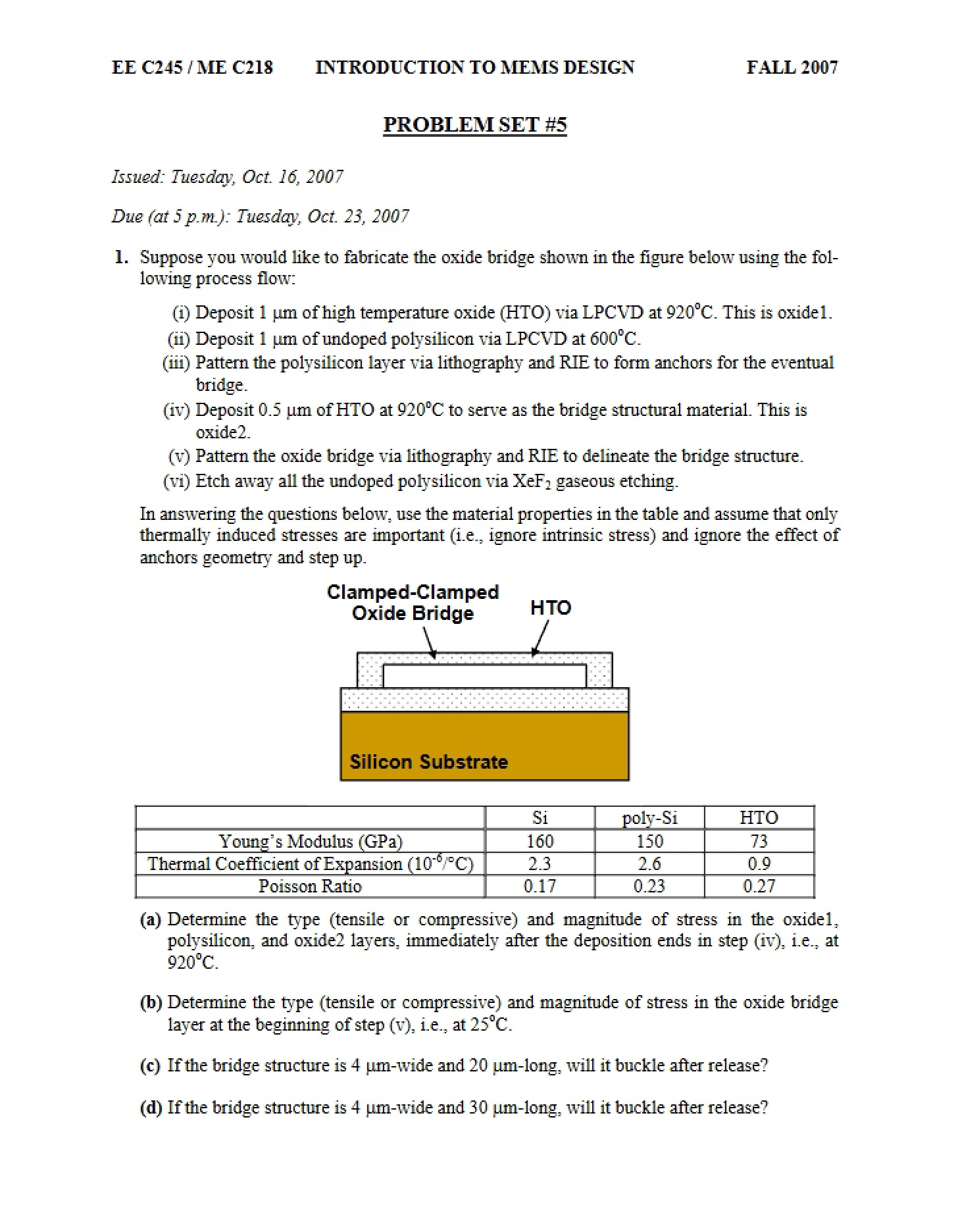
* Illustrative figures and diagrams of the device’s structure and components.
* A table of key device parameters and specifications.
* A schematic representation of the associated electronic circuits.
* A series of analytical questions designed to test your understanding of the device’s functionality and design trade-offs.
* A defined operating condition (DC bias voltage) for analysis.