What This Document Is
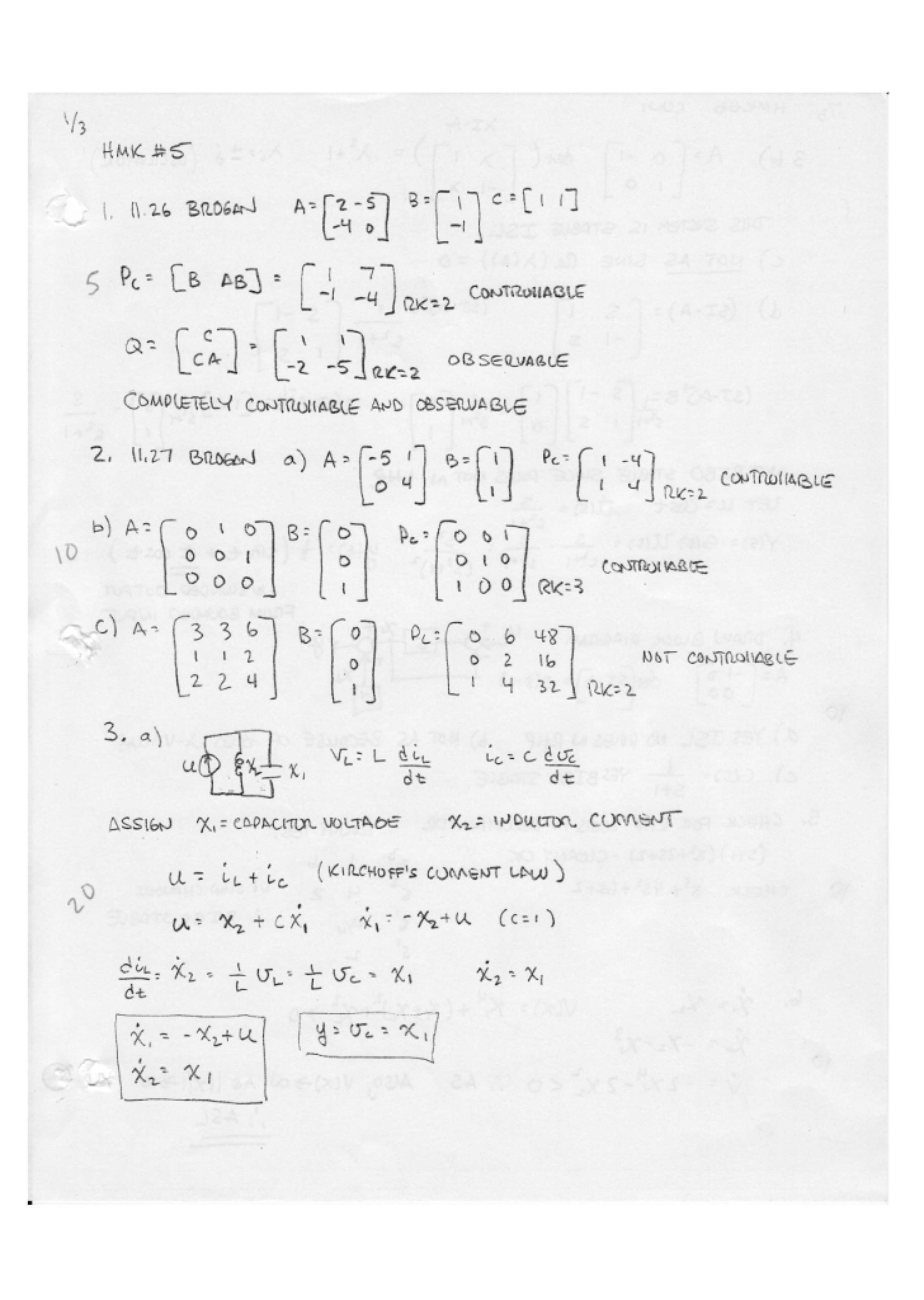
This document presents a detailed solution set for Homework Four within the ESE 543 Control Systems Design course at Washington University in St. Louis. It focuses on applying state-space methods to analyze and solve control systems problems. The material builds upon concepts related to system representation, controllability, observability, and potentially, system response analysis. It appears to delve into matrix manipulations and linear algebra as applied to control theory.
Why This Document Matters
This resource is invaluable for students enrolled in advanced control systems courses utilizing state-space techniques. It’s particularly helpful for those seeking to verify their understanding of complex problem-solving methodologies. Students who are struggling with the mathematical derivations or application of state-space concepts will find a detailed walkthrough beneficial. It’s best used *after* attempting the homework problems independently, as a means of checking work and identifying areas needing further review. It can also serve as a strong study aid before exams covering these topics.
Common Limitations or Challenges
This solution set does not provide foundational explanations of the core control systems principles. It assumes a pre-existing understanding of state-space representation, controllability, observability, and related mathematical tools. It will not teach the underlying theory; rather, it demonstrates the *application* of that theory to specific problems. Furthermore, it focuses solely on the solutions for Homework Four and does not cover broader course concepts outside of those problems.
What This Document Provides
* Step-by-step workings through assigned homework problems.
* Detailed calculations involving matrix operations and linear algebra.
* Applications of state-space analysis techniques to determine system properties.
* Illustrations of how to approach complex control systems design challenges.
* Worked examples relating to system characteristics and potential limitations.
* Analysis of system behavior based on state-space models.