What This Document Is
This document represents a detailed solution set for Homework Assignment Three of EE 555: Broadband Network Architectures, offered at the University of Southern California in Fall 2007. It’s a collection of worked problems designed to reinforce understanding of core concepts related to broadband network design and analysis. The material focuses on applying theoretical knowledge to practical scenarios within the field of high-speed data communication. It delves into the intricacies of network switching fabrics and performance evaluation.
Why This Document Matters
This resource is invaluable for students currently enrolled in, or revisiting, a broadband network architecture course. It’s particularly helpful when you’re seeking to solidify your grasp of complex topics like non-blocking network design, probability of blocking, and performance analysis of switching systems. If you’ve attempted the homework problems and are looking to validate your approach, understand alternative solution methodologies, or pinpoint areas where your understanding needs strengthening, this solution set will be a significant aid. It’s best used *after* you’ve made a genuine effort to solve the problems independently.
Common Limitations or Challenges
This document provides completed solutions; it does not offer step-by-step guidance through the problem-solving process. It assumes a foundational understanding of the course material and related mathematical concepts. While the solutions demonstrate *how* to arrive at answers, they do not substitute for actively engaging with the problems yourself. It also focuses specifically on the problems presented in Homework Three and won’t cover broader theoretical explanations beyond what’s necessary to understand the solutions presented.
What This Document Provides
* Detailed analyses of problems related to multi-stage interconnection networks.
* Applications of probability theory to assess blocking performance in network switches.
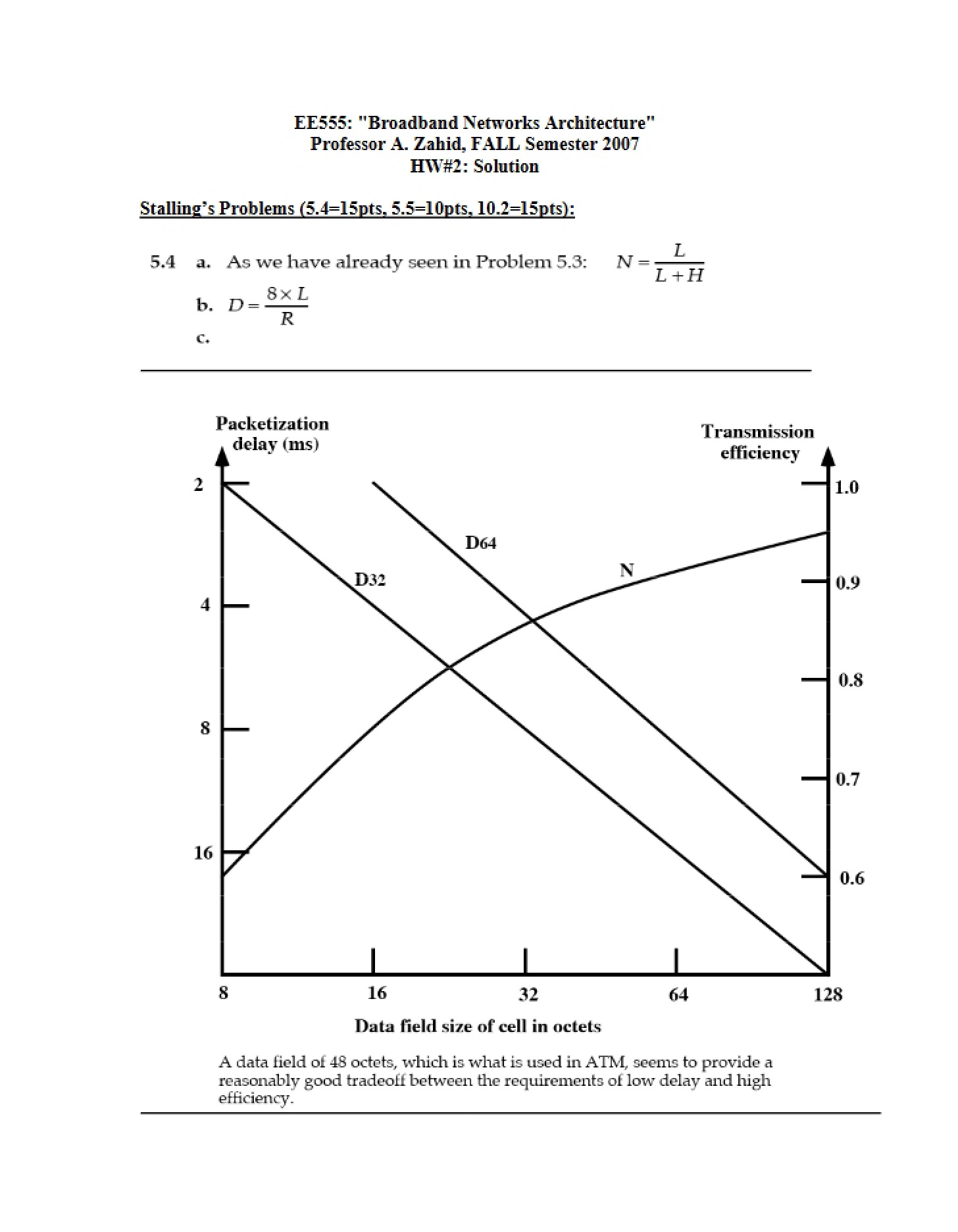
* Calculations concerning data segment sizes, transmission times, and bit rates.
* Discussions on the scalability limitations of different switching architectures (output buffering, knockout switches).
* Performance evaluations of OC-3 and OC-12 links, including cell delay calculations.
* Exploration of space-time-space switching configurations and their non-blocking properties.
* Problem sets covering concepts related to loss rates and probability of loss in network systems.