What This Document Is
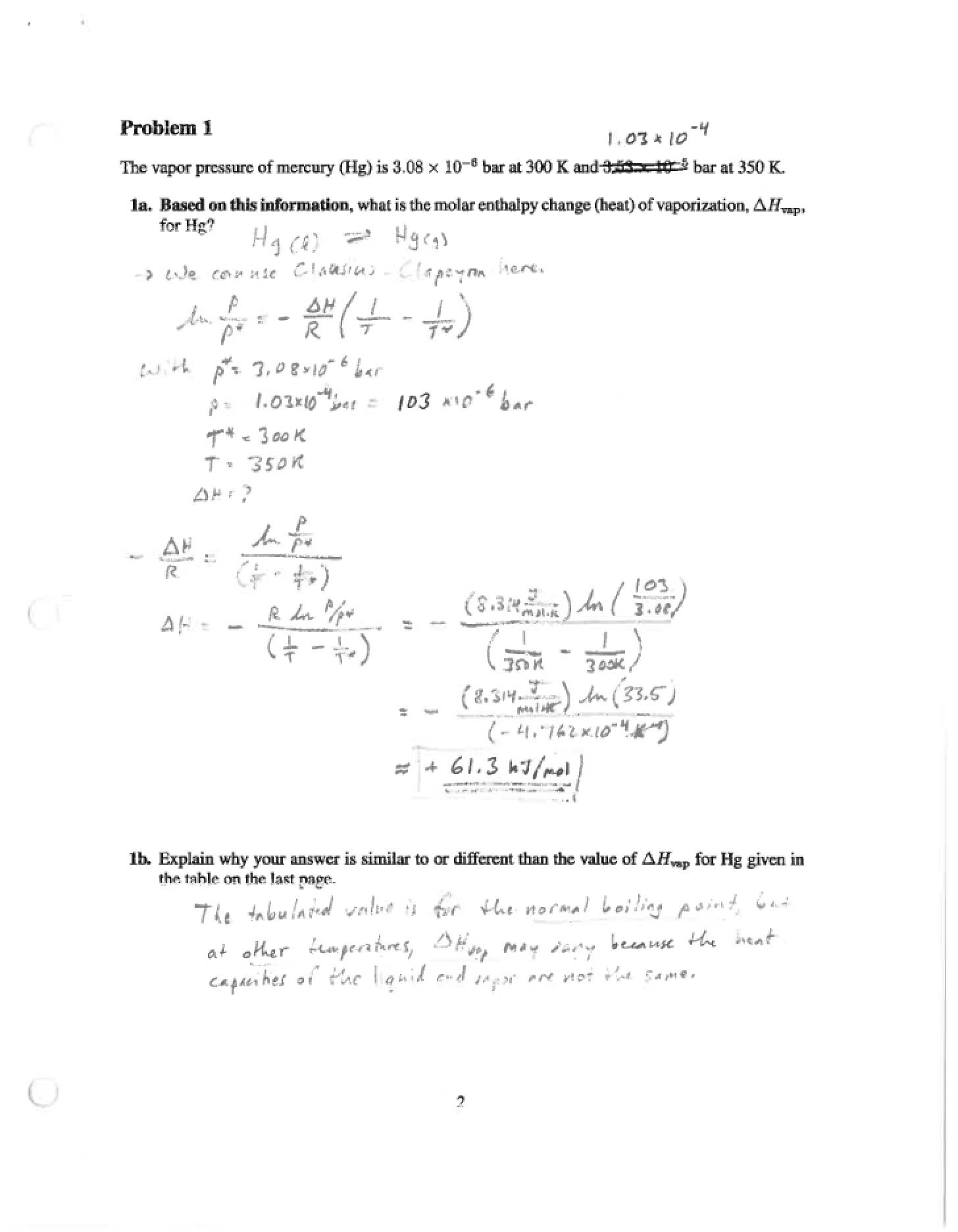
This document contains worked solutions for Exam 1 of CHEM 541, Physical Chemistry, offered at the University of South Carolina in Fall 2016. It’s a comprehensive resource detailing the approaches to solving a variety of problems central to the course’s initial assessment. The exam covers fundamental principles within physical chemistry, requiring application of theoretical knowledge to quantitative problems. The solutions presented demonstrate a step-by-step methodology for tackling complex calculations.
Why This Document Matters
This resource is invaluable for students who have taken (or are preparing to take) a similar physical chemistry exam. It’s particularly helpful for those seeking to understand *how* to approach problem-solving, not just obtain the correct answer. Students can use this to review their own work after attempting the exam, identify areas of weakness, and solidify their understanding of core concepts. It’s best utilized *after* independent study and an initial attempt at the exam questions, serving as a detailed guide to refine your technique.
Common Limitations or Challenges
This document focuses solely on the solutions to Exam 1. It does not include the original exam questions themselves, nor does it provide a comprehensive review of all physical chemistry concepts. It assumes a foundational understanding of the course material. Furthermore, while detailed, the solutions represent *one* possible approach; alternative valid methods may exist. It will not substitute for attending lectures, completing assigned homework, or actively participating in study groups.
What This Document Provides
* Detailed solutions to six distinct problems from the exam.
* Demonstration of proper application of physical chemistry principles.
* Illustrations of how to incorporate units and sign conventions into calculations.
* Examples of how to state assumptions and approximations used in problem-solving.
* A breakdown of calculations related to ideal gas behavior and deviations from ideality.
* Worked examples concerning thermodynamic properties like enthalpy and internal energy.
* Guidance on applying the virial equation of state.