What This Document Is
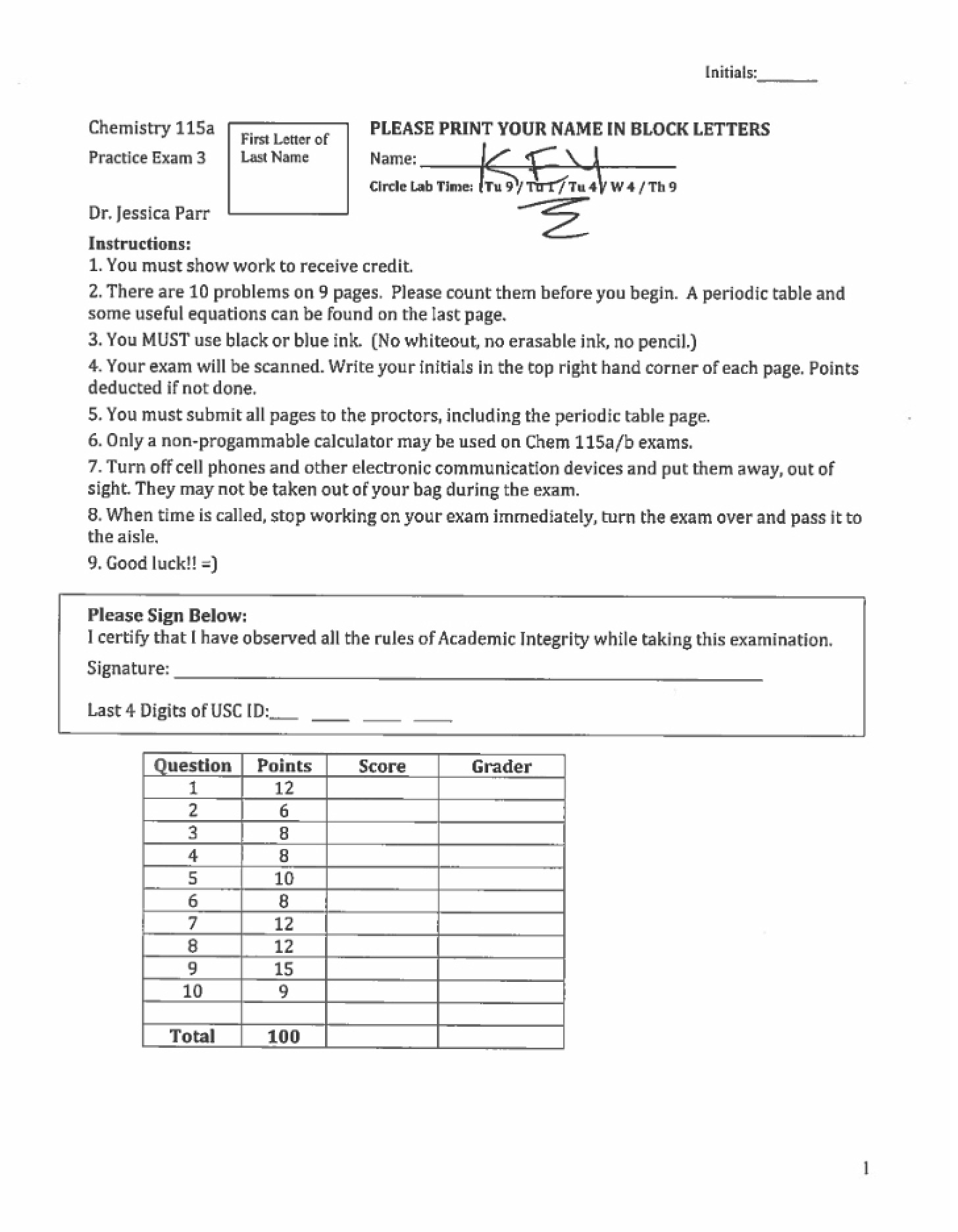
This document contains worked solutions for Exam 3 from Advanced General Chemistry (CHEM 115aLg) at the University of Southern California, taught by Dr. Parr. It’s designed to provide a detailed walkthrough of problems covering key concepts in thermodynamics and quantum mechanics. The material focuses on applying theoretical principles to quantitative problem-solving, a crucial skill for success in this rigorous course. It includes completed responses to questions posed during the exam.
Why This Document Matters
This resource is invaluable for students who have already attempted Exam 3 and are looking to deepen their understanding of the material. It’s particularly helpful for identifying areas where conceptual misunderstandings may have led to incorrect answers. Studying these solutions can reinforce correct problem-solving strategies and provide insight into the expected level of detail and reasoning required by the instructor. It’s best used *after* independent study and an initial attempt at the exam, as relying on solutions prematurely can hinder the learning process.
Common Limitations or Challenges
This document focuses *solely* on the solutions to the specific questions presented on Exam 3. It does not include explanations of fundamental concepts, derivations of equations, or alternative approaches to problem-solving. It assumes a solid foundation in the course material and is not a substitute for attending lectures, completing homework assignments, or engaging with the textbook. It will not provide new example problems or cover topics not addressed on this particular exam.
What This Document Provides
* Complete responses to questions assessing understanding of endothermic and exothermic processes.
* Detailed calculations related to enthalpy changes for dissolving solid compounds in water.
* Step-by-step determination of enthalpy for complex chemical reactions using Hess's Law.
* Answers to multiple-choice questions covering internal energy changes, heat capacities, enthalpy of formation, and energy types.
* Calculations involving the relationship between energy, wavelength, and frequency of light.
* Applications of the de Broglie wavelength and Heisenberg uncertainty principle to a physical system.
* A completed exam with space for student initials and ID verification.