What This Document Is
This document contains detailed, worked solutions to a practice exercise set for CHEM 541: Physical Chemistry, offered at the University of South Carolina. It focuses on applying core physical chemistry principles to solve quantitative problems. The exercise set covers a range of topics central to understanding chemical behavior, including thermodynamics, phase equilibria, and solution chemistry. It’s designed to reinforce concepts presented in lectures and textbooks, and to prepare students for more formal assessments.
Why This Document Matters
This resource is invaluable for students currently enrolled in a physical chemistry course, particularly those seeking to solidify their understanding of key problem-solving techniques. It’s most beneficial when used *after* attempting the practice problems independently. Reviewing these solutions can help identify areas of weakness, clarify confusing concepts, and demonstrate a rigorous approach to tackling complex calculations. Students preparing for quizzes or exams will find it particularly useful for honing their skills and building confidence.
Common Limitations or Challenges
This document provides solutions to a *specific* practice exercise. It does not offer comprehensive explanations of the underlying theory or derivations of equations. It assumes a foundational understanding of physical chemistry principles. Furthermore, it focuses on a particular set of problems and may not cover all possible problem types or variations within each topic. It is not a substitute for attending lectures, reading the textbook, or actively participating in the learning process.
What This Document Provides
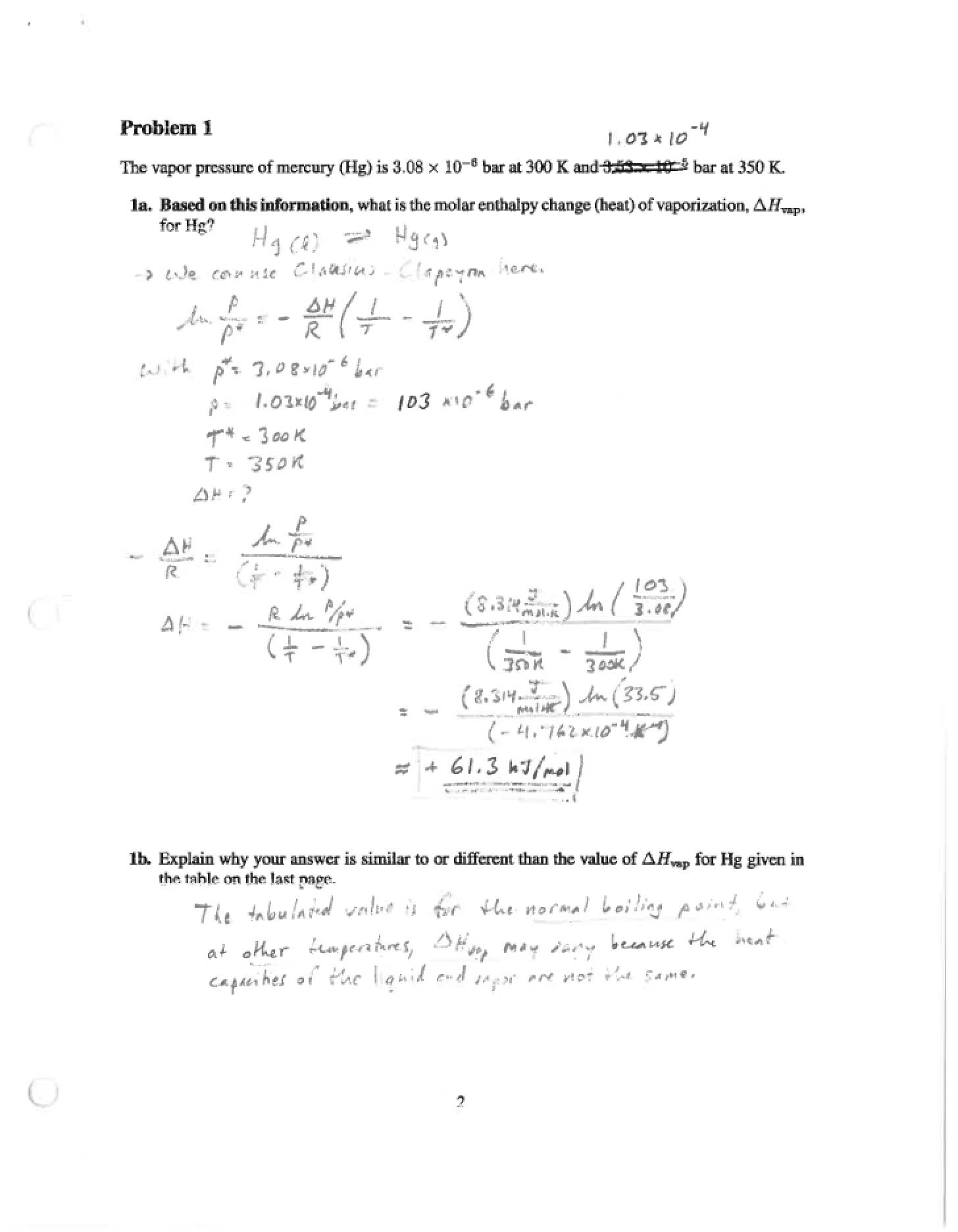
* Detailed, step-by-step solutions to multiple problems related to chemical thermodynamics and equilibria.
* Applications of concepts like vapor pressure, boiling point elevation, and chemical potential.
* Problem sets involving ideal and non-ideal mixtures, including calculations of partial pressures and mole fractions.
* Worked examples demonstrating the application of thermodynamic principles to real-world scenarios, such as the behavior of gases in the atmosphere.
* Solutions addressing the impact of solutes on the properties of solutions, including boiling point and chemical potential.