What This Document Is
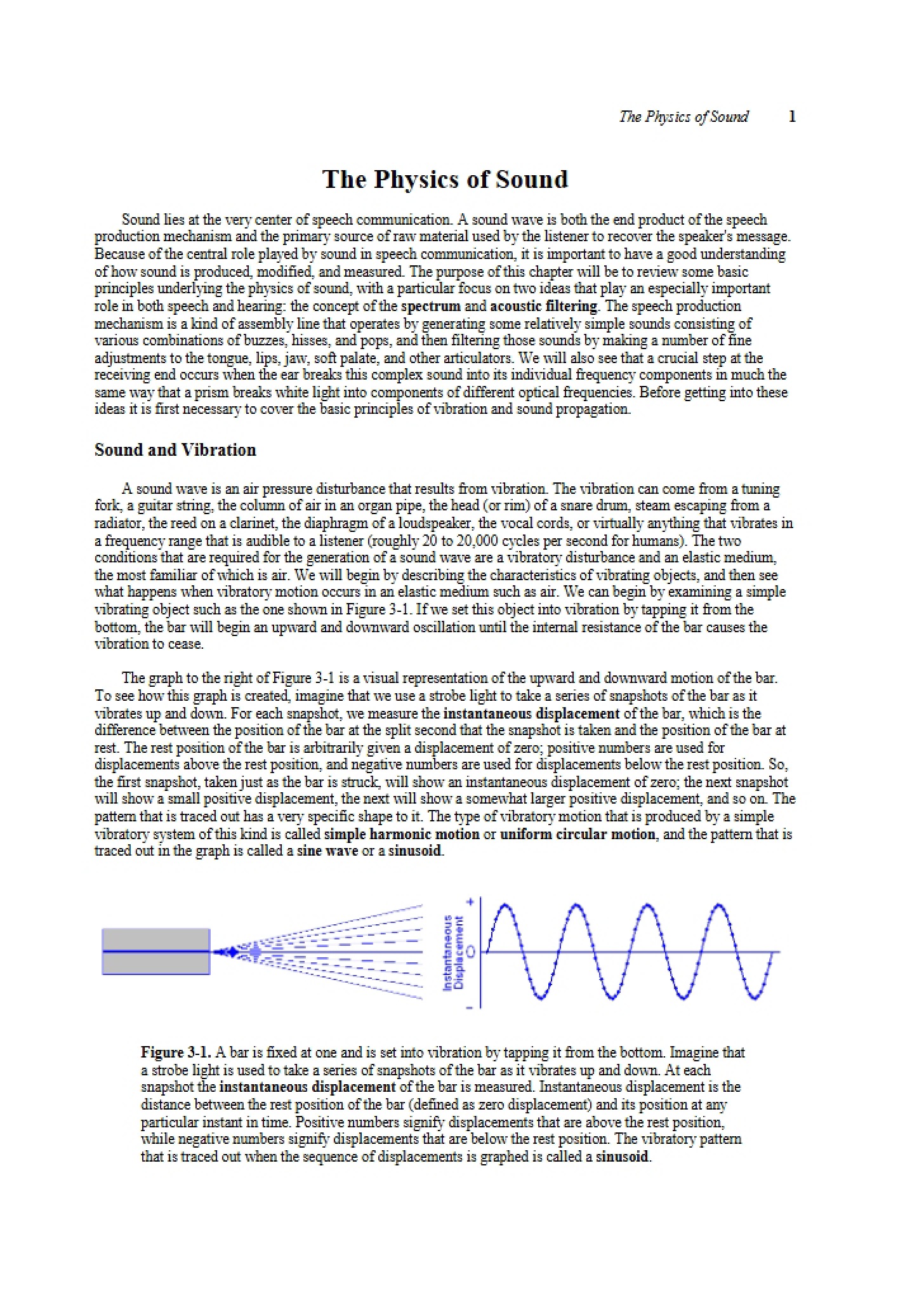
This document provides a foundational exploration of the physics of sound, specifically geared towards students of speech and hearing science. It delves into the core principles governing how sound is created, travels, and is ultimately perceived. The material focuses on establishing a strong understanding of the physical properties of sound waves as they relate to communication processes. It’s designed to build a theoretical base for more advanced topics within the field.
Why This Document Matters
This resource is invaluable for students in hearing science programs, speech-language pathology, audiology, and related disciplines. It’s particularly helpful when first encountering the scientific underpinnings of auditory perception and speech production. Use this material to solidify your understanding *before* tackling complex concepts like spectral analysis or acoustic filtering. It’s also a useful refresher for anyone needing a review of fundamental sound principles. A firm grasp of these concepts will significantly enhance your ability to understand more applied coursework.
Common Limitations or Challenges
This document focuses on the *principles* of sound physics. It does not offer practical applications like sound measurement techniques, detailed explanations of specific instruments, or clinical case studies. It also assumes a basic level of scientific literacy and does not provide extensive mathematical derivations. While it lays the groundwork for understanding complex sound phenomena, it won’t provide ready-made solutions to specific problems.
What This Document Provides
* An overview of the relationship between vibration and sound wave creation.
* Discussion of the necessary conditions for sound propagation.
* Explanation of key concepts related to the characteristics of vibrating objects.
* Introduction to the representation of vibration through graphical methods.
* Foundational terminology related to sound wave properties.
* A focus on concepts crucial for understanding both speech production and auditory processing.