What This Document Is
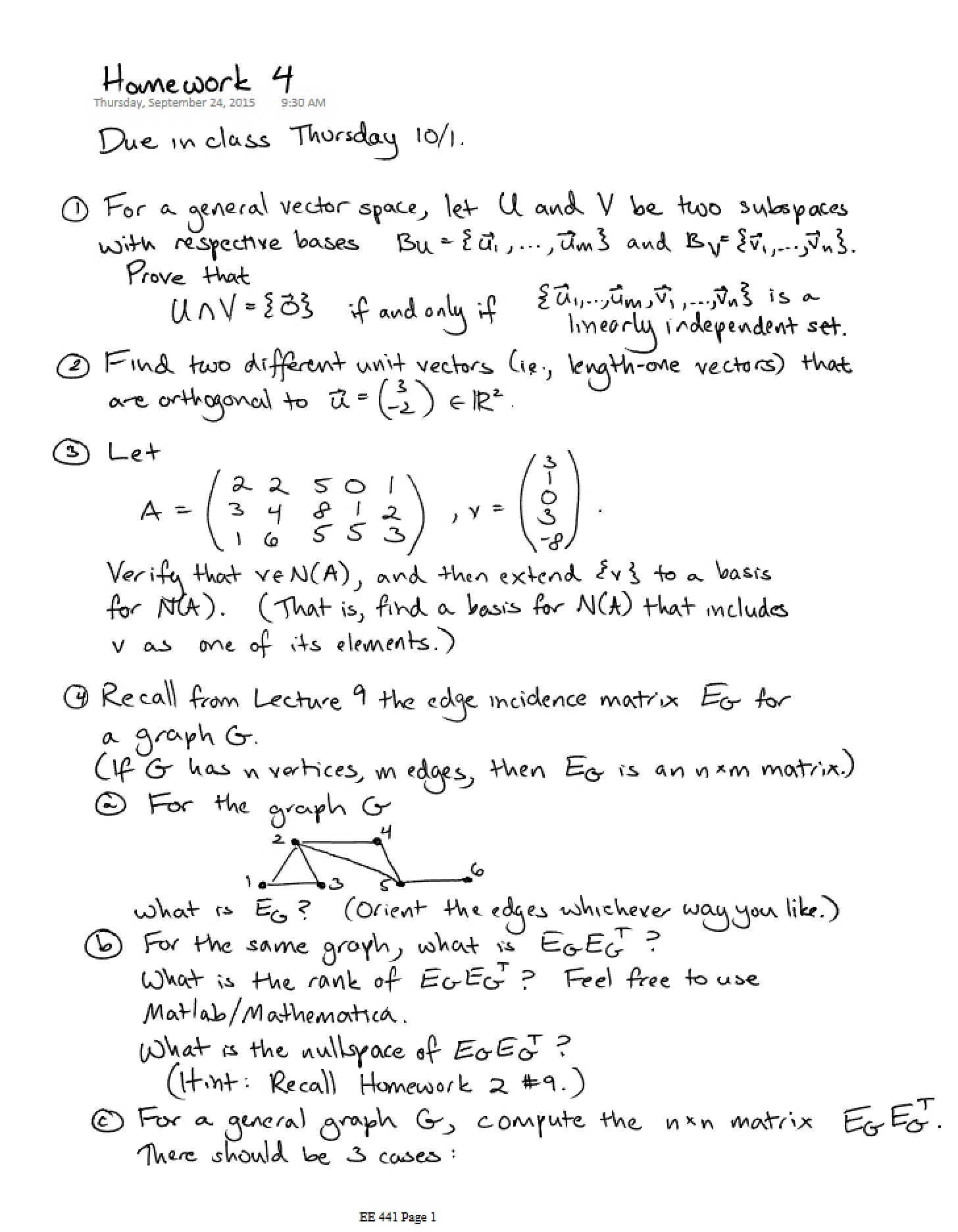
This document represents a lecture from the Applied Linear Algebra for Engineering course (EE 441) at the University of Southern California, specifically focusing on Spectral Graph Analysis. It delves into the application of linear algebraic tools – particularly decompositions – to the study of complex networks and relationships represented as graphs. The lecture explores how the properties of matrices associated with graphs reveal crucial information about the graph’s structure and behavior. It builds upon foundational linear algebra concepts and applies them to a discrete, yet powerful, area of engineering mathematics.
Why This Document Matters
This lecture is essential for engineering students, particularly those in electrical engineering, computer science, and related fields, who need to analyze networks. Understanding spectral graph analysis is valuable when dealing with problems involving connectivity, clustering, and information flow within systems. Students preparing for exams, working on related projects, or seeking a deeper understanding of the interplay between linear algebra and graph theory will find this material highly beneficial. It’s particularly useful for those interested in areas like machine learning, data science, and network optimization.
Common Limitations or Challenges
This lecture provides a focused exploration of spectral graph analysis, but it doesn’t offer a comprehensive introduction to graph theory itself. It assumes a foundational understanding of linear algebra concepts like eigenvalues, eigenvectors, and matrix decompositions. While the lecture touches upon computational aspects, it doesn’t provide detailed coding implementations or software tutorials. It also doesn’t cover all possible applications of spectral graph analysis; instead, it concentrates on core principles and illustrative examples.
What This Document Provides
* An overview of the core idea behind using linear algebraic methods to analyze graphs.
* Discussion of the relationship between graph properties and the spectra of associated matrices.
* Exploration of how matrix properties relate to graph isomorphism.
* Illustrative examples to motivate the concepts.
* Connections to relevant research and further study in the field of graph analysis.
* Discussion of tensor products and their application to graph analysis.