What This Document Is
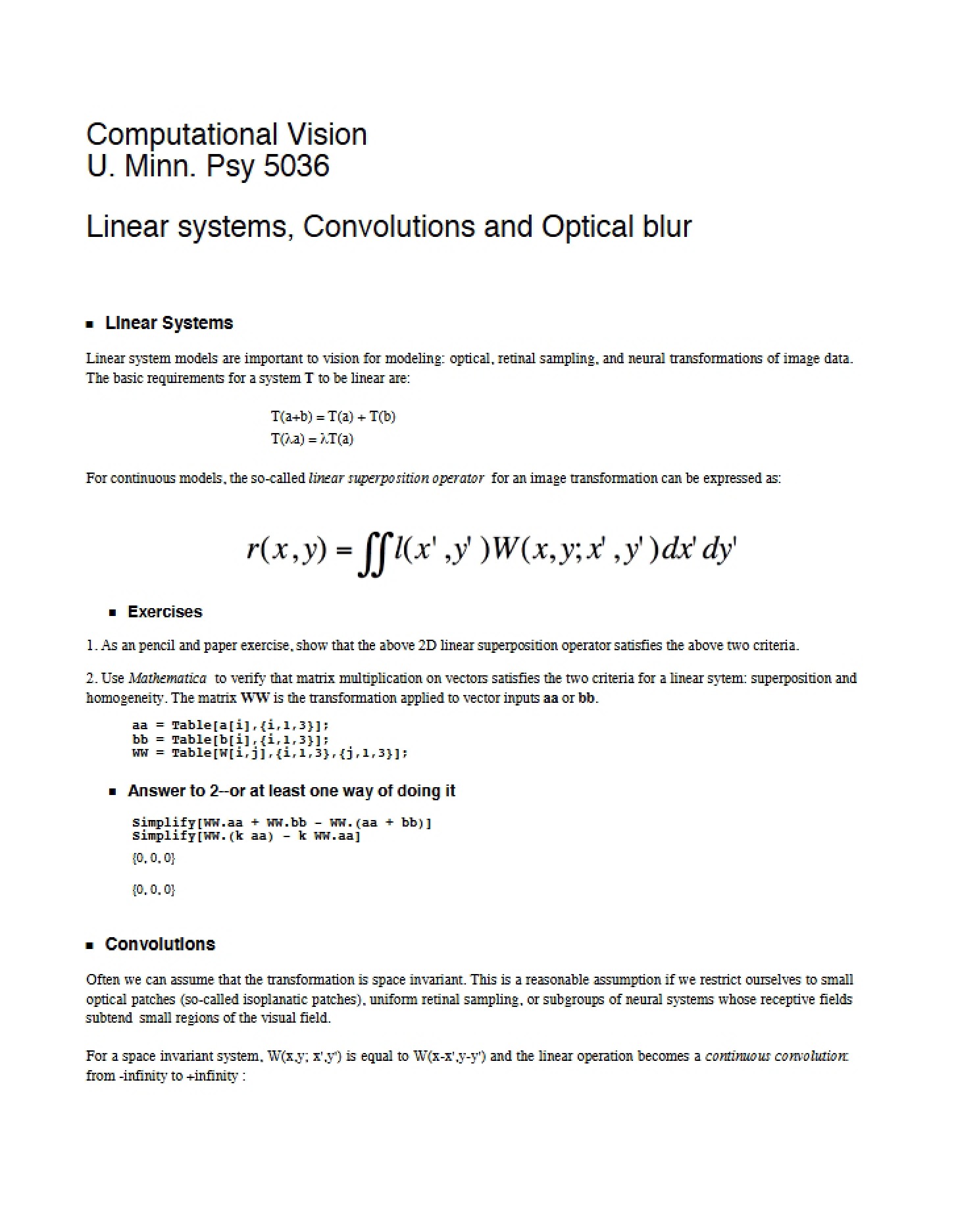
This file represents lecture notes from a Computational Vision course (PSY 5036W) at the University of Minnesota Twin Cities, specifically focusing on the application of Bayesian decision theory to visual perception. It builds upon foundational concepts of signal detection theory and extends them to more complex pattern inference tasks. The material explores how to model and understand the processes involved when the brain attempts to interpret ambiguous or incomplete visual information. It delves into the mathematical and theoretical frameworks used to describe these processes.
Why This Document Matters
Students enrolled in Computational Vision, or related fields like Cognitive Psychology, Neuroscience, or Computer Vision, will find these notes particularly valuable. It’s ideal for reinforcing concepts presented in lectures and providing a deeper understanding of the theoretical underpinnings of visual perception. This resource is most helpful when studying topics related to probabilistic modeling, Bayesian inference, and the challenges of interpreting complex sensory data. It’s designed to support learning *before* or *after* tackling related problem sets or projects.
Common Limitations or Challenges
This material presents a theoretical framework and does not offer practical coding examples or step-by-step implementations of the discussed concepts. It assumes a foundational understanding of probability and statistics. While it introduces the idea of graphical models, it doesn’t provide exhaustive coverage of all possible model types or their specific applications. It also doesn’t include detailed derivations of all equations presented. Access to the full document is required for a complete understanding of the mathematical details and specific examples.
What This Document Provides
* An exploration of extending signal detection theory to pattern inference.
* Discussion of the role of graphical models in representing dependencies between variables influencing image formation.
* Conceptual overview of converging, diverging, and intermediate nodes within generative models.
* Introduction to the relationship between causal structure, conditional independence, and Bayes nets.
* A foundation for understanding how probabilistic principles are applied to model visual perception.