What This Document Is
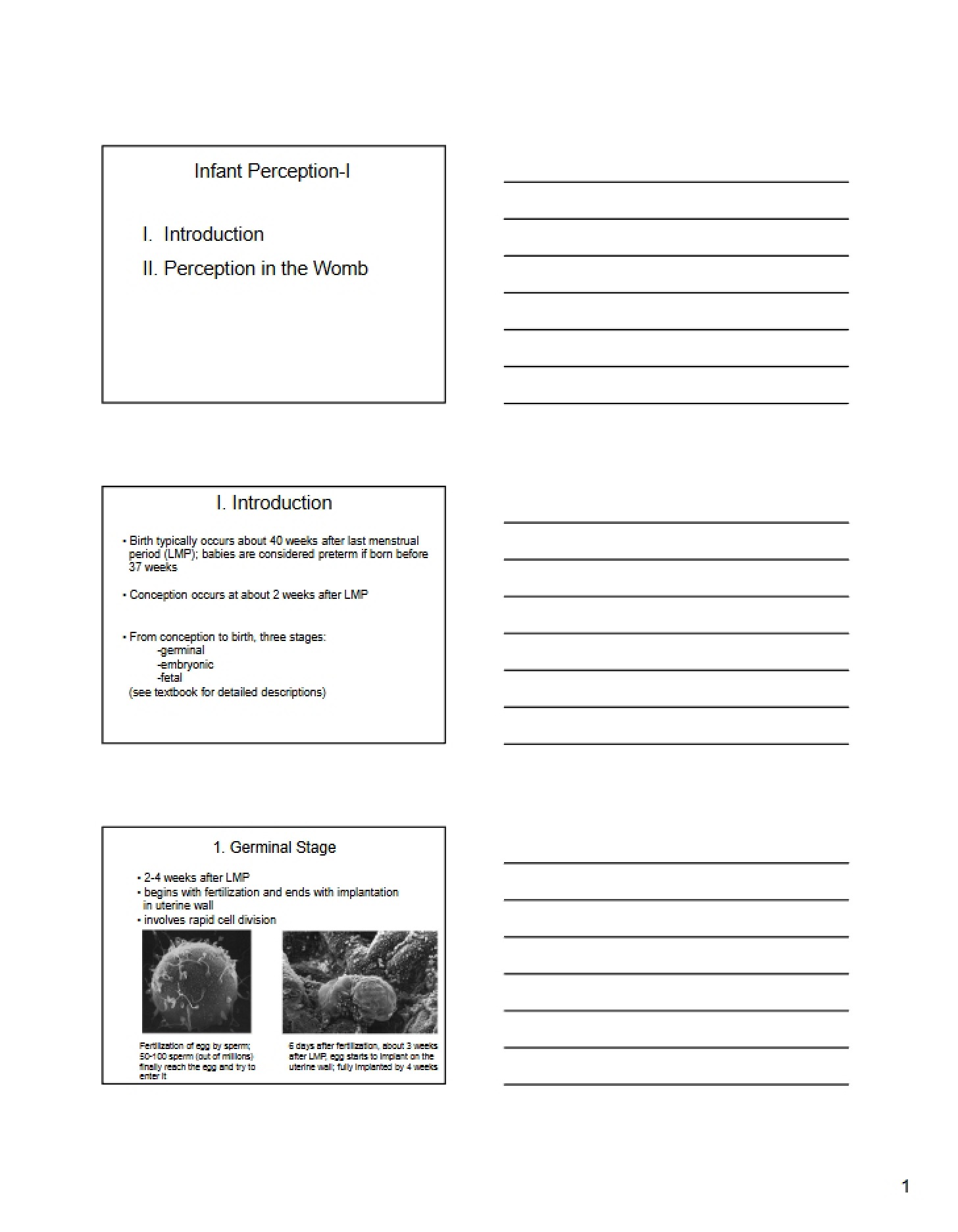
This resource is a detailed study guide covering foundational concepts within a Child Psychology course, specifically focusing on perceptual and cognitive development. It appears to be a unit-level compilation of lecture material, exploring how children interpret the world around them and the underlying mechanisms that shape their understanding. The guide delves into areas like visual perception, auditory processing, and the influence of inherent constraints on learning. It also touches upon evolutionary perspectives related to psychological traits.
Why This Document Matters
This study guide is invaluable for students enrolled in introductory or intermediate Child Psychology courses – particularly those at the University of Illinois at Urbana-Champaign. It’s best utilized as a companion to lectures, offering a structured framework for reviewing complex topics. Students preparing for exams, working on assignments requiring in-depth understanding of perceptual processes, or seeking to solidify their grasp of cognitive development will find this resource particularly helpful. It’s designed to enhance comprehension and facilitate effective study habits.
Common Limitations or Challenges
This guide is not a substitute for attending lectures or completing assigned readings. It provides a focused overview of key concepts but does not include original research studies or detailed experimental methodologies. It also doesn’t offer practice questions or direct application exercises. The material is presented as a compilation of ideas and theories, and requires further exploration to fully grasp the nuances of each topic. It's a support tool, not a complete course solution.
What This Document Provides
* An overview of constraints influencing cognitive processes, such as the whole object and taxonomic constraints.
* Discussion of computational complexities involved in perception and learning.
* Exploration of the role of heuristics and their potential limitations.
* Insights into the evolutionary basis of perceptual and cognitive abilities.
* Examination of core principles of visual perception, including color constancy and grouping mechanisms.
* Analysis of auditory perception, including speech segmentation and categorical perception.
* Consideration of the influence of context on taste and smell perception.