What This Document Is
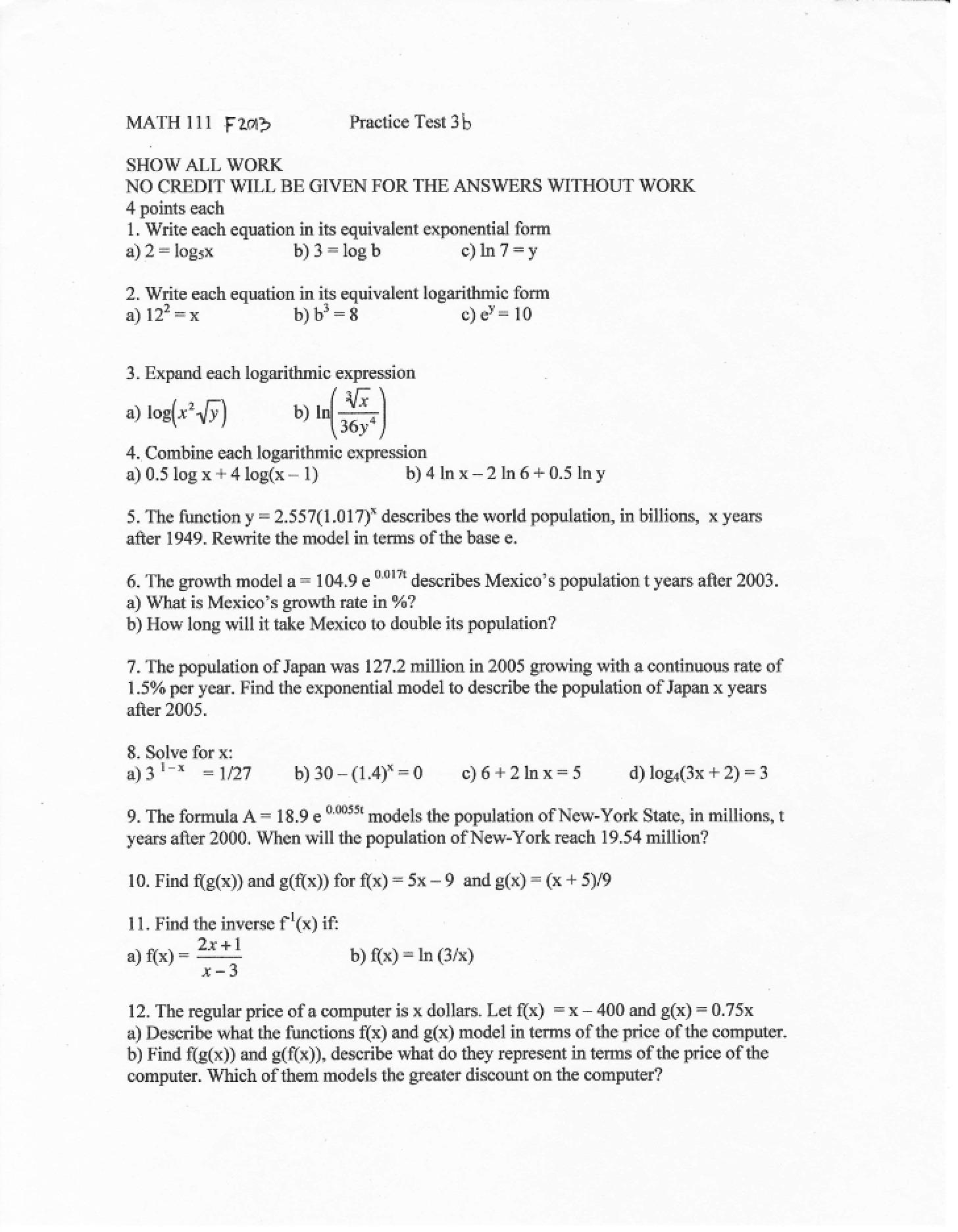
This is a practice test designed to help students prepare for Test 2A in MATH 111, Basic College Mathematics at the University of South Carolina. The practice test covers material from Chapters 2 and 3 of the course, focusing on foundational concepts and problem-solving techniques. It’s formatted to mimic a real exam environment, requiring students to show their work for full credit.
Why This Document Matters
This resource is invaluable for students looking to assess their understanding of key topics before a high-stakes exam. It’s particularly useful for identifying areas where further study is needed and for building confidence in applying mathematical principles. Students who actively work through practice problems tend to perform better on actual tests. This practice test is best utilized *after* reviewing course notes, assigned readings, and examples worked in class. It serves as a crucial self-assessment tool to gauge readiness.
Common Limitations or Challenges
While this practice test is comprehensive in its coverage of Chapters 2 and 3, it does not provide detailed explanations or step-by-step solutions. It’s designed to test your existing knowledge, not to teach you new concepts. Furthermore, the actual Test 2A may contain questions with slightly different wording or focus, so this should be used as one component of a broader study strategy. It doesn’t replace attending lectures or seeking help from a tutor.
What This Document Provides
* A series of problems covering topics such as rate of change calculations.
* Exercises involving linear equations and finding equations of lines.
* Application problems related to real-world scenarios like health insurance and investments.
* Problems focused on exponential functions, including modeling and decay.
* Questions requiring the application of compound interest formulas.
* Practice with interpreting and creating mathematical models from data presented in tables and graphs.
* Problems involving perimeter calculations with geometric shapes.
* Exercises designed to test understanding of proportional relationships.