What This Document Is
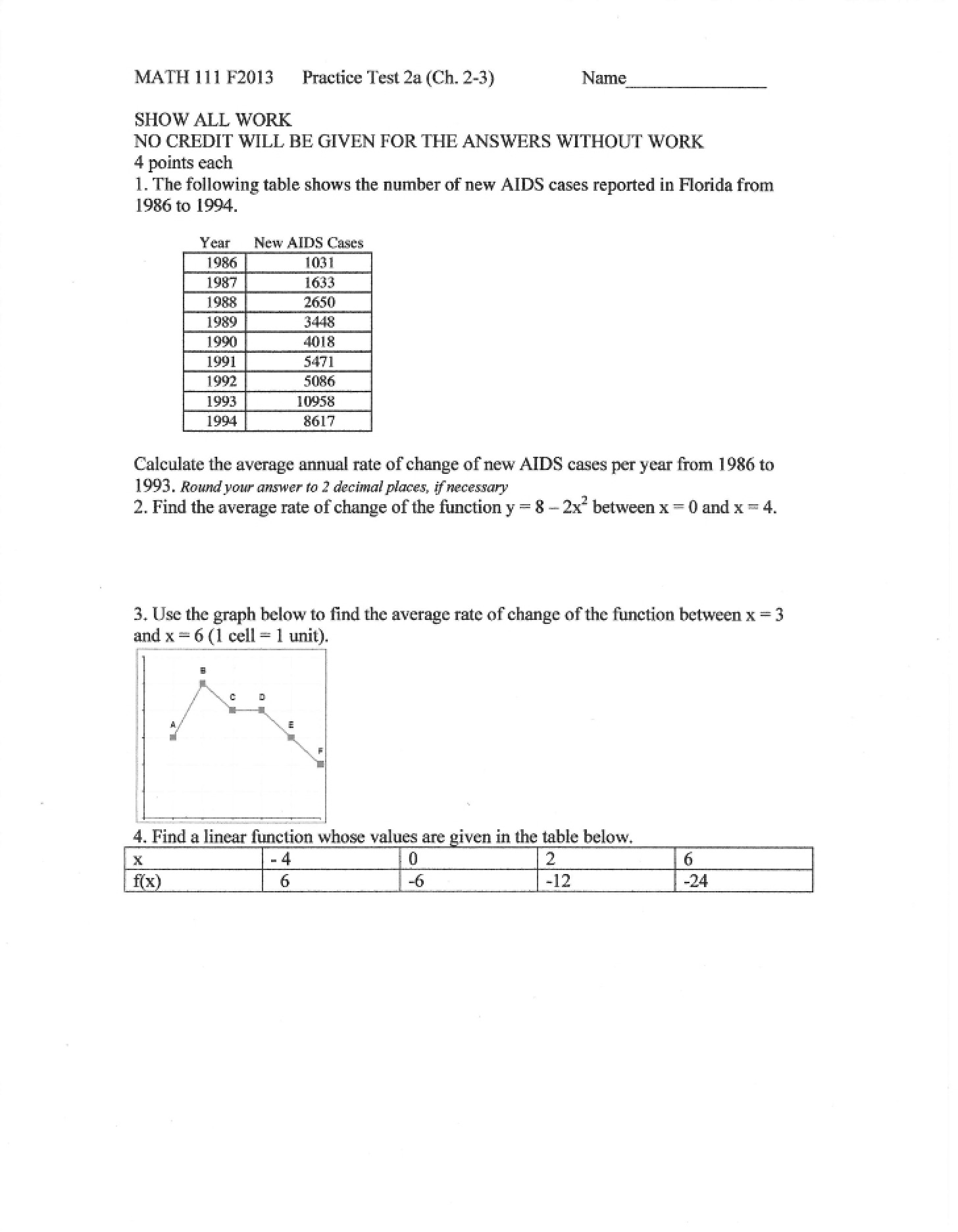
This is a practice test designed to help you assess your understanding of key concepts in Basic College Mathematics (MATH 111) at the University of South Carolina. Specifically, it focuses on topics typically covered in the third exam of the course. The practice test is formatted to mimic a real exam environment, requiring you to demonstrate your problem-solving abilities without relying on pre-calculated answers. It emphasizes showing your work as a crucial part of the evaluation process.
Why This Document Matters
This resource is ideal for students currently enrolled in MATH 111 who are preparing for their third exam. It’s particularly beneficial for those who want to identify areas where they need further study and practice. Working through these types of problems *before* the actual test can significantly reduce anxiety and improve performance. It’s best used after you’ve reviewed lecture notes, textbook readings, and completed assigned homework, as it’s designed to solidify your knowledge, not introduce new concepts.
Common Limitations or Challenges
This practice test is a tool for self-assessment and does not provide detailed explanations or step-by-step solutions. It’s designed to challenge you to recall and apply the concepts you’ve learned independently. While it covers a range of topics likely to appear on the exam, it may not be fully comprehensive of *every* possible question type. It also doesn’t replace the need for active participation in class and seeking help from your instructor or tutoring services when needed.
What This Document Provides
* A series of problems covering logarithmic and exponential functions.
* Exercises involving transformations of logarithmic and exponential graphs.
* Practice with applying growth and decay models to real-world scenarios.
* Problems focused on inverse functions and function composition.
* Application problems involving price discounts and population modeling.
* Questions requiring you to determine key features of parabolic functions.
* Opportunities to practice converting between exponential and logarithmic forms.
* Problems requiring you to solve equations involving logarithms and exponentials.