What This Document Is
This document is a laboratory exercise designed for an introductory Earth History course (GY 112L) at the University of South Alabama. It focuses on the Mesozoic Era, a pivotal period in Earth’s history bookended by major extinction events. The lab specifically delves into the study of fossil groups that originated in the Paleozoic Era, with a particular emphasis on the emergence and characteristics of early chordates – animals with backbones – including fish and amphibians. Additionally, the lab incorporates the examination of plant fossils from the Mesozoic period and connects these fossils to specific geological formations found within the state of Alabama.
Why This Document Matters
This lab is crucial for students seeking a deeper understanding of the Mesozoic Era and the evolution of life on Earth. It’s particularly beneficial for those enrolled in Earth Science, Geology, or Paleontology courses. Students will gain practical experience in identifying and understanding the significance of key fossil groups and relating them to the geological context of Alabama’s subsurface rock formations, which are important for resource exploration. This material is best utilized during dedicated lab sessions or as supplemental study material when learning about the Mesozoic Era and fossil identification.
Common Limitations or Challenges
This resource does *not* provide a comprehensive overview of the entire Mesozoic Era. It concentrates on specific fossil groups and Alabama stratigraphy. It also doesn’t offer detailed instructions on fossil excavation or advanced paleontological techniques. The lab assumes a foundational understanding of geological time scales and basic biological classification. It is designed to be used *in conjunction* with lectures and other course materials, and does not stand alone as a complete learning module.
What This Document Provides
* An overview of the Mesozoic Era’s place within Earth’s history.
* Background information on the phylum Chordata and its relevance to understanding vertebrate evolution.
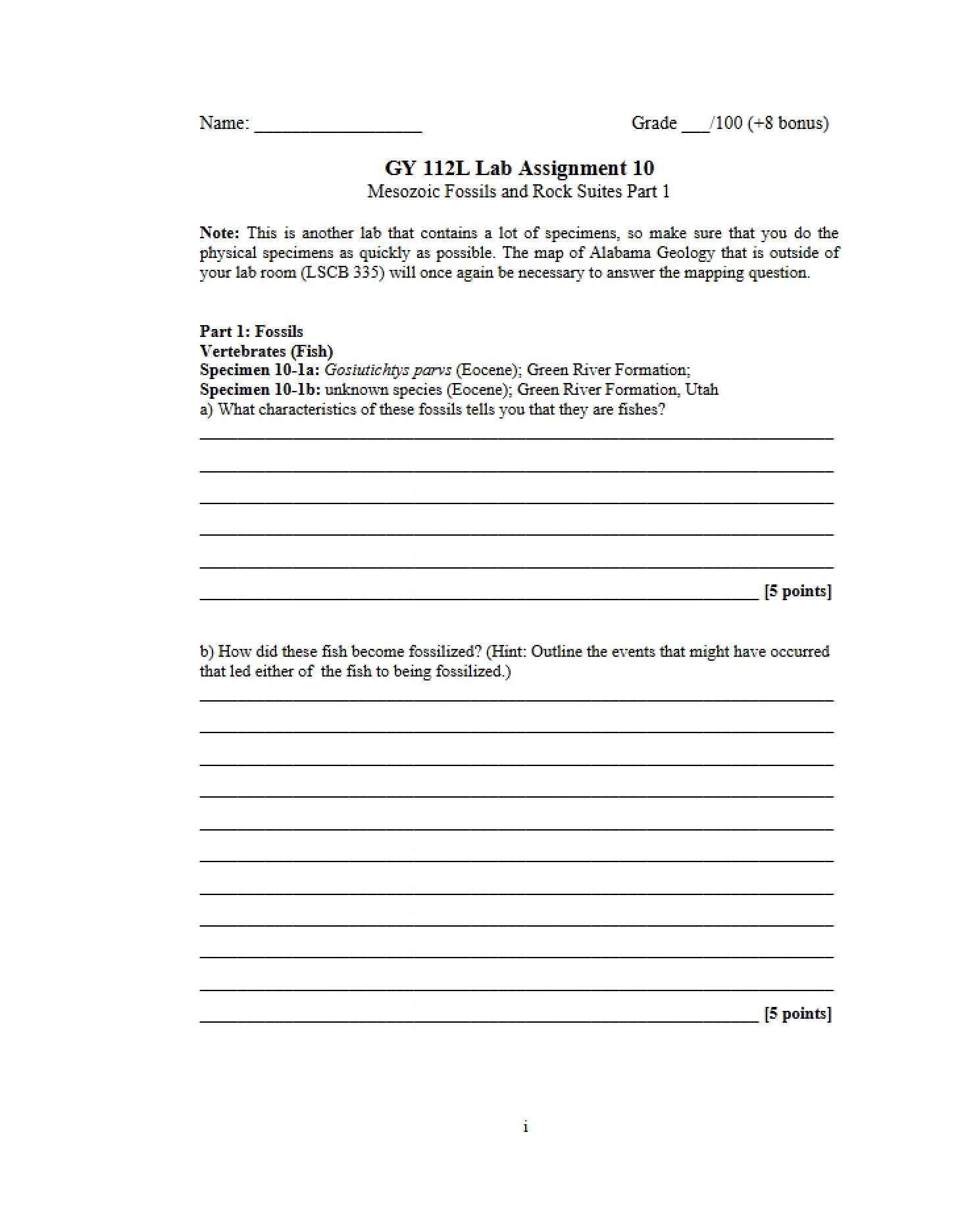
* Focus on key fossil groups – fish, amphibians, and plants – and their evolutionary significance.
* Contextualization of Alabama’s Mesozoic rock formations, including the Smackover and Norphlet Formations.
* References to geological literature for further exploration.
* Discussion of the importance of accurate diagram labeling and scaling in scientific illustration.