What This Document Is
This document provides a focused exploration of tree data structures, going beyond the commonly studied binary trees to examine more general tree implementations. It’s part of the CS 245 Data Structures and Algorithms course at the University of San Francisco, and delves into the concepts necessary for working with trees containing an arbitrary number of children per node. The material builds upon foundational tree knowledge and introduces techniques for managing and processing these more complex structures.
Why This Document Matters
This resource is invaluable for computer science students learning about advanced data structures. It’s particularly helpful for those preparing to tackle problems where binary trees are insufficient, or when modeling hierarchical relationships with varying degrees of branching. Students will benefit from understanding these concepts when designing and implementing algorithms that require flexible and adaptable data organization. It’s ideal for use during coursework, while practicing algorithm design, or as a reference when building projects involving hierarchical data.
Common Limitations or Challenges
This material concentrates on the *principles* of general trees and their manipulation. It does not offer a comprehensive library of pre-built tree implementations or a step-by-step guide to coding them from scratch. It also assumes a foundational understanding of basic tree concepts (nodes, edges, traversal) and recursion. While it touches upon serialization, it doesn’t provide a complete solution for all possible tree structures.
What This Document Provides
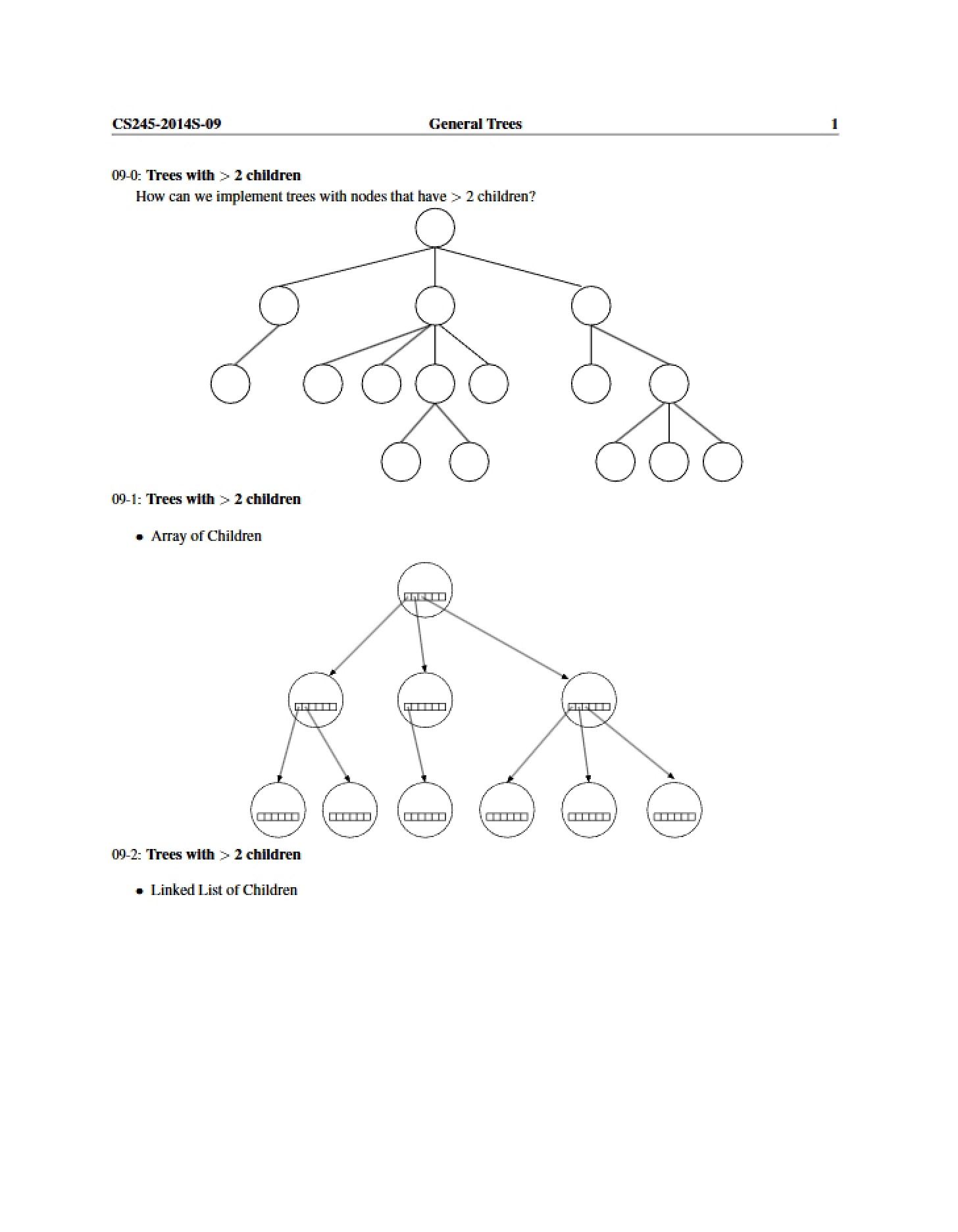
* Discussion of different methods for representing trees with multiple children, including array-based and linked-list approaches.
* Exploration of techniques for navigating and manipulating general tree structures.
* Conceptual understanding of algorithms for calculating key tree properties.
* Consideration of methods for representing tree structure in a linear format.
* Illustrative examples to aid in understanding the concepts (though specific values are not provided).