What This Document Is
This resource focuses on the core principles of differentiating trigonometric functions within a Calculus I context. It’s designed to build upon foundational derivative rules and extend them to the six primary trigonometric functions – sine, cosine, tangent, cotangent, secant, and cosecant – and their inverses. The material explores applying derivative rules to complex combinations of these functions, including those involving exponential and polynomial terms.
Why This Document Matters
This is an essential study aid for students enrolled in a first-semester calculus course, particularly those at the University of Minnesota Twin Cities (MATH 1271). Mastering trigonometric function derivatives is crucial for success in subsequent calculus topics like integration, applications of derivatives, and more advanced mathematical modeling. It’s particularly helpful when tackling related rates problems and optimization challenges involving angles and periodic phenomena. Students preparing for quizzes and exams covering differentiation techniques will find this a valuable resource to solidify their understanding.
Common Limitations or Challenges
This material assumes a prior understanding of basic differentiation rules (power rule, exponential rule, etc.) and familiarity with the six trigonometric functions and their identities. It does *not* provide a comprehensive review of prerequisite concepts. Furthermore, while it presents applications, it doesn’t delve into proofs of the derivative formulas themselves, nor does it cover advanced techniques like implicit differentiation applied to trigonometric functions. It focuses specifically on direct application of derivative rules.
What This Document Provides
* A series of practice problems designed to reinforce the application of derivative rules to trigonometric functions.
* Examples involving combinations of trigonometric functions with other common functions (polynomials, exponentials).
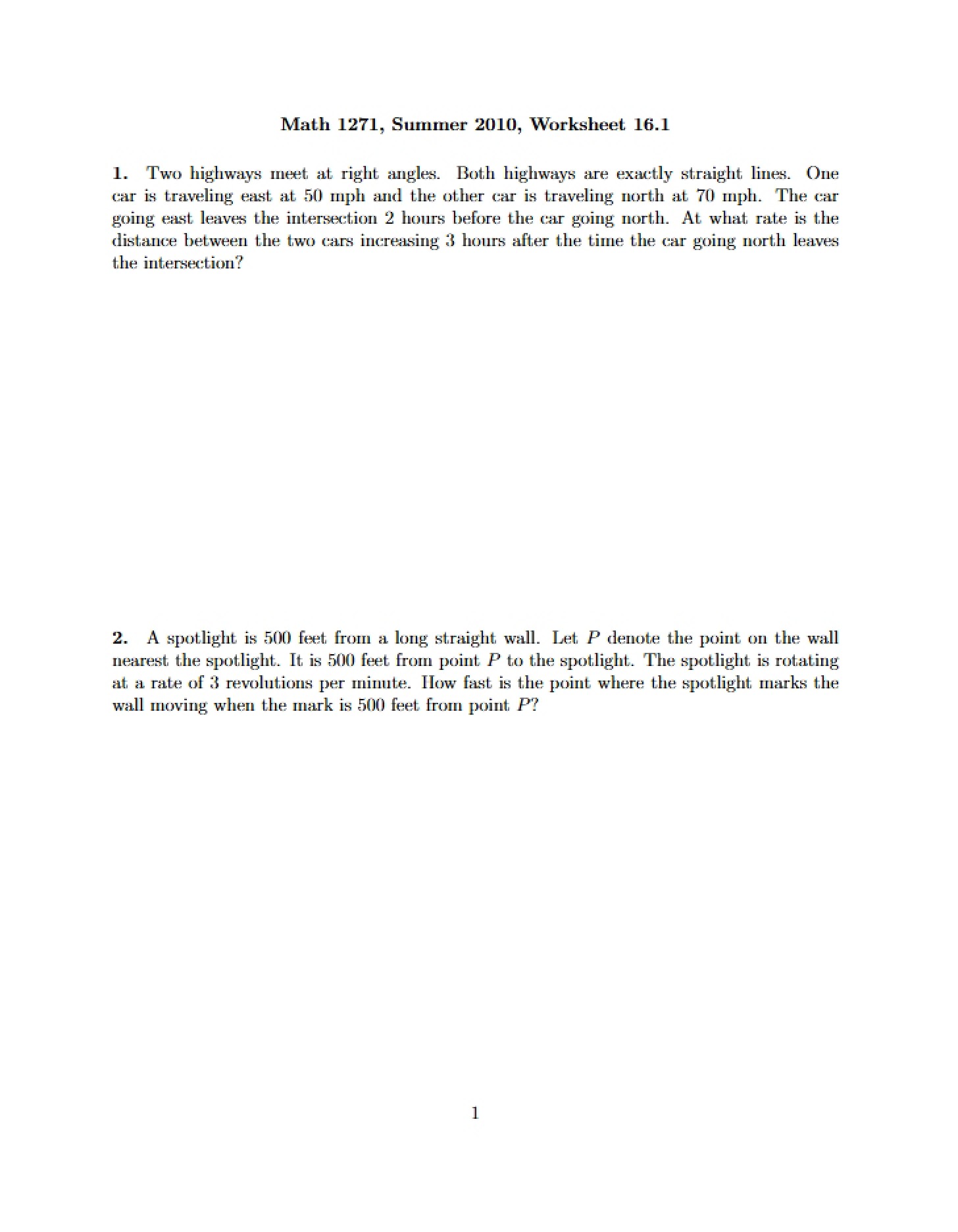
* Application problems demonstrating how derivatives of trigonometric functions are used to model real-world scenarios.
* Exercises focused on finding tangent lines to curves defined by trigonometric functions.
* Problems involving rates of change related to angles and distances, requiring the use of trigonometric derivatives.