What This Document Is
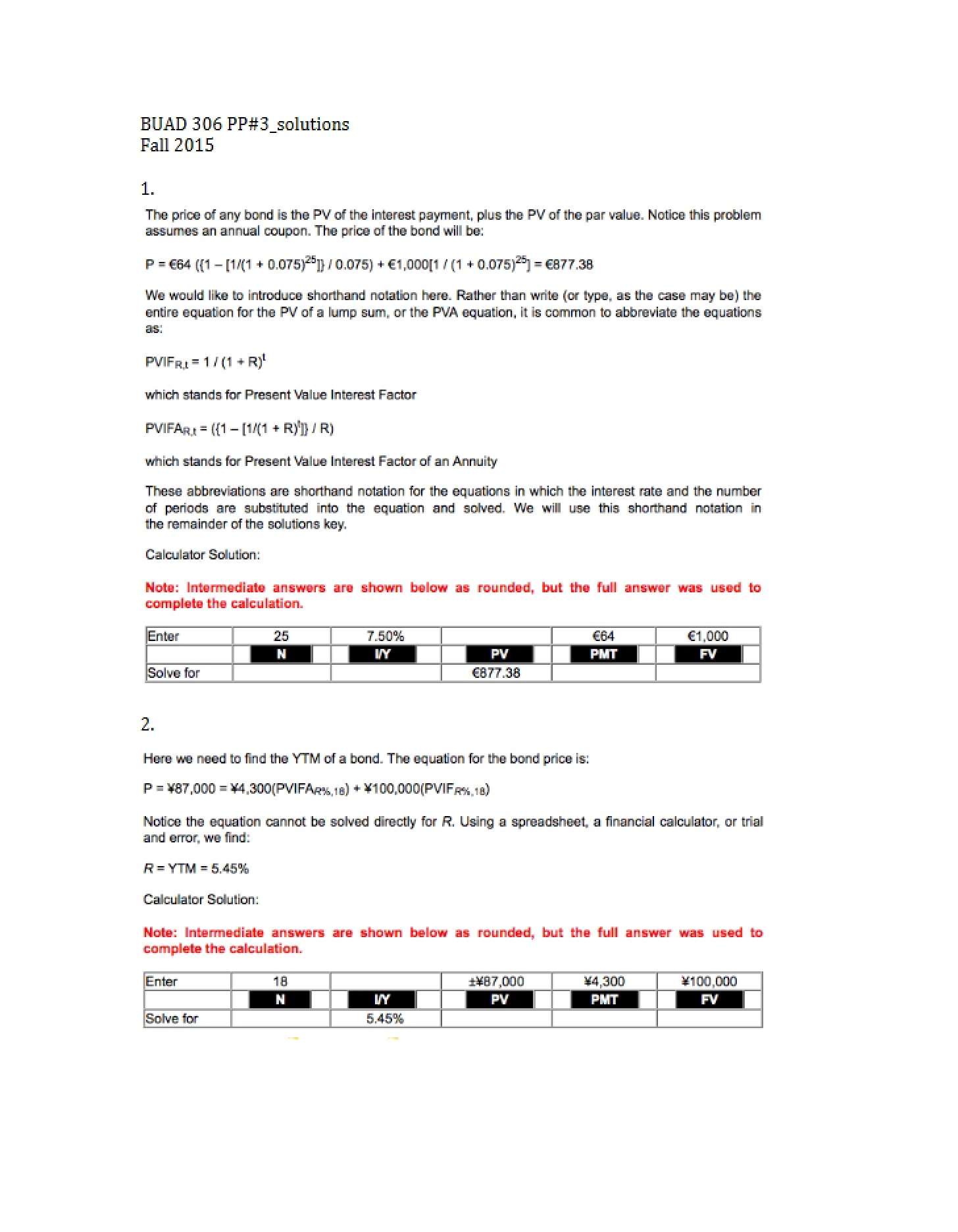
This study guide provides detailed worked solutions to a set of practice problems in Business Finance (BUAD 306) at the University of Southern California, specifically for Fall 2015. It focuses on core concepts related to investment valuation, risk assessment, and portfolio management. The material is designed to reinforce understanding of key principles discussed in the course, covering topics from market efficiency to the Capital Asset Pricing Model (CAPM). It’s presented as a comprehensive answer key to assigned homework.
Why This Document Matters
This resource is invaluable for students enrolled in BUAD 306 seeking to solidify their grasp of complex financial concepts. It’s particularly helpful when reviewing completed assignments to identify areas of strength and weakness. Students preparing for quizzes or exams will find it useful for checking their understanding of problem-solving techniques and ensuring they can apply theoretical knowledge to practical scenarios. It’s best used *after* attempting the original homework problems independently, as a tool for self-assessment and targeted learning.
Common Limitations or Challenges
This document does *not* contain explanations of the underlying financial theories or formulas. It assumes a foundational understanding of the course material. It also doesn’t offer alternative solution methods or detailed step-by-step derivations – it presents completed solutions only. Furthermore, it is specific to the Fall 2015 iteration of the course and may not perfectly align with subsequent assignments or variations in the curriculum. It is not a substitute for attending lectures or actively participating in class.
What This Document Provides
* Detailed responses to a series of practice problems covering market efficiency (weak, semi-strong, and strong forms).
* Illustrations relating investment returns to risk levels.
* Explanations differentiating between systematic and unsystematic risk, with examples.
* Calculations involving portfolio beta and asset allocation strategies.
* Problem solutions related to expected rates of return under different economic conditions.
* Variance calculations for investment portfolios.
* Applications of the Capital Asset Pricing Model (CAPM) to determine expected returns and beta values.
* Solutions to problems involving risk-free rates and market risk premiums.