What This Document Is
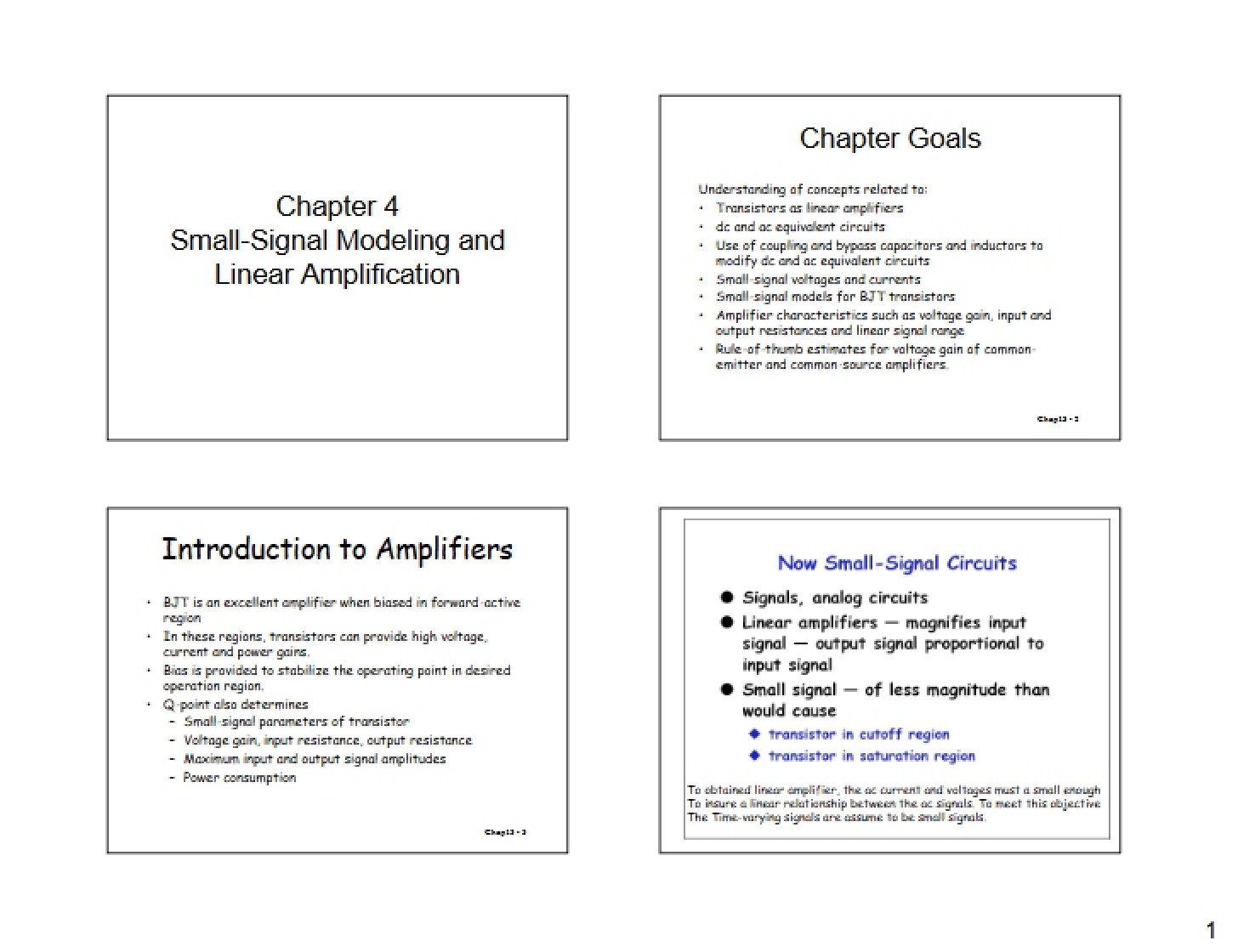
This is a focused exploration of linear amplification and small-signal modeling within the context of Electronic Circuit Engineering (ECE 334) at the University of South Alabama. It delves into the core principles behind how transistors function as amplifiers, moving beyond basic operation to a more detailed analysis of their behavior with applied signals. The material centers on understanding transistor circuits not as simple on/off switches, but as devices capable of proportionally increasing signal strength. It bridges the gap between large-signal (DC) analysis and the dynamic behavior of circuits responding to alternating current (AC) signals.
Why This Document Matters
This resource is invaluable for students enrolled in intermediate-level electronics courses. It’s particularly helpful when you’re tasked with analyzing the gain, input/output impedance, and overall performance of amplifier circuits. If you're struggling to predict how a transistor circuit will respond to a varying input signal, or need a deeper understanding of the parameters that govern amplifier behavior, this material will provide a solid foundation. It’s also beneficial for anyone preparing to design or troubleshoot analog electronic systems where amplification is a key component.
Common Limitations or Challenges
This document focuses specifically on the *analysis* of linear amplification. It does not provide a comprehensive overview of transistor fundamentals – a prior understanding of BJT operation is assumed. While it touches upon circuit configurations, it doesn’t offer a step-by-step guide to building or physically testing amplifier circuits. Furthermore, it concentrates on small-signal models, meaning it simplifies the analysis by assuming signal variations are small enough to maintain linear operation; the effects of signal distortion at larger amplitudes are not extensively covered.
What This Document Provides
* A detailed examination of the Q-point and its influence on amplifier characteristics.
* An introduction to AC and DC analysis techniques for transistor circuits.
* Discussion of coupling and bypass capacitors and their role in amplifier design.
* Exploration of the common-emitter configuration and its equivalent circuits.
* Presentation of hybrid-pi models for transistor analysis.
* Methods for determining key amplifier parameters using small-signal models.
* A framework for understanding the relationship between transistor parameters and amplifier performance.