What This Document Is
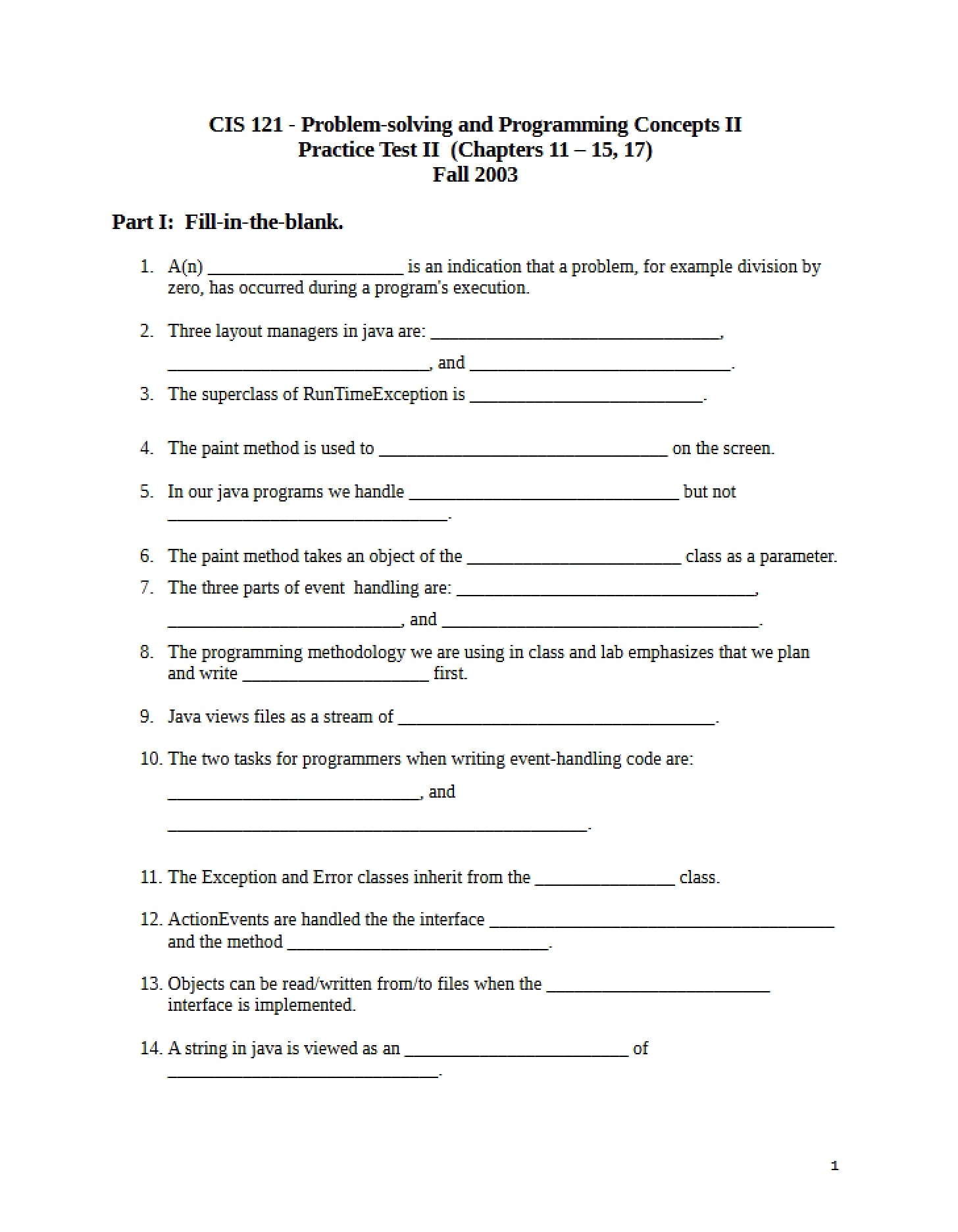
This document is a practice test designed to assess your understanding of core programming concepts covered in CIS 121 at the University of South Alabama. Specifically, it focuses on topics from Chapters 6 through 13, likely building upon foundational principles introduced in the first part of the course. The test format includes a variety of question types intended to evaluate both recall and application of knowledge. It’s structured to mirror the style and scope of an actual exam, providing a realistic assessment opportunity.
Why This Document Matters
This practice test is an invaluable resource for students enrolled in CIS 121 who are preparing for their first major evaluation. It’s particularly helpful for identifying areas where your understanding may be weak, allowing you to focus your study efforts effectively. Utilizing this test under timed conditions can also help build exam-taking confidence and reduce anxiety. Students who proactively engage with practice materials generally perform better on formal assessments. It’s best used *after* completing the assigned readings and participating in class activities.
Common Limitations or Challenges
This practice test is a sample assessment and does not encompass *every* possible topic or question type that may appear on the actual exam. It’s designed to be representative, but shouldn’t be considered a complete substitute for thorough course review. Furthermore, while the test aims to assess your understanding of concepts, it doesn’t provide detailed explanations of correct answers – those are found within your course materials. It also doesn’t offer personalized feedback on your performance.
What This Document Provides
* A series of fill-in-the-blank questions testing terminology and definitions.
* Discussion prompts requiring short-answer responses demonstrating conceptual understanding.
* Questions relating to object-oriented programming principles like inheritance and relationships between classes.
* Topics related to GUI (Graphical User Interface) development using AWT and Swing components.
* Concepts surrounding event handling and listener interfaces.
* Questions covering fundamental string manipulation techniques.
* Areas of focus including layout managers, graphics manipulation, and applet programming.