What This Document Is
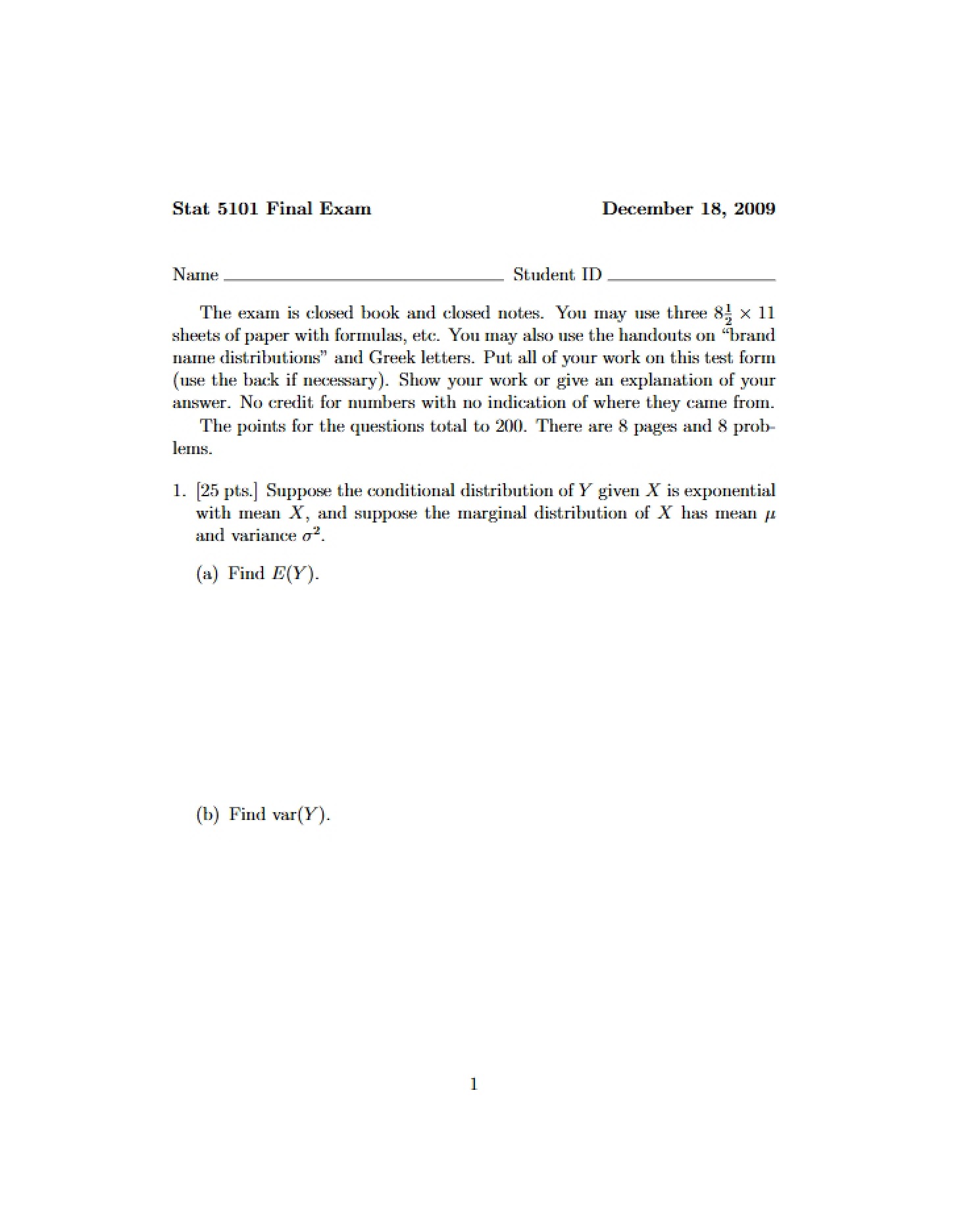
This is a comprehensive end-of-term examination for STATS 5101: Theory of Statistics I, offered at the University of Minnesota Twin Cities. It’s designed to assess a student’s understanding of core statistical concepts covered throughout the course. The exam focuses on theoretical foundations rather than computational exercises, requiring a strong grasp of probability distributions, statistical inference principles, and mathematical derivations. It’s a closed-book, closed-notes assessment, emphasizing recall and application of learned material.
Why This Document Matters
This examination is invaluable for students currently enrolled in or preparing for a similar Theory of Statistics I course. It serves as an excellent benchmark to gauge your preparedness and identify areas needing further review. Studying this exam’s structure and the types of questions asked will help you focus your study efforts and anticipate the level of rigor expected on your own assessment. It’s particularly useful during final exam review periods or for students seeking to solidify their understanding of advanced statistical theory. Access to this exam allows you to familiarize yourself with the expected format and scope of questions.
Common Limitations or Challenges
Please note that this document *only* contains the examination questions themselves. It does not include solutions, worked examples, or explanations of the correct approaches to solving the problems. It is designed to *test* your knowledge, not to teach it. Successfully utilizing this resource requires a solid foundation in the course material and the ability to independently apply statistical principles. It assumes you have access to course notes, textbooks, and other learning resources.
What This Document Provides
* A full copy of the December 17, 2008 STATS 5101 final exam.
* Ten distinct problems covering a range of topics in statistical theory.
* Questions relating to probability density functions (PDFs) and marginal/conditional distributions.
* Problems involving independent and identically distributed (IID) random variables.
* Applications of Poisson processes and geometric distributions.
* Questions exploring variance stabilizing transformations.
* Exercises focused on cumulative distribution functions (DFs).
* Problems involving random vectors, mean vectors, and variance matrices.
* A clear indication of the point value for each question, reflecting its relative weight.
* A total possible score of 200 points.