What This Document Is
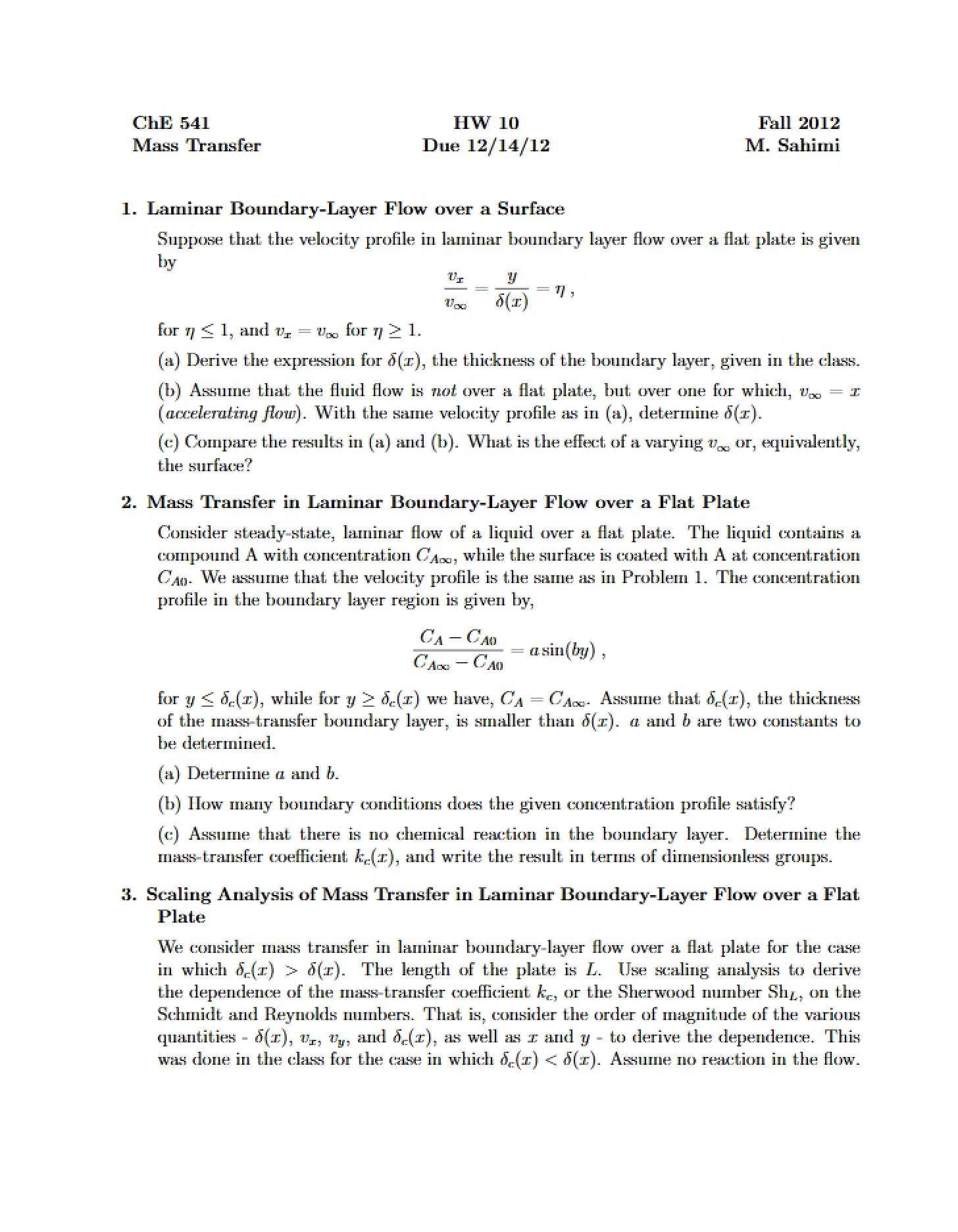
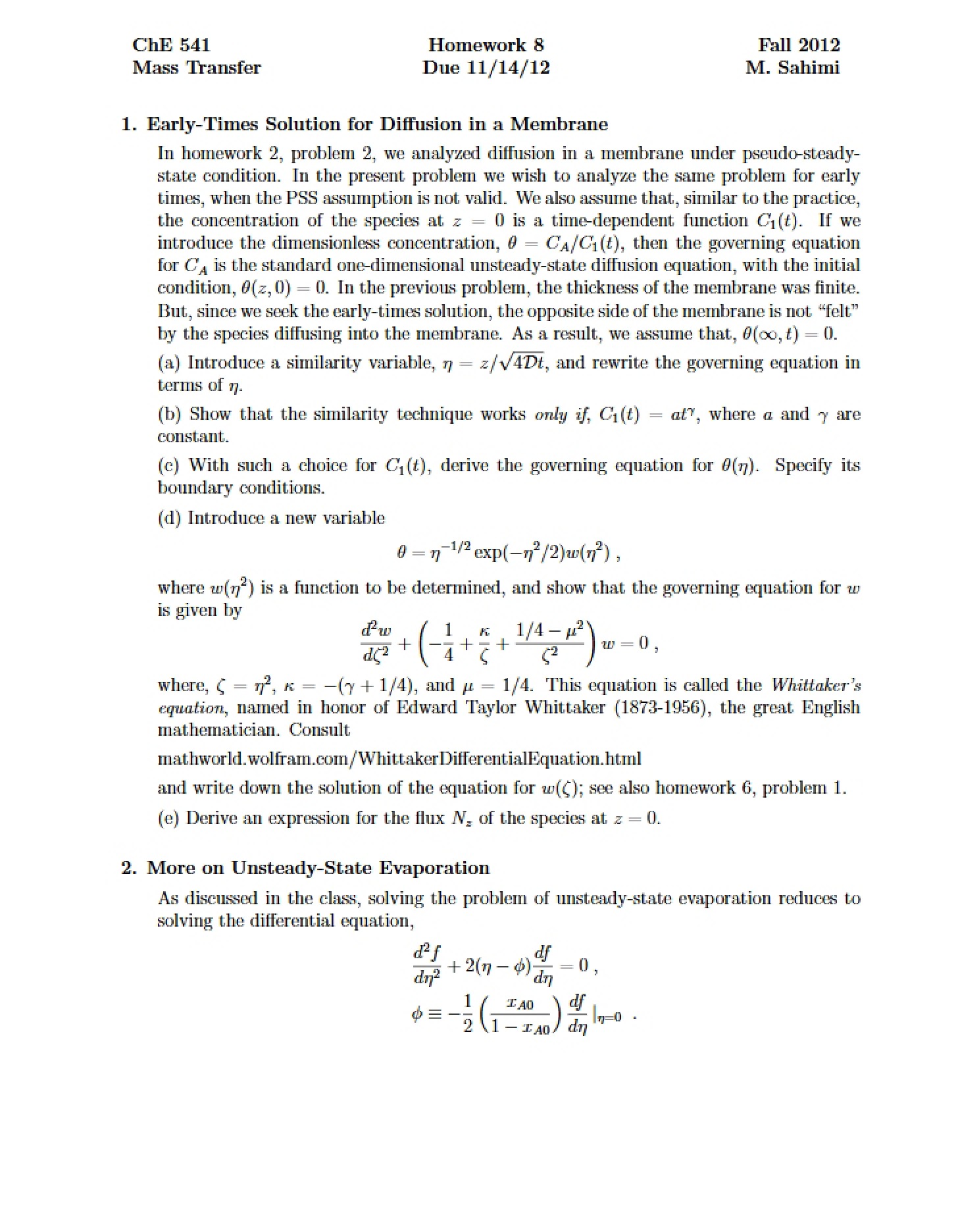
This is a homework assignment for CHE 541, Mass Transfer, at the University of Southern California. It focuses on applying fundamental mass transfer principles to fluid flow scenarios, specifically laminar boundary layer flow. The assignment challenges students to analyze and solve problems related to momentum and mass transport occurring near surfaces. It builds upon concepts typically covered in an undergraduate or introductory graduate-level mass transfer course.
Why This Document Matters
This assignment is crucial for students enrolled in a Mass Transfer course seeking to solidify their understanding of boundary layer theory and its application to mass transfer phenomena. It’s particularly valuable when preparing for exams or tackling more complex engineering problems involving convective mass transfer. Students who work through these types of problems will develop a stronger intuitive grasp of how fluid dynamics influence mass transport rates. It’s best utilized *after* a thorough review of lecture notes and textbook material on boundary layers, velocity profiles, and concentration profiles.
Common Limitations or Challenges
This assignment does not provide a comprehensive review of foundational mass transfer concepts. It assumes a pre-existing understanding of definitions like the Schmidt number, Reynolds number, and mass transfer coefficient. It also doesn’t offer step-by-step solutions or worked examples; it’s designed to be a self-directed problem-solving exercise. The problems require a strong analytical skillset and the ability to apply theoretical knowledge to practical scenarios.
What This Document Provides
* Problems centered around laminar boundary layer flow over a flat plate.
* Scenarios involving both momentum and mass transfer considerations.
* Opportunities to derive expressions for boundary layer thickness under varying flow conditions.
* Exercises focused on determining concentration profiles within a boundary layer.
* A challenge to perform scaling analysis to determine relationships between dimensionless groups (Sherwood, Reynolds, Schmidt numbers) and mass transfer coefficients.
* Problems that require consideration of the interplay between velocity and concentration distributions.