What This Document Is
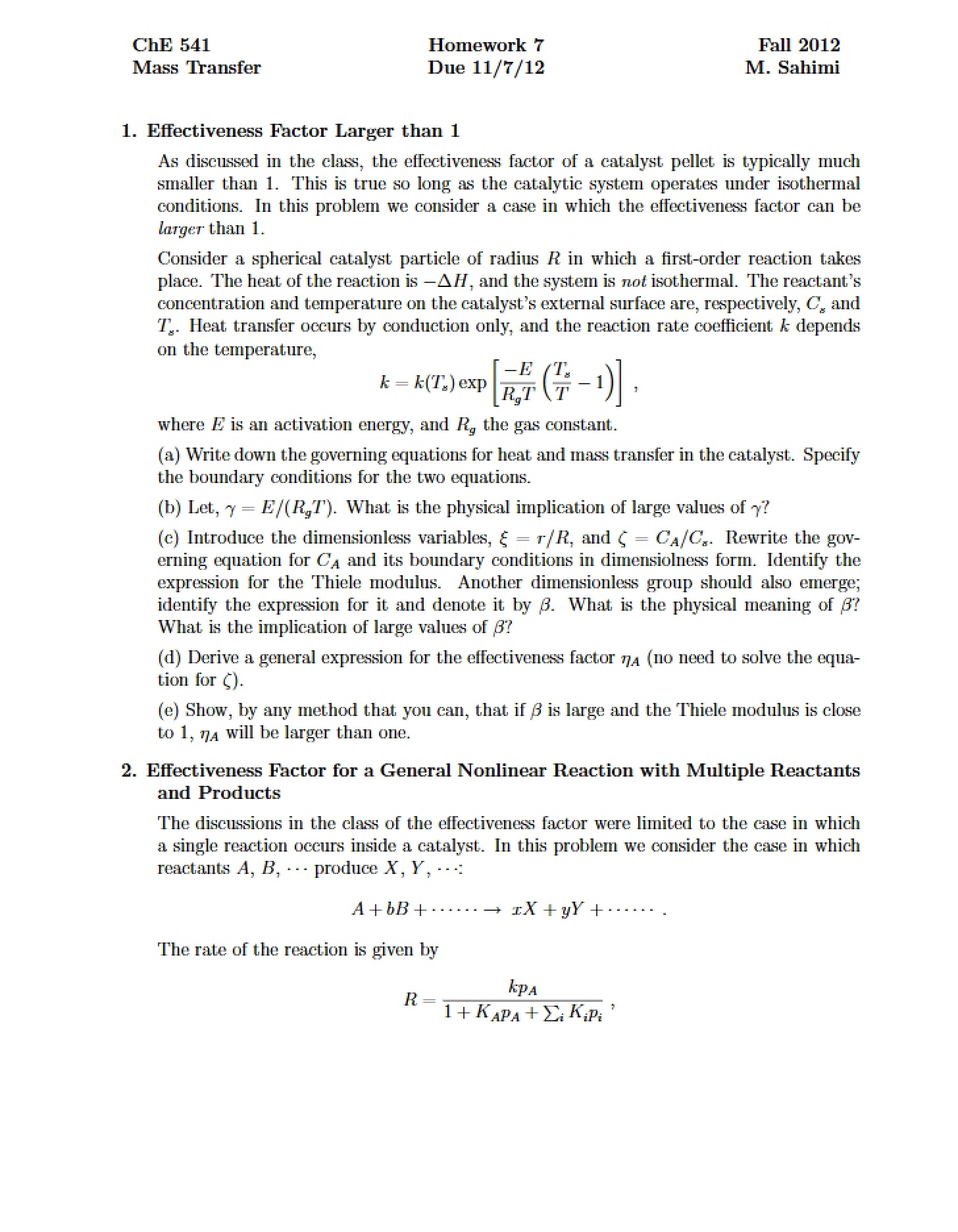
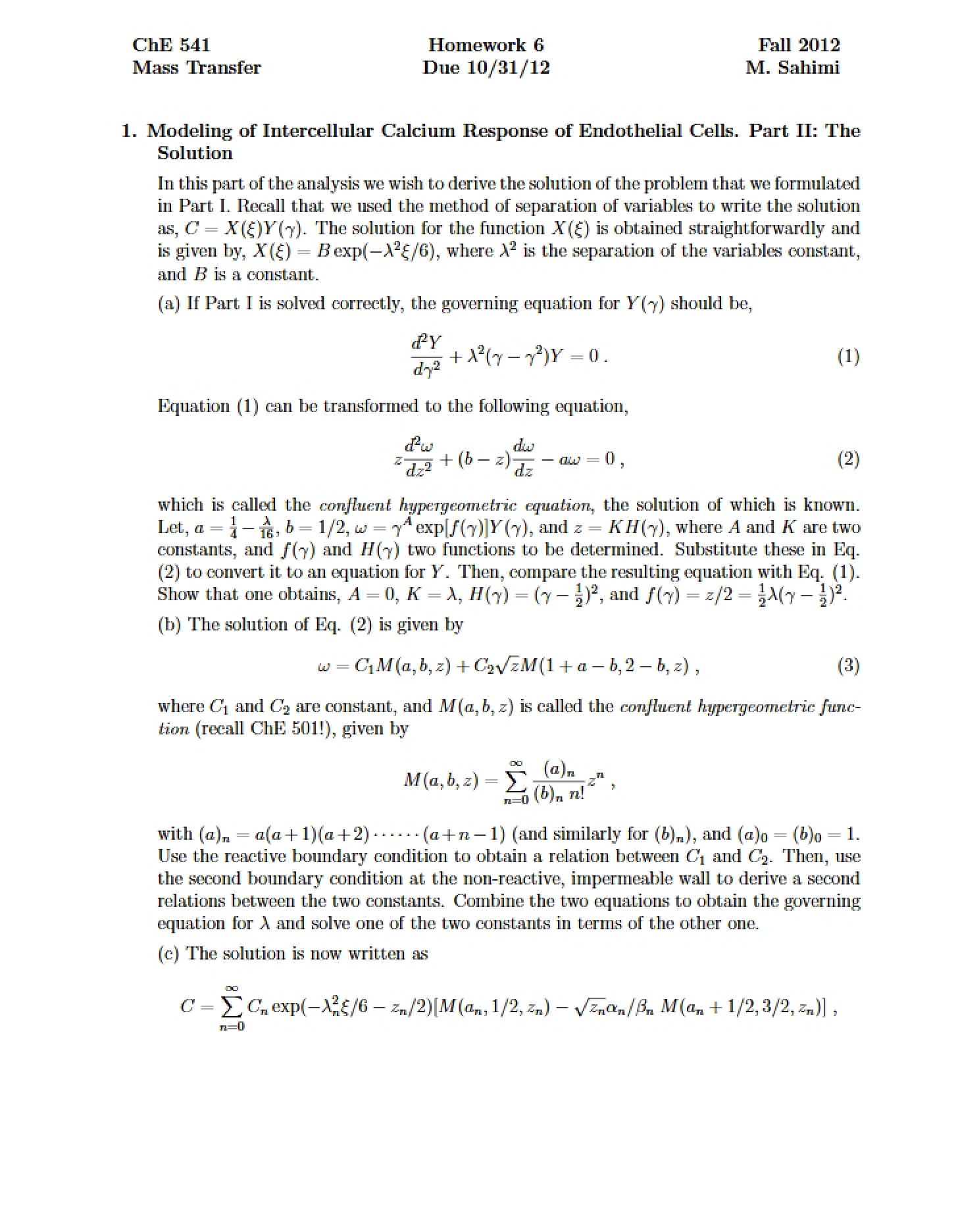
This is a homework assignment for a graduate-level Mass Transfer course (CHE 541) at the University of Southern California. It focuses on advanced concepts related to catalytic reaction engineering, specifically the effectiveness factor – a crucial metric for evaluating catalyst performance. The assignment delves into scenarios beyond simplified models, exploring complexities like non-isothermal operation, multi-reactant systems, and non-linear kinetics. It requires a strong understanding of differential equations, dimensionless analysis, and reaction rate theory.
Why This Document Matters
This assignment is ideal for chemical engineering students enrolled in a transport phenomena or reaction engineering course. It’s particularly valuable for those preparing for advanced studies or careers in catalysis, reactor design, or process optimization. Working through these problems will solidify your ability to apply theoretical knowledge to practical catalytic systems and develop skills in mathematical modeling of transport processes. It’s best utilized *after* a foundational understanding of effectiveness factor concepts has been established in lectures and textbooks.
Common Limitations or Challenges
This document presents a set of challenging problems requiring significant analytical effort. It does *not* provide step-by-step solutions or worked examples. Students will need to independently apply the principles learned in class and from course materials to derive solutions. The problems build upon each other, so a strong grasp of earlier concepts is essential. It assumes familiarity with concepts like Thiele modulus, dimensionless groups, and partial pressures.
What This Document Provides
* Detailed problem statements exploring the effectiveness factor under varying conditions.
* Scenarios involving first-order reactions with temperature dependence.
* Analysis of systems with multiple reactants and products, utilizing partial pressure considerations.
* Application of the Michaelis-Menten kinetic model to catalyst performance evaluation.
* Opportunities to practice dimensionless analysis and derive expressions for key parameters.
* Exercises designed to deepen understanding of the physical meaning of dimensionless groups.
* A framework for evaluating the limitations of simplified models in complex catalytic systems.