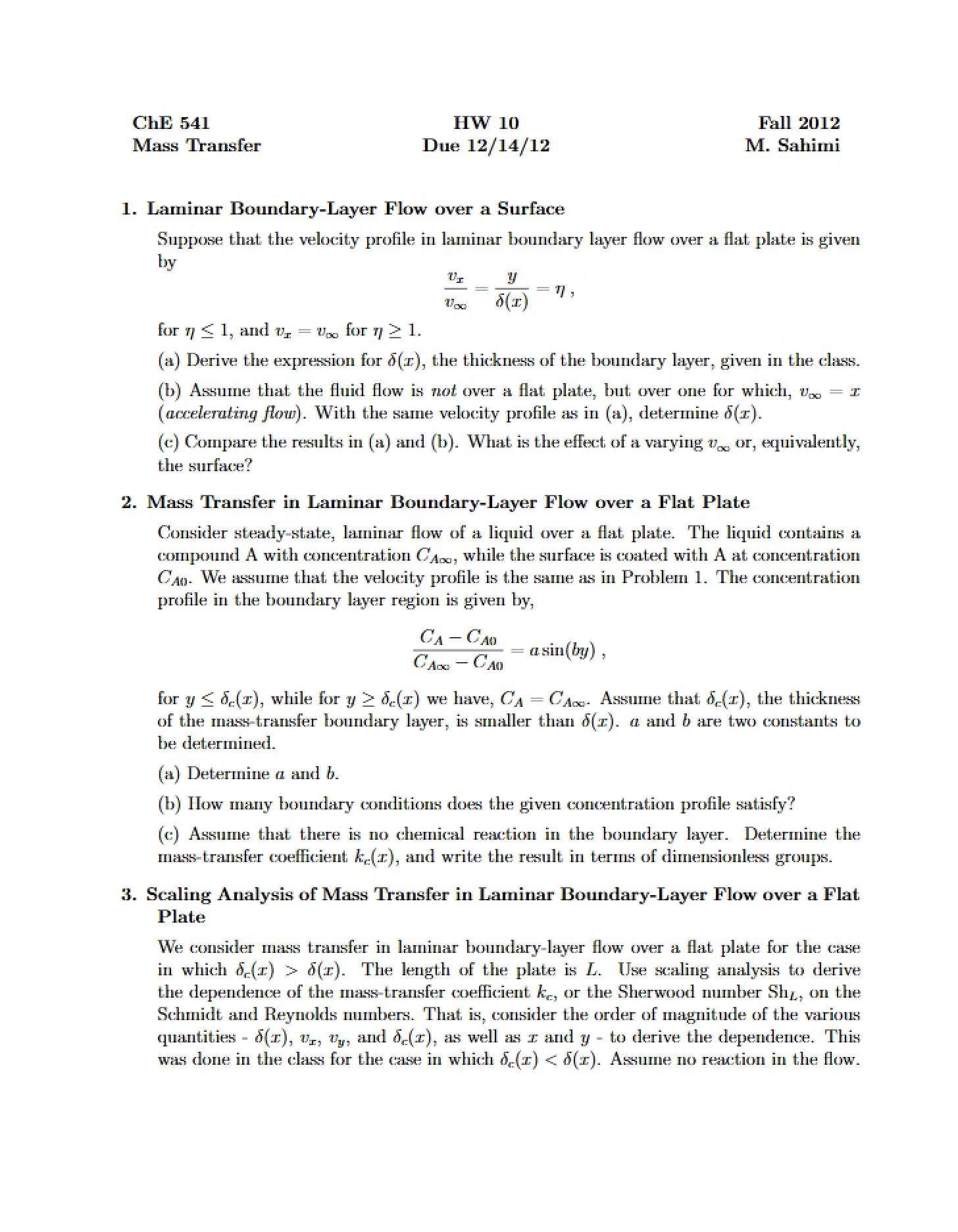
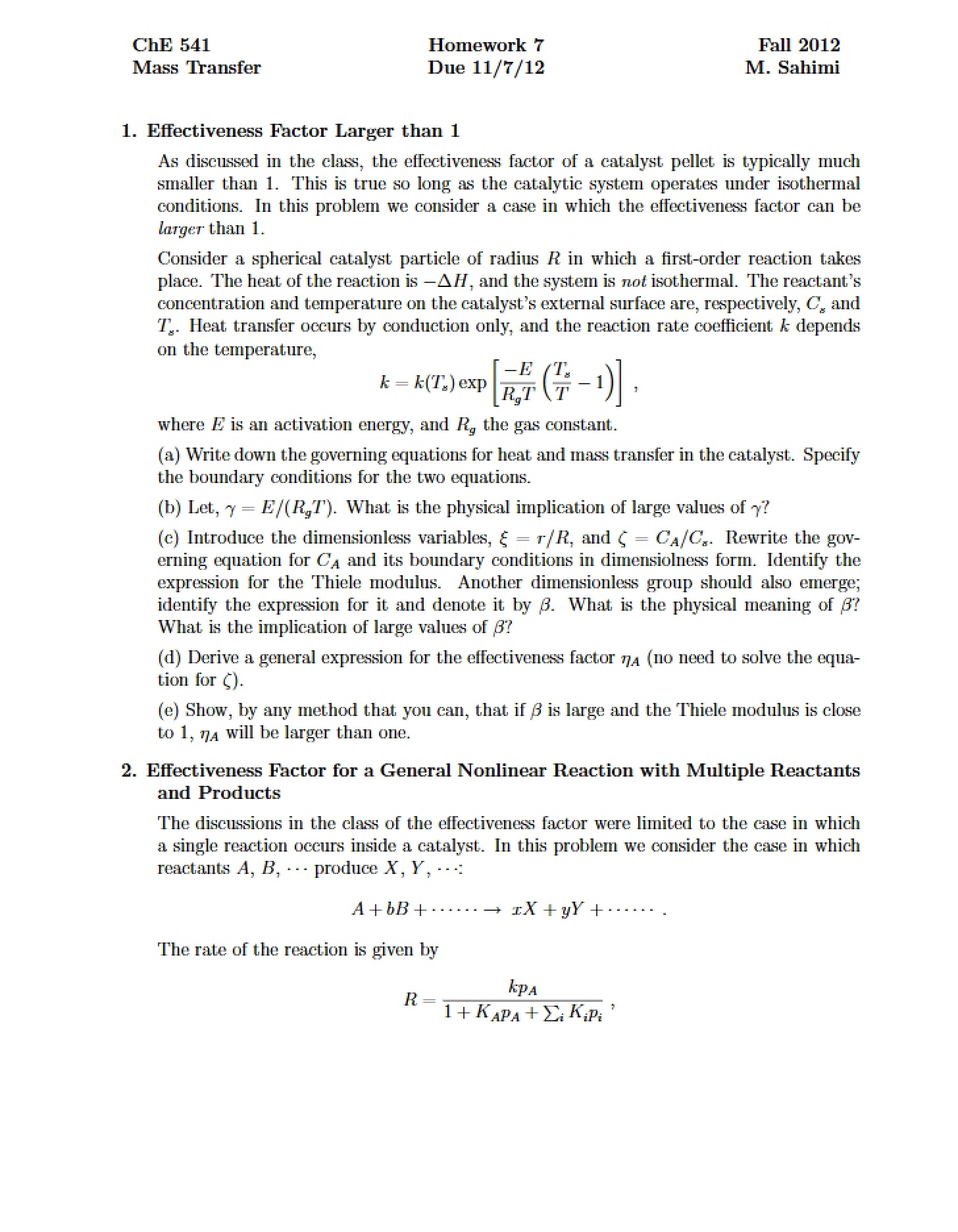
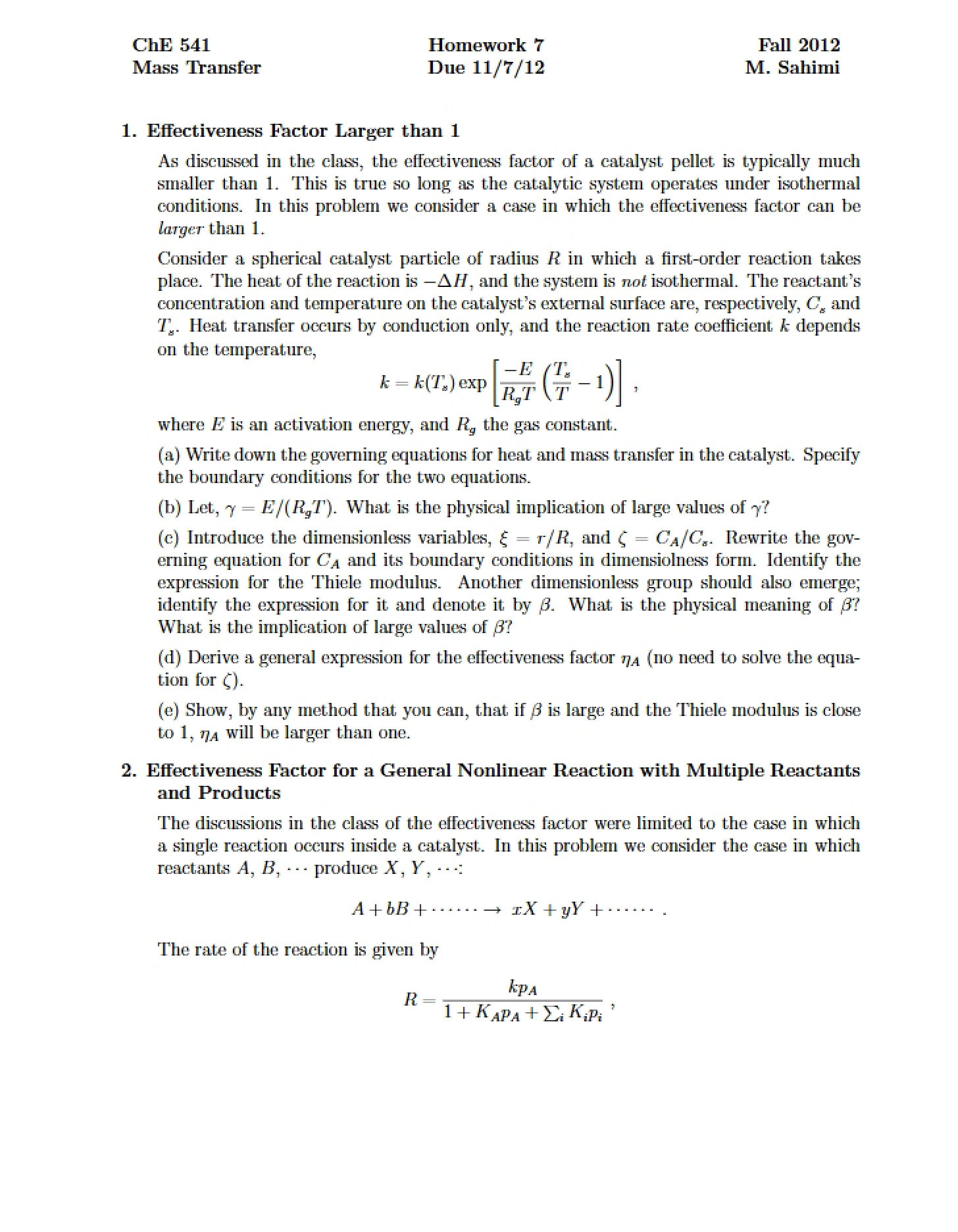
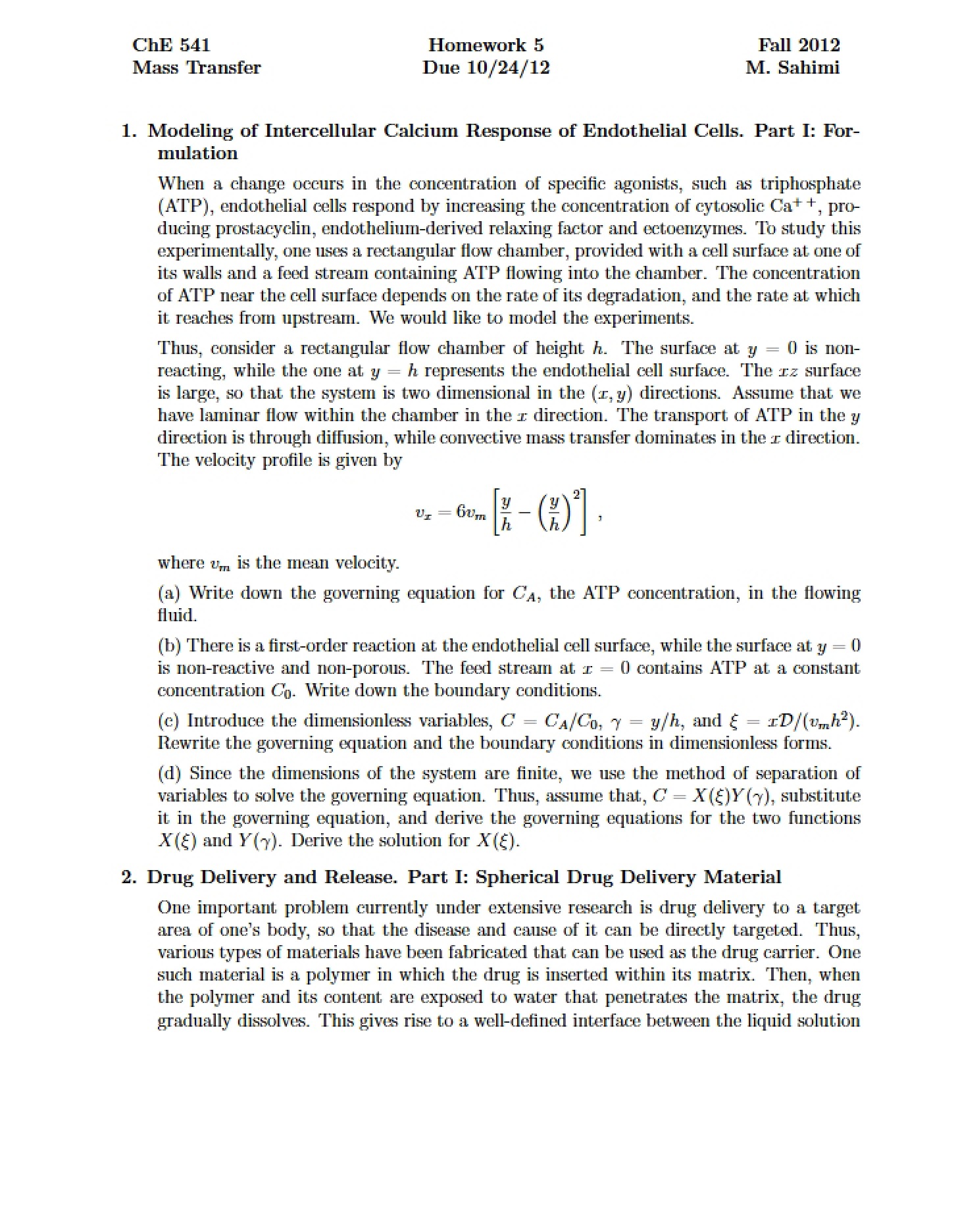
What This Document Is
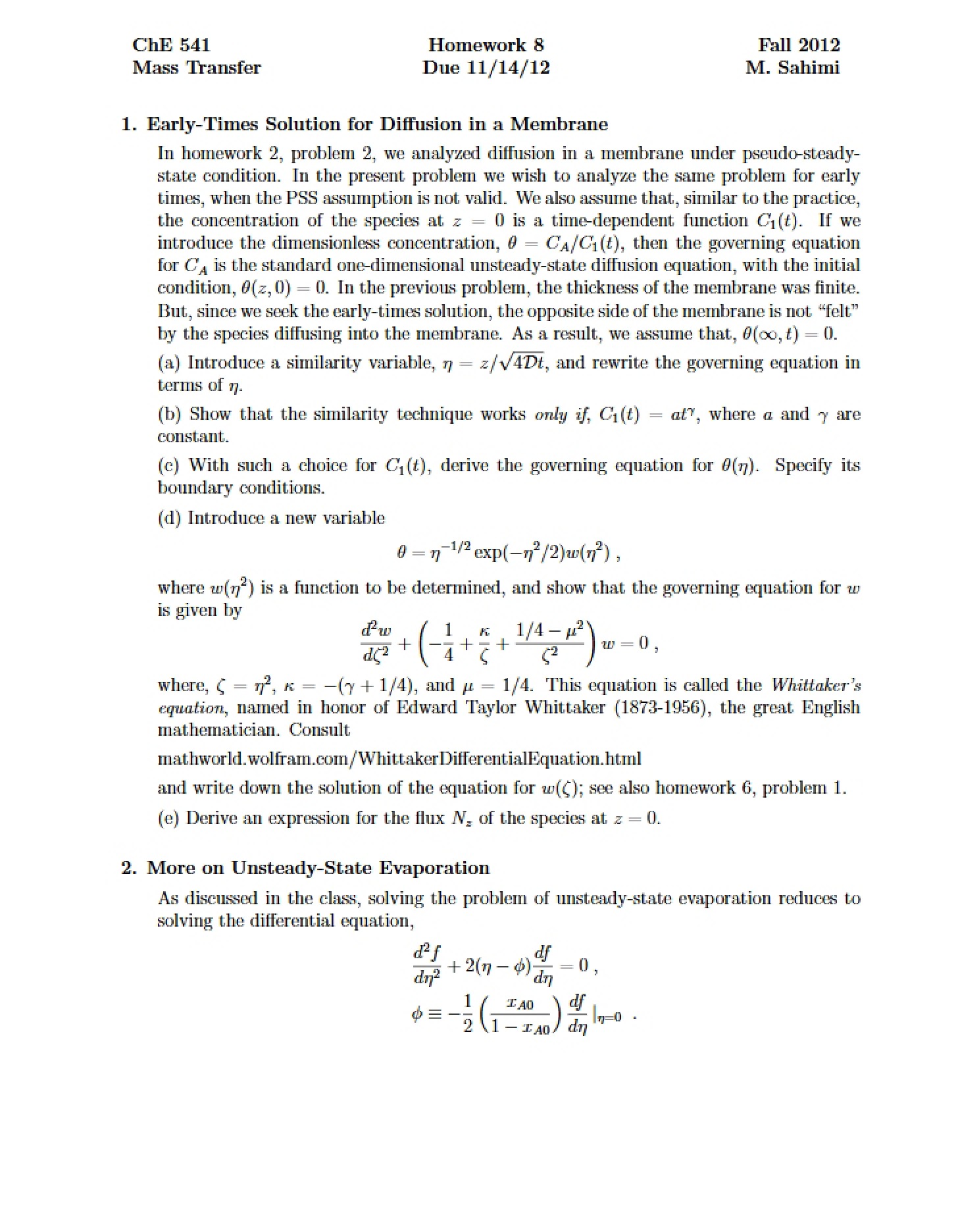
This is a homework assignment for CHE 541: Mass Transfer, offered at the University of Southern California. It focuses on applying core mass transfer principles to solve complex, multi-component transport problems. The assignment presents a series of challenging problems designed to test your understanding of diffusion, convection, migration, and the interplay between transport and chemical reactions. It builds upon concepts typically covered in an advanced undergraduate or introductory graduate-level mass transfer course.
Why This Document Matters
This assignment is crucial for students enrolled in CHE 541 seeking to solidify their grasp of mass transfer phenomena. Successfully completing these problems will demonstrate your ability to model and analyze real-world separation processes, membrane transport, and reactive systems. It’s particularly valuable for those pursuing careers in chemical engineering fields involving process design, separation technology, or reaction engineering. Working through these problems will prepare you for more advanced coursework and professional challenges.
Common Limitations or Challenges
This assignment requires a strong foundation in differential equations, transport phenomena, and chemical kinetics. It does *not* provide a comprehensive review of fundamental mass transfer concepts; it assumes you have already mastered those basics. The problems require independent application of theoretical knowledge and may involve simplifying assumptions to arrive at tractable solutions. It also doesn’t offer step-by-step solutions or worked examples – it’s designed to be a self-directed learning exercise.
What This Document Provides
* Problems involving transport through charged hydrogel membranes, requiring consideration of electroneutrality and ion diffusion.
* Scenarios involving the diffusion of multiple components (ammonia, water, helium) through a membrane, with a focus on boundary conditions and steady-state analysis.
* A problem exploring the impact of instantaneous reactions on diffusion-controlled processes, specifically focusing on radical reactions in liquid solutions.
* Opportunities to apply flux expressions incorporating diffusive, convective, and migration contributions.
* Problems requiring the derivation of concentration profiles and reaction rates.