What This Document Is
This document contains lecture notes from ECE 350: Field and Waves, offered at the University of Illinois at Urbana-Champaign. Specifically, this is Lecture 26, which delves into the behavior of electromagnetic waves within parallel-plate waveguides. It builds upon previous discussions of guided modes and expands the analysis to include a specific polarization of waves. The material is presented at a university-level engineering standard, assuming a foundational understanding of electromagnetic theory.
Why This Document Matters
This lecture is crucial for students studying electrical engineering, physics, or related fields who need a strong grasp of wave propagation. It’s particularly valuable when tackling coursework involving transmission lines, antenna design, or microwave engineering. Students preparing for exams on guided waves, or those seeking a deeper understanding of how electromagnetic fields are confined and directed, will find this resource beneficial. It serves as a detailed exploration of theoretical concepts, providing a foundation for more advanced studies.
Topics Covered
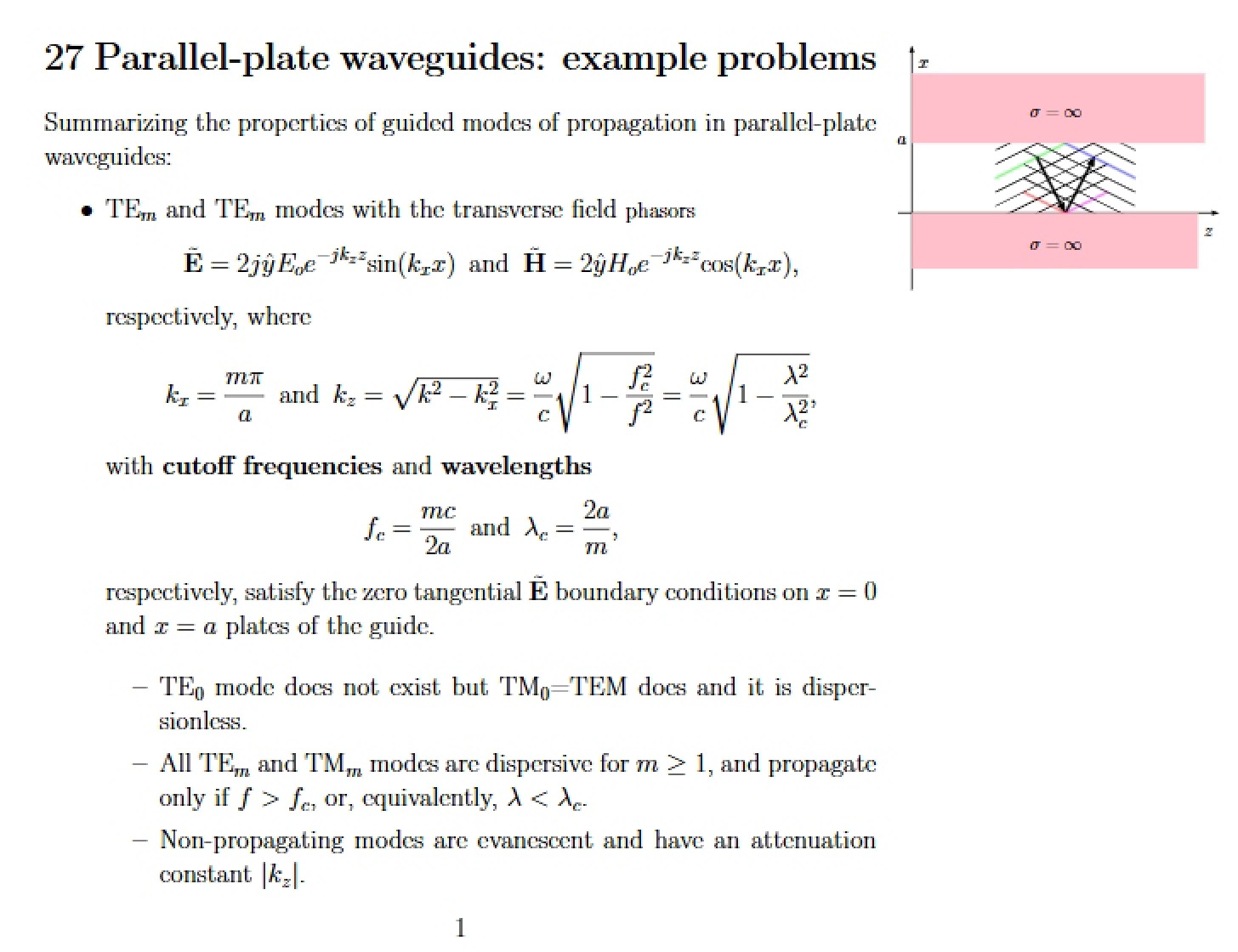
* TM-mode propagation in parallel-plate waveguides
* Comparison of TM and TE modes
* Cutoff frequencies and wavelengths for guided modes
* Phase and group velocity within the waveguide structure
* Guide impedance and its relation to field components
* The special case of the TEM mode (m=0) and its connection to transmission line theory
* Adaptation of equations for waveguides embedded in dielectric media
What This Document Provides
* A detailed mathematical framework for analyzing TM-mode fields.
* Explanations of the conditions required for wave propagation versus evanescent behavior.
* Relationships between frequency, wavelength, and wavenumber within the waveguide.
* A conceptual link between guided waves and plasma dispersion relations.
* A worked example illustrating the determination of electric field phasors and guide impedance (the solution itself is not provided).
* Insights into the behavior of waves in different material environments.