What This Document Is
This is a lecture transcript from an advanced undergraduate course in Field and Waves (ECE 350) at the University of Illinois at Urbana-Champaign. Lecture 29 focuses on the behavior of electromagnetic waves within rectangular waveguides, specifically examining higher-order Transverse Electric (TE) modes. It delves into the mathematical foundations required to analyze wave propagation within these structures, building upon previously established concepts related to Transverse Magnetic (TM) modes. The material is geared towards students with a solid understanding of vector calculus, electromagnetic theory, and transmission line principles.
Why This Document Matters
This lecture is essential for students pursuing careers in electrical engineering, particularly those specializing in microwave engineering, antenna design, and high-frequency circuit design. Understanding waveguide modes is crucial for designing efficient and reliable systems for transmitting electromagnetic energy. This resource is most valuable when used in conjunction with course lectures, assigned readings, and problem sets, offering a detailed reference for complex theoretical concepts. It’s particularly helpful when preparing for exams or tackling advanced design projects.
Topics Covered
* Analysis of TE modes in rectangular waveguides
* Application of boundary conditions to determine valid mode patterns
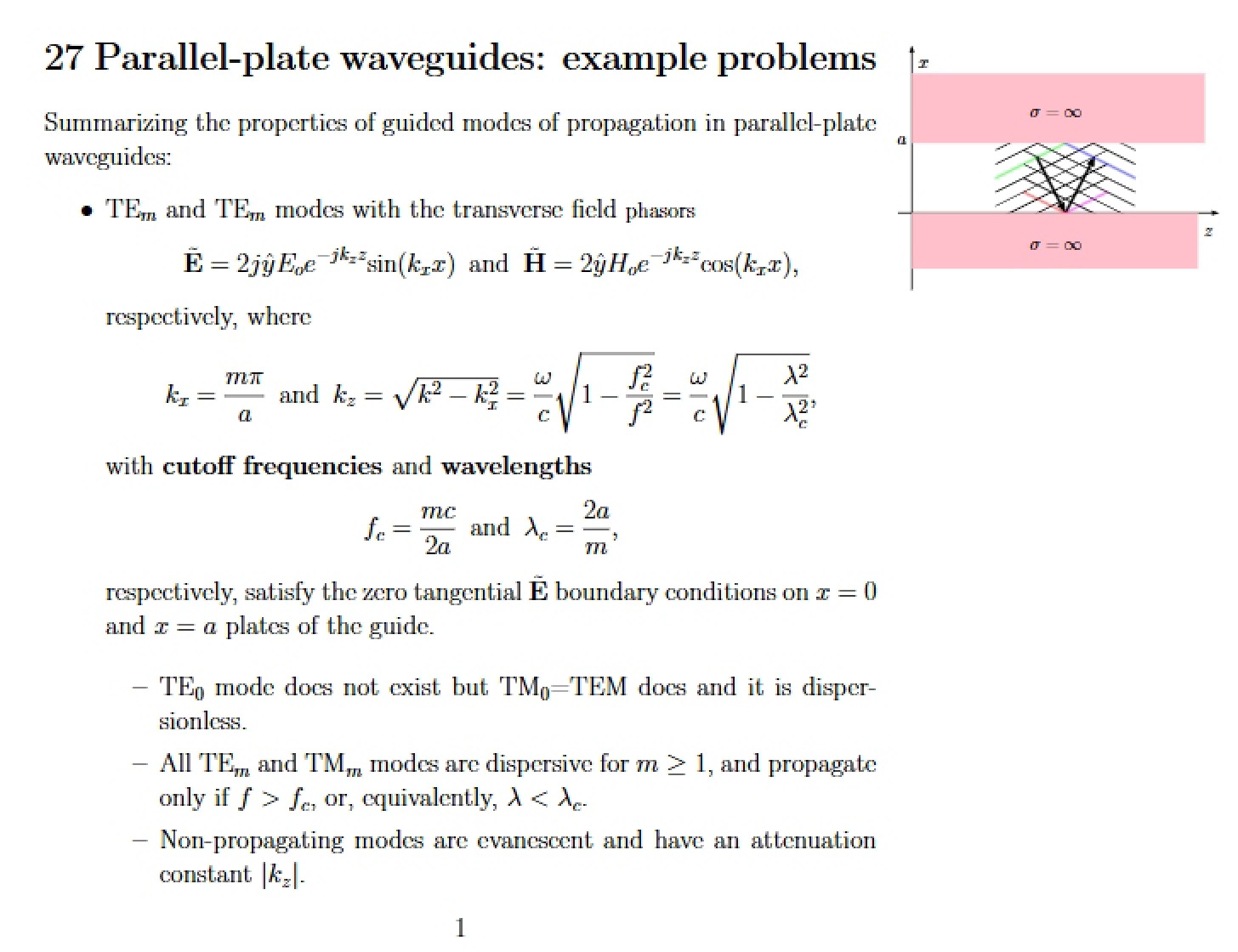
* Cutoff frequencies and mode propagation characteristics
* Relationship between waveguide dimensions and mode behavior
* Considerations for single-mode operation within specified frequency bands
* Waveguide design principles for practical applications
What This Document Provides
* A rigorous mathematical treatment of TE mode fields within rectangular waveguides.
* Detailed explanations of how to apply boundary conditions to solve for mode characteristics.
* Illustrative examples demonstrating the application of theoretical concepts to practical waveguide design.
* A framework for understanding the relationship between waveguide geometry, frequency of operation, and mode propagation.
* A foundation for analyzing more complex waveguide structures and applications.