What This Document Is
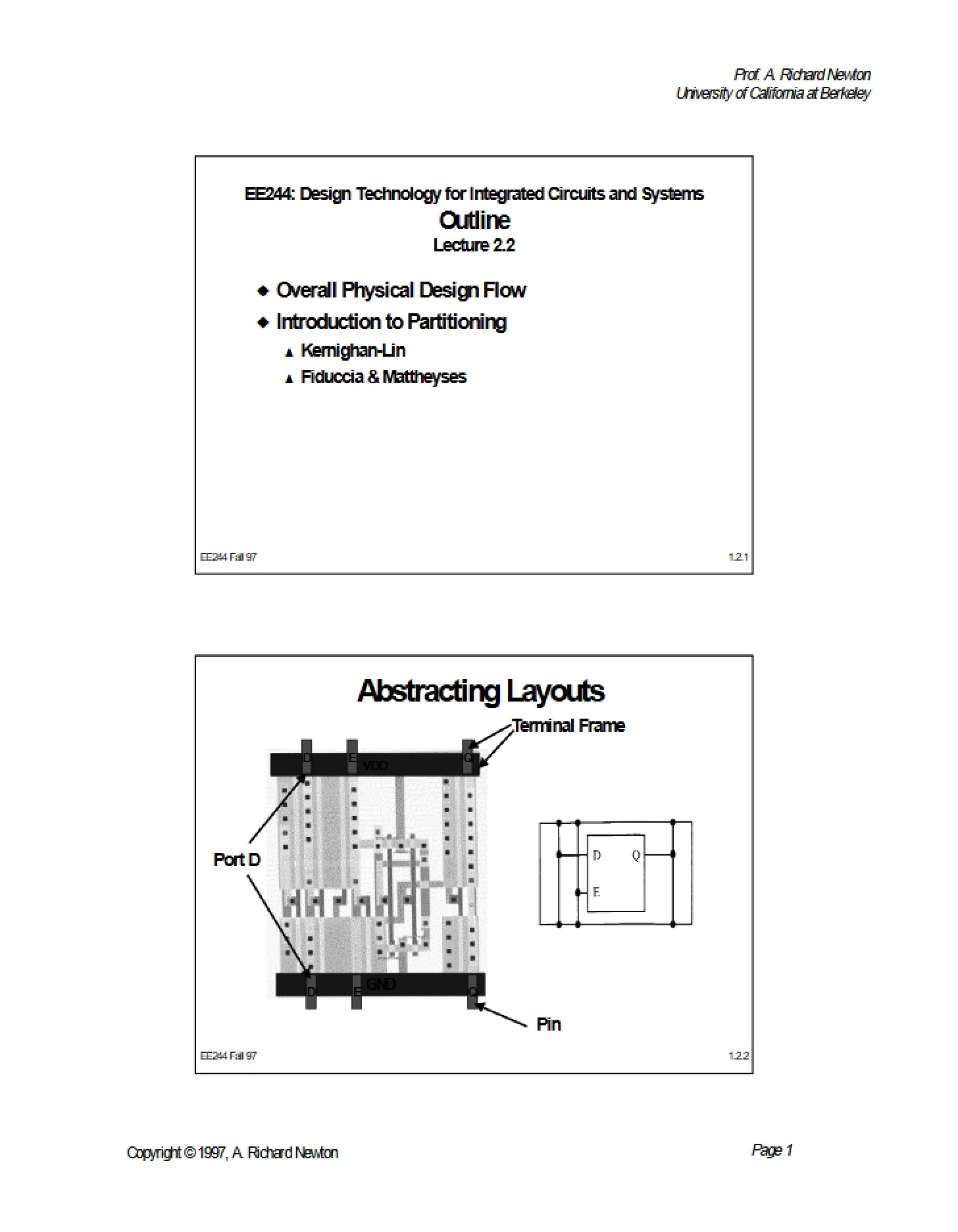
This document presents a lecture overview from EE244: Design Technology for Integrated Circuits and Systems at the University of California, Berkeley. It delves into the core principles and techniques surrounding the physical design and layout of CMOS circuits, particularly focusing on methodologies applicable in deep submicron technologies. The material explores various approaches to building complex digital systems from fundamental building blocks. It appears to be a detailed exploration of how logic functions are mapped onto physical silicon.
Why This Document Matters
This overview is invaluable for students enrolled in advanced digital logic design, VLSI design, or integrated circuit fabrication courses. It’s particularly beneficial for those seeking a deeper understanding of the practical considerations involved in translating schematic designs into actual chip layouts. Engineers and researchers working on custom IC design or physical design automation will also find this material relevant. Accessing the full content will provide a solid foundation for understanding the challenges and trade-offs inherent in modern integrated circuit design.
Topics Covered
* Regular Module Structures in CMOS design
* CMOS Synthetic Libraries and their implementation
* Programmable Logic Array (PLA) and Storage Logic Array (SLA) architectures
* Automating the design process for regular circuit structures
* Single-Strip Static CMOS layout techniques
* Graph theory applications in circuit layout optimization
* Euler path algorithms for efficient transistor placement
* Gate Matrix layout methodologies for nMOS and pMOS implementation
What This Document Provides
* A structured outline of key concepts in static CMOS layout.
* An introduction to symbolic layout representations.
* Discussion of optimization strategies for minimizing diffusion areas.
* Exploration of dual graph representations for circuit layout.
* Insights into heuristic algorithms for planar circuit representation.
* A glimpse into the challenges of handling even and odd numbers of inputs in logic design.
* A foundational understanding of gate matrix layout approaches.