What This Document Is
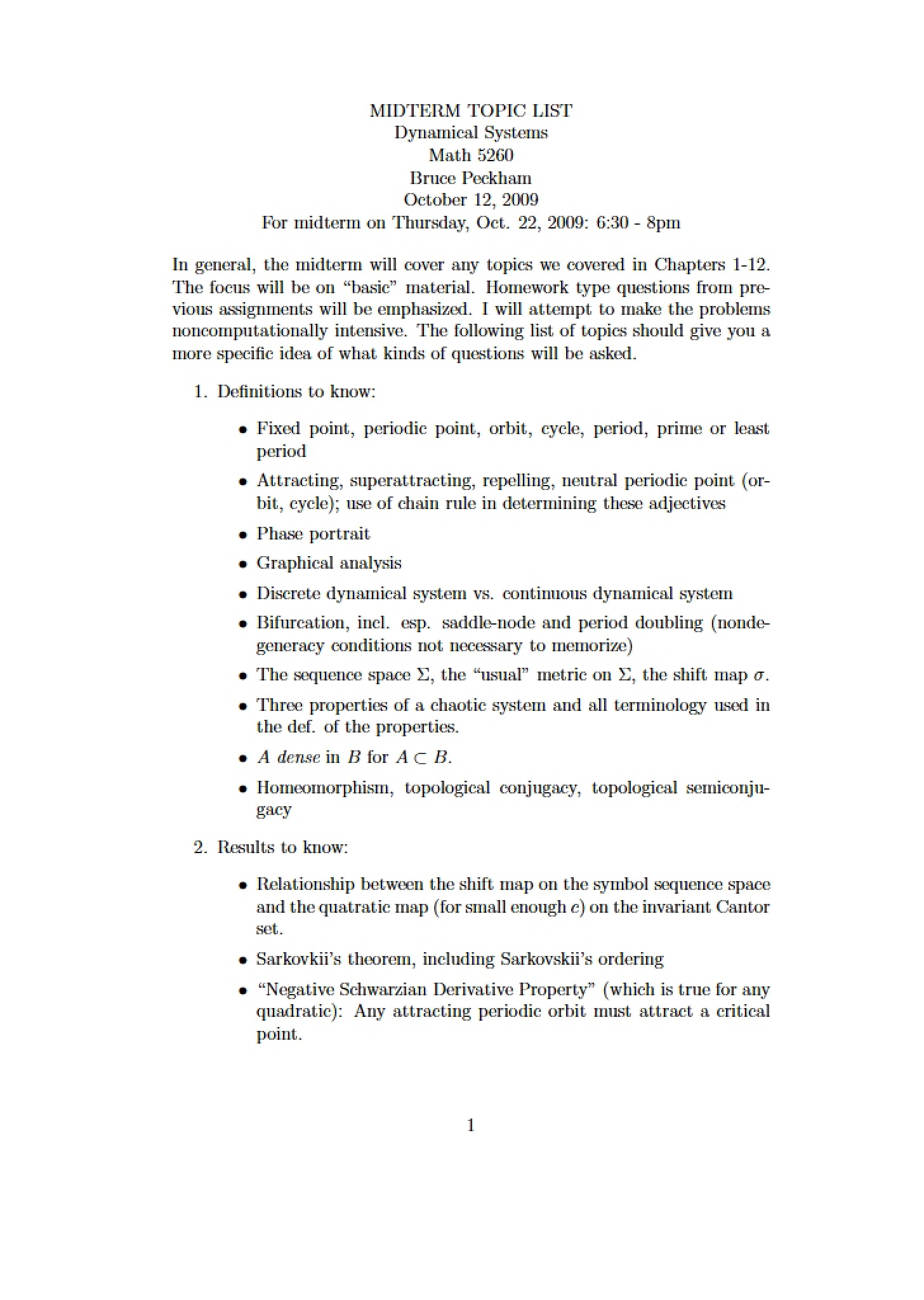
This is a focused topic list outlining the core concepts and skills expected to be demonstrated on Midterm 2 for MATH 5260: Dynamical Systems, offered at the University of Minnesota Twin Cities. It serves as a comprehensive, though not exhaustive, guide to the material covered in the course leading up to the assessment. It’s designed to help students prioritize their study efforts and ensure they’ve engaged with the most important themes.
Why This Document Matters
This resource is invaluable for students currently enrolled in MATH 5260, or those preparing for a similar course in dynamical systems. It’s particularly useful as you begin your focused review for the midterm examination. Knowing *what* will be tested allows for a more efficient and targeted study plan. Students who utilize this list can better gauge their understanding of key areas and identify topics needing further attention. It’s best used in conjunction with lecture notes, assigned readings, and completed homework assignments.
Common Limitations or Challenges
This topic list is a guide, not a substitute for thorough understanding of the course material. It doesn’t include practice problems, detailed explanations, or worked examples. It also doesn’t represent the *only* topics that *might* be touched upon, but rather those considered central to the midterm’s scope. The level of detail expected for each topic isn’t explicitly stated, so students should refer to course materials for clarification.
What This Document Provides
* A breakdown of key areas within the study of differential equations, including both 1D and 2D systems.
* Guidance on understanding phase space analysis and its relationship to analytical solutions.
* An overview of essential definitions and terminology related to dynamical systems.
* Coverage of equilibrium point analysis, including classifications and stability criteria.
* Information regarding linearization techniques for nonlinear systems.
* A section dedicated to bifurcations, including identification and examples.
* A focus on one-dimensional maps and associated definitions.
* Details on expected knowledge of existence and uniqueness theorems.