What This Document Is
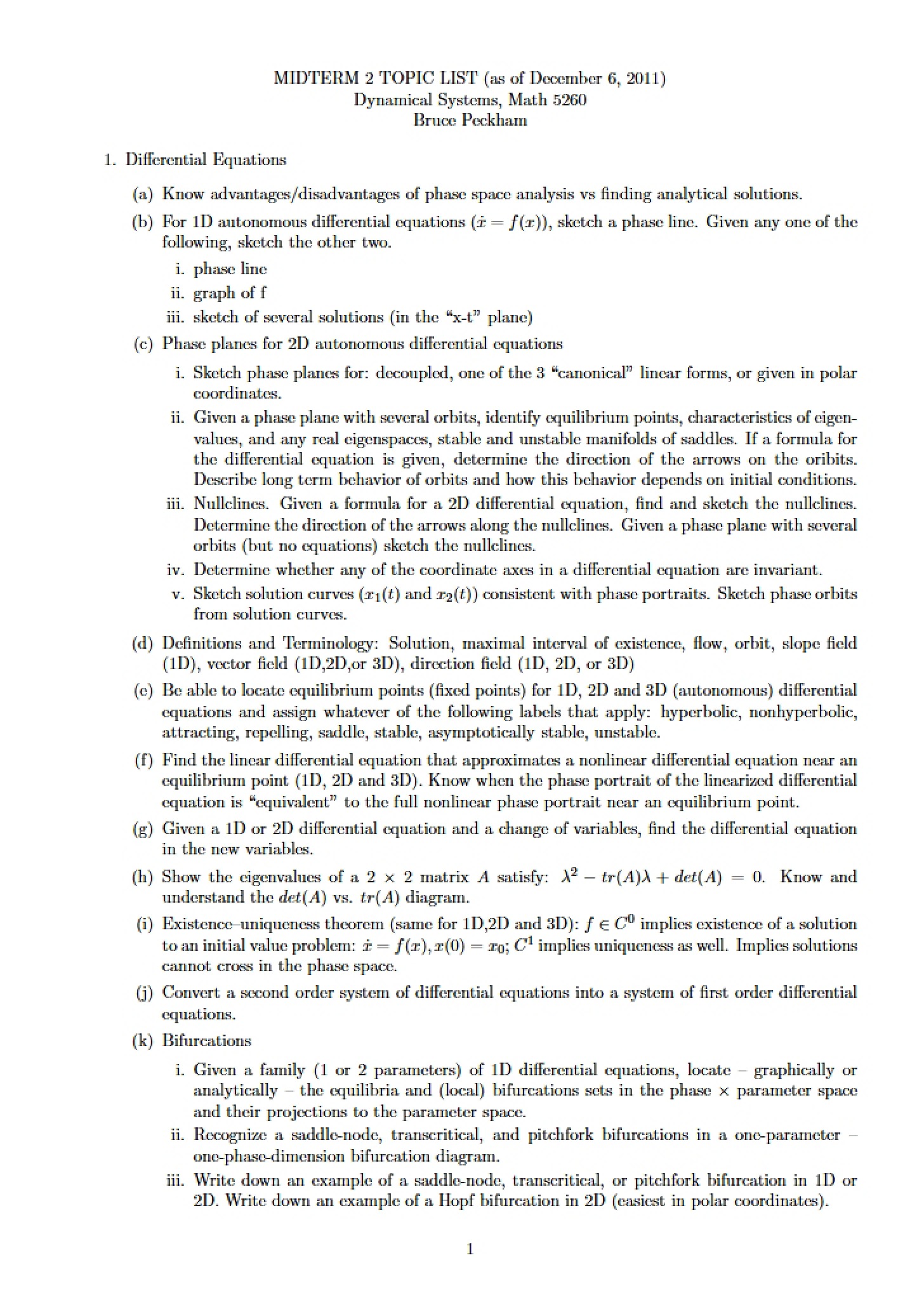
This is a comprehensive topic list outlining the key concepts and skills expected for the second midterm examination in MATH 5260: Dynamical Systems, offered at the University of Minnesota Twin Cities. It serves as a focused review guide, detailing the areas of emphasis for your preparation. The list is organized by major subject areas within dynamical systems, providing a structured overview of the material covered.
Why This Document Matters
This resource is invaluable for students currently enrolled in MATH 5260, or those reviewing the core principles of dynamical systems. It’s particularly useful as you finalize your study plan leading up to the midterm. Knowing precisely which topics will be assessed allows for efficient and targeted preparation, maximizing your study time. Students who utilize this list can better gauge their understanding and identify areas needing further attention. It’s best used in conjunction with your course notes, textbook, and completed assignments.
Common Limitations or Challenges
This topic list is *not* a substitute for attending lectures, completing homework, or engaging with the course materials. It does not contain detailed explanations, worked examples, or practice problems. It’s a high-level overview, and assumes a foundational understanding of the concepts already presented in the course. It also doesn’t provide any indication of the difficulty or weighting of each topic on the exam itself.
What This Document Provides
* A categorized breakdown of topics related to differential equations (both 1D and 2D).
* Key terminology and definitions essential for understanding dynamical systems.
* Guidance on analyzing phase space, including identifying equilibrium points and their characteristics.
* An overview of concepts related to bifurcations and their graphical/analytical identification.
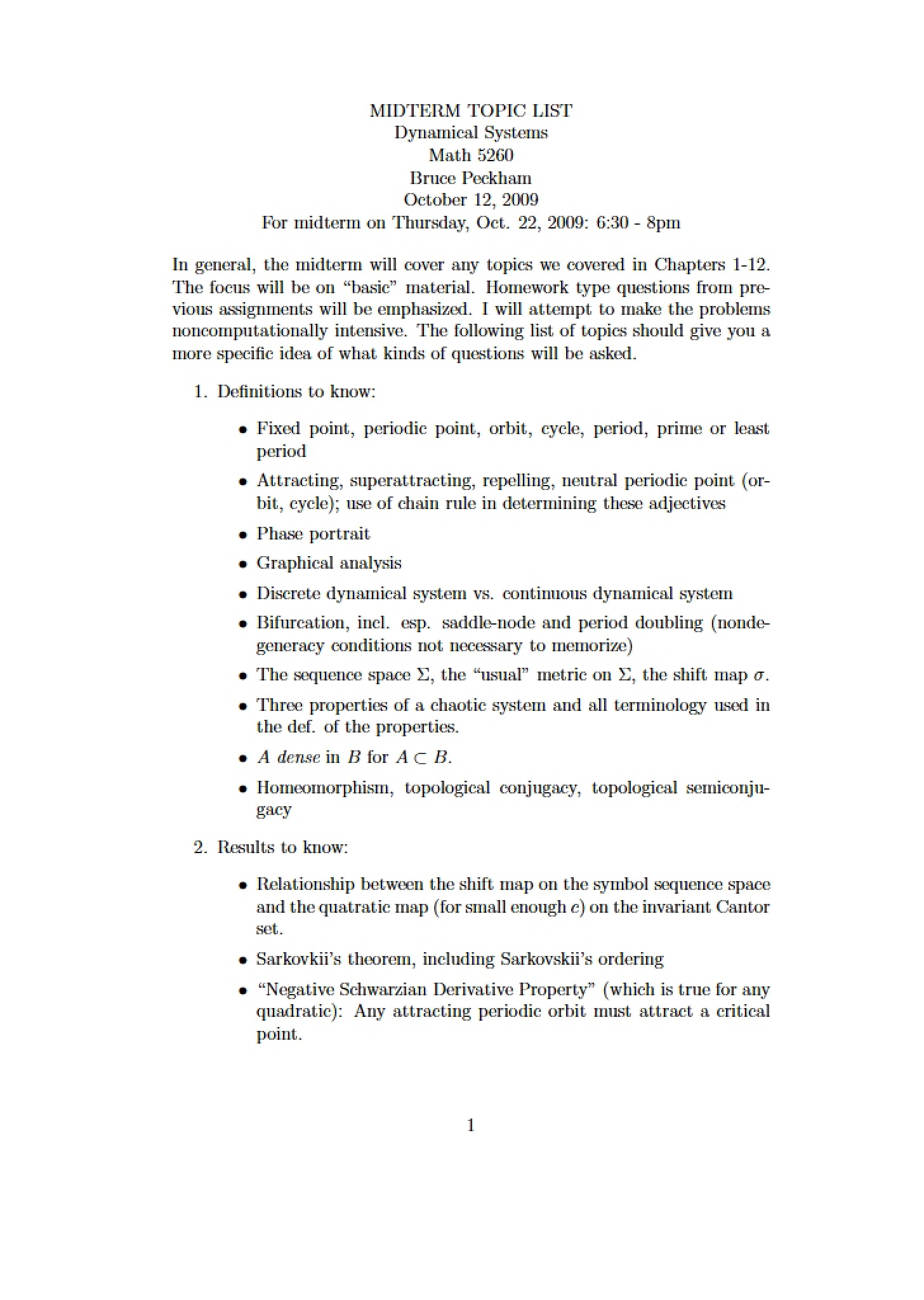
* A section dedicated to one-dimensional maps, including definitions of fixed and periodic points.
* Information regarding the application of linear algebra to dynamical systems, including eigenvalue calculations.
* A reminder of important theorems related to existence and uniqueness of solutions.
* Coverage of techniques for transforming and simplifying differential equations.