What This Document Is
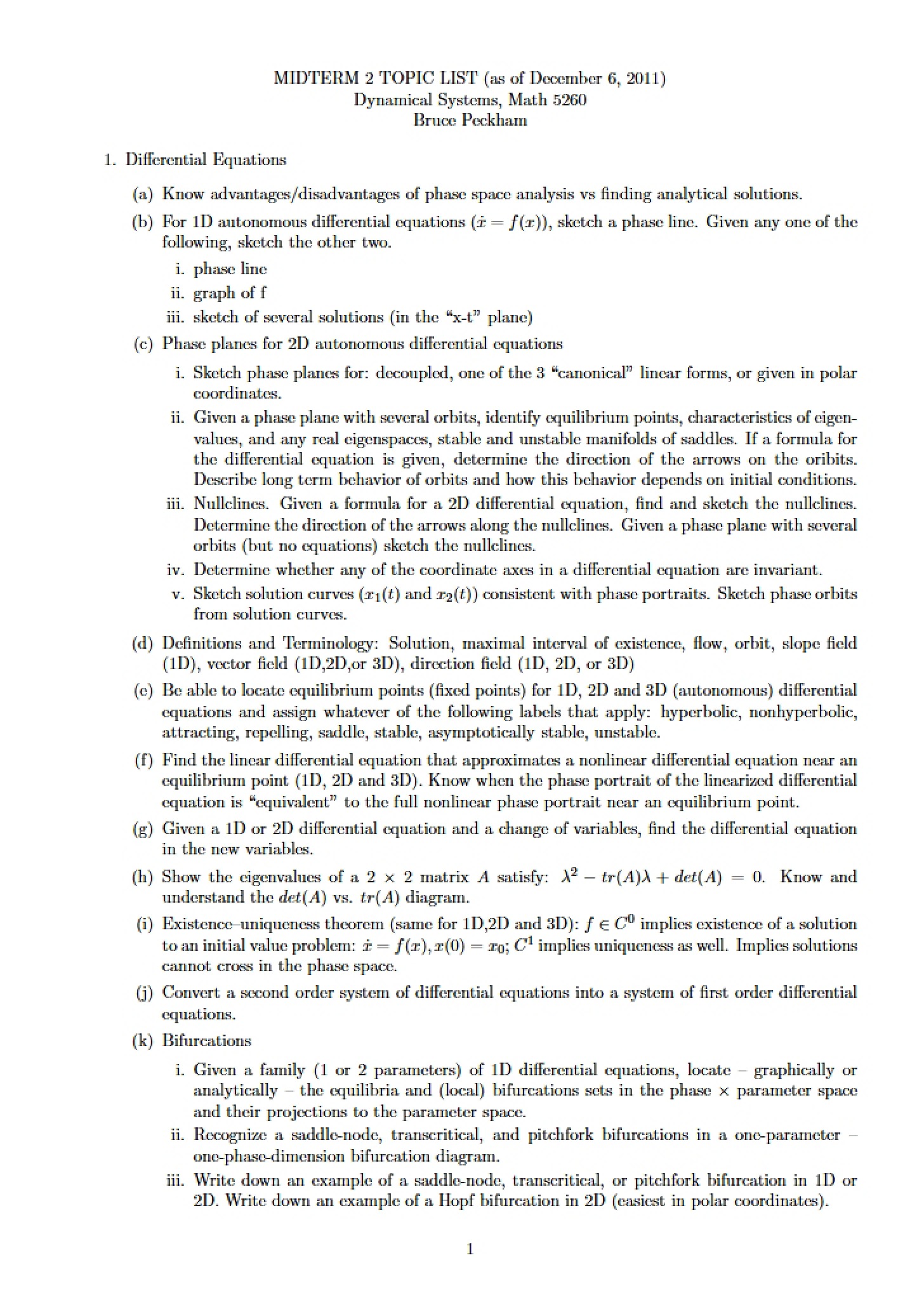
This document is a focused topic list designed to prepare students for a midterm examination in a Dynamical Systems course (MATH 5260) at the University of Minnesota Twin Cities. It outlines the core concepts, theorems, and techniques that will be assessed, serving as a concentrated review guide for the material covered in the first portion of the course. The material spans both discrete and continuous dynamical systems.
Why This Document Matters
This resource is invaluable for students enrolled in a similar dynamical systems course, particularly as they approach a midterm assessment. It’s best used as a checklist to gauge understanding and identify areas needing further review. Students who utilize this list can prioritize their study efforts, ensuring they focus on the most critical elements of the course material. It’s especially helpful for those who benefit from a clear, organized overview of exam expectations.
Common Limitations or Challenges
This document is *not* a substitute for attending lectures, completing homework assignments, or engaging with the full course materials. It does not contain detailed explanations, worked examples, or step-by-step solutions. It’s a high-level overview intended to *direct* study, not to *replace* it. The list emphasizes “basic” material, meaning advanced or nuanced topics may receive less explicit coverage here.
What This Document Provides
* A categorized list of definitions students are expected to know, covering fundamental concepts like fixed points, bifurcations, and chaotic systems.
* Key theorems and relationships that form the theoretical foundation of the course, including connections between different dynamical systems.
* A breakdown of essential techniques for analyzing dynamical systems, such as locating periodic points and interpreting orbit diagrams.
* Identification of specific proofs students should be able to reproduce or understand.
* Guidance on recognizing important phenomena in dynamical systems, like saddle-node and period-doubling bifurcations.