What This Document Is
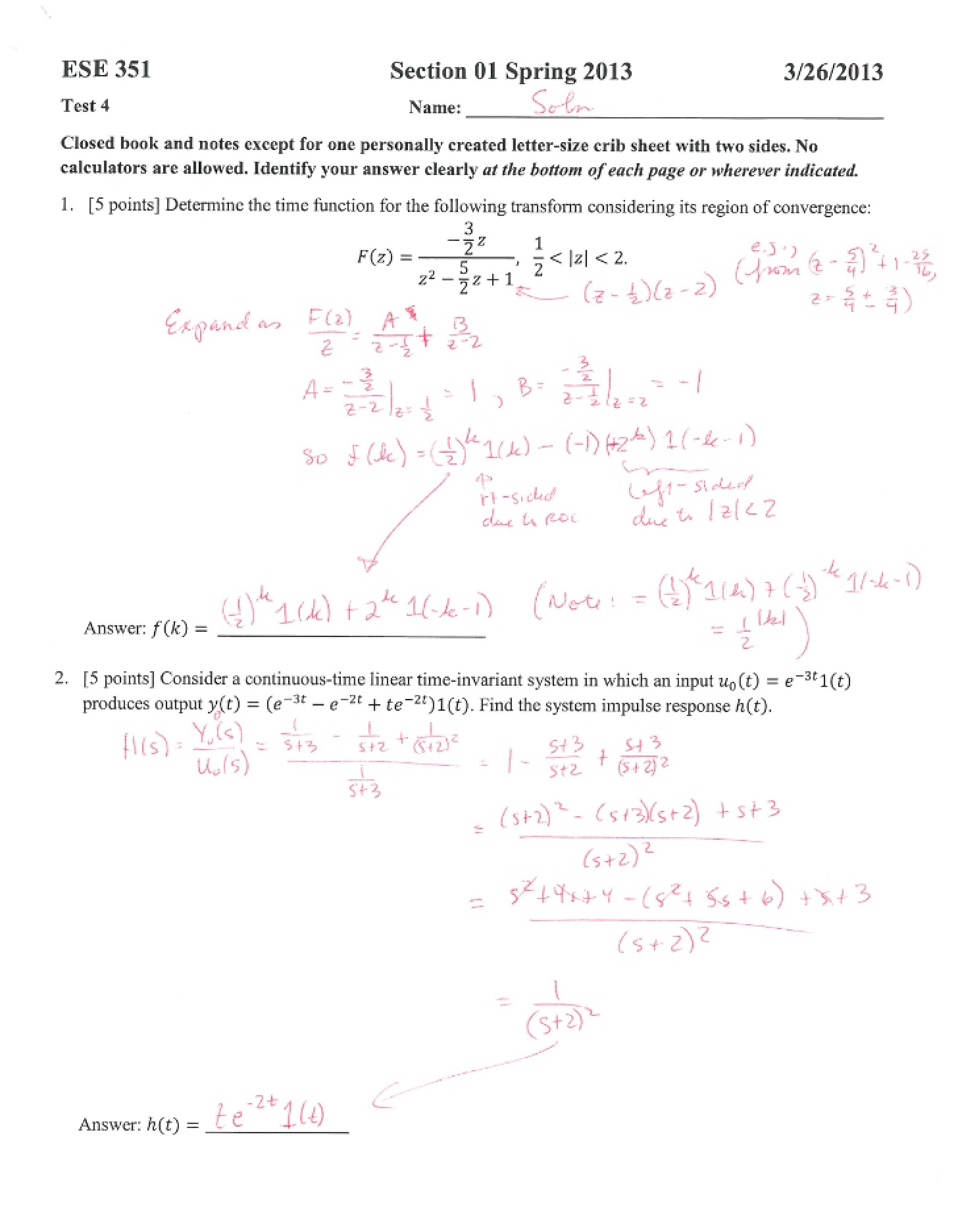
This document is a detailed, worked solution set for a Signals and Systems course (ESE 351) test, specifically Test Four administered at Washington University in St. Louis in Fall 2015. It focuses on core concepts within the field of dynamic systems, including transfer function analysis, system stability, and time-domain response. The test itself covered material taught over a specific period within the course, and this solution set aims to clarify the expected approach to problem-solving.
Why This Document Matters
This resource is invaluable for students currently enrolled in a Signals and Systems course, or those reviewing these fundamental concepts in control systems or electrical engineering. It’s particularly helpful for understanding how to apply theoretical knowledge to practical problems encountered in exams. Students who are struggling with specific problem types, or who want to verify their understanding of the course material, will find this solution set a useful study aid. It’s best used *after* attempting the original test problems independently, to identify areas where further clarification is needed.
Common Limitations or Challenges
This document provides solutions to a *specific* test from a *specific* course instance. It does not serve as a comprehensive textbook or a substitute for attending lectures and completing assigned homework. The problems presented reflect the instructor’s emphasis and style, and may not perfectly align with the content of other Signals and Systems courses. Furthermore, it does not include explanations of the underlying theory – it assumes a base level of understanding of the concepts. It will not teach you the fundamentals, but rather demonstrate their application.
What This Document Provides
* Detailed breakdowns of problem-solving approaches for systems described by difference equations.
* Analysis of system stability, focusing on the conditions for Bounded-Input Bounded-Output (BIBO) stability.
* Methods for determining transfer functions from system descriptions.
* Applications of system analysis to mechanical systems (mass-spring-damper).
* Illustrative examples of how to apply concepts to both discrete-time and continuous-time systems.
* Worked examples involving state-space representations and their relationship to transfer functions.