What This Document Is
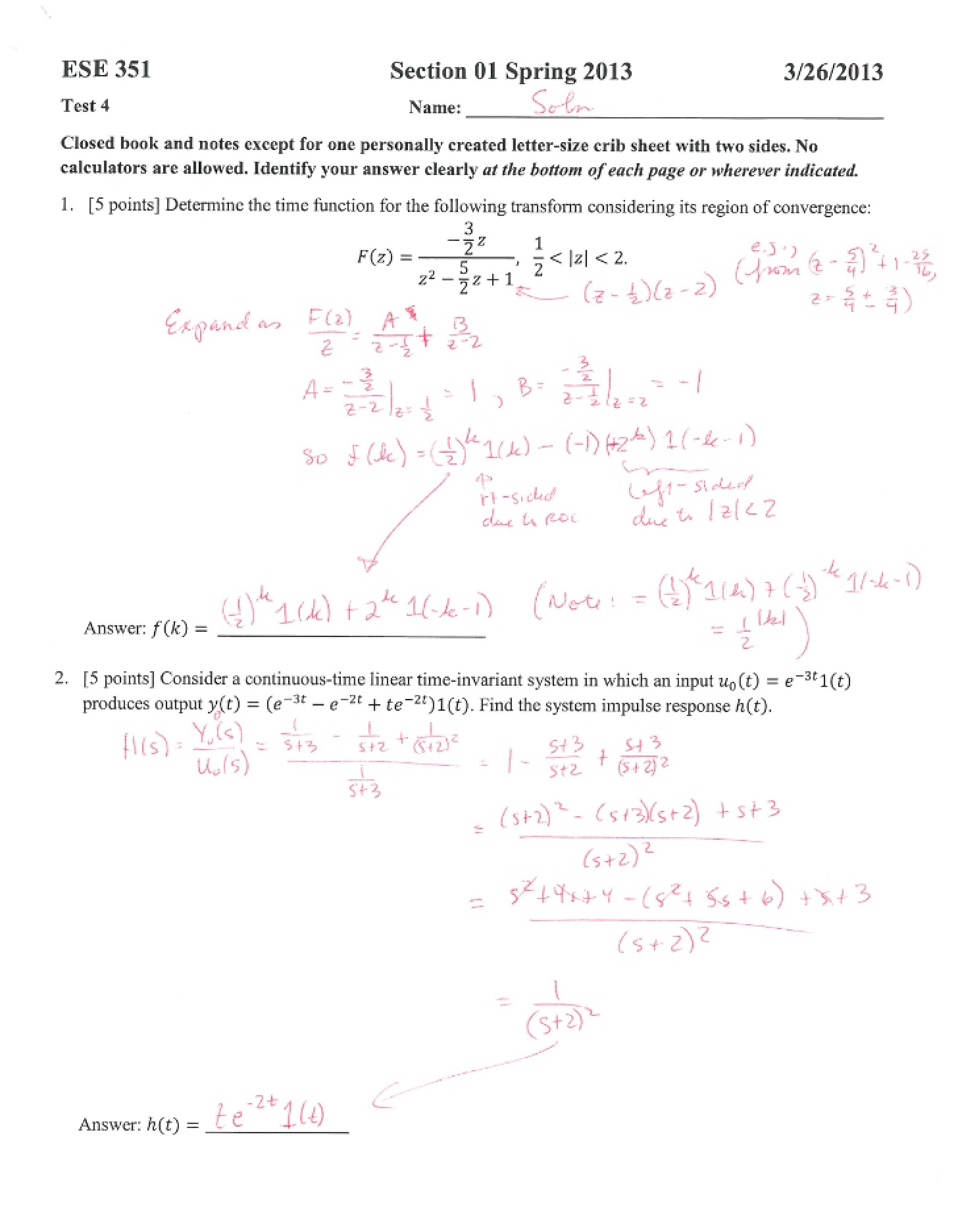
This document contains worked solutions for a past exam – specifically, Test Four – from ESE 351: Signals and Systems, a course offered at Washington University in St. Louis during the Spring 2013 semester. It focuses on applying core signals and systems principles to solve specific problems. The material covered builds upon foundational concepts related to system analysis and signal processing. It’s designed for students who have already engaged with the course material and are looking to solidify their understanding through detailed examples.
Why This Document Matters
This resource is invaluable for students preparing for assessments in a Signals and Systems course. It’s particularly helpful for those seeking to review problem-solving techniques and identify areas where their understanding might need strengthening. Studying completed solutions can illuminate the expected approach to different question types and demonstrate how to apply theoretical knowledge to practical scenarios. It’s best used *after* attempting similar problems independently, as a way to check your work and learn from alternative solution paths. Access to this material can significantly boost confidence and improve exam performance.
Common Limitations or Challenges
This document focuses exclusively on the solutions to one specific past exam. It does not provide a comprehensive review of all Signals and Systems concepts, nor does it offer detailed explanations of the underlying theory. It assumes a prior understanding of the course material. Furthermore, while the problems are representative of the course content, they may not cover every possible topic or question style. It’s important to remember that exam questions can vary, and relying solely on this resource is not a substitute for thorough study and practice.
What This Document Provides
* Detailed solutions to problems involving linear time-invariant (LTI) systems and convolution.
* Applications of time-domain methods for determining system impulse responses.
* Solutions to problems based on input-output difference equations.
* Worked examples applying differential equations to analyze system behavior with specific initial conditions and inputs.
* Solutions presented for problems involving both discrete-time (k-domain) and continuous-time (t-domain) signals and systems.