What This Document Is
This is a quiz designed to assess your understanding of foundational concepts in digital logic and computer design, specifically as taught within the CSE 260 course at Washington University in St. Louis. It focuses on core principles relating to number systems, binary representation, and basic processor operations. The quiz tests your ability to apply theoretical knowledge to practical scenarios involving accumulator-based processors and memory interaction. Expect questions that require you to demonstrate understanding of how instructions are executed and how data is manipulated within a simplified computer architecture.
Why This Document Matters
This quiz is an invaluable resource for students currently enrolled in CSE 260. It serves as a critical self-assessment tool to gauge your preparedness for larger exams and to identify areas where further study is needed. Working through practice problems – like those found within – is essential for solidifying your grasp of the material. It’s particularly useful for students who benefit from applying concepts in a problem-solving context, and for those aiming to achieve a high level of proficiency in digital logic design. Utilizing this quiz *before* formal assessments can significantly improve your performance.
Common Limitations or Challenges
This quiz represents a snapshot of the topics covered in the course and does not encompass *every* possible concept within digital logic and computer design. It is designed to test specific skills and knowledge points, and won’t function as a comprehensive study guide. Furthermore, the quiz focuses on a particular simplified processor model used in CSE 260; the principles may translate to other architectures, but direct application of solutions may not be possible. It does not provide detailed explanations of *why* answers are correct or incorrect – access to the full solution set is required for that level of understanding.
What This Document Provides
* Problems relating to converting between decimal and binary number systems.
* Scenarios involving signed binary representation using two’s complement.
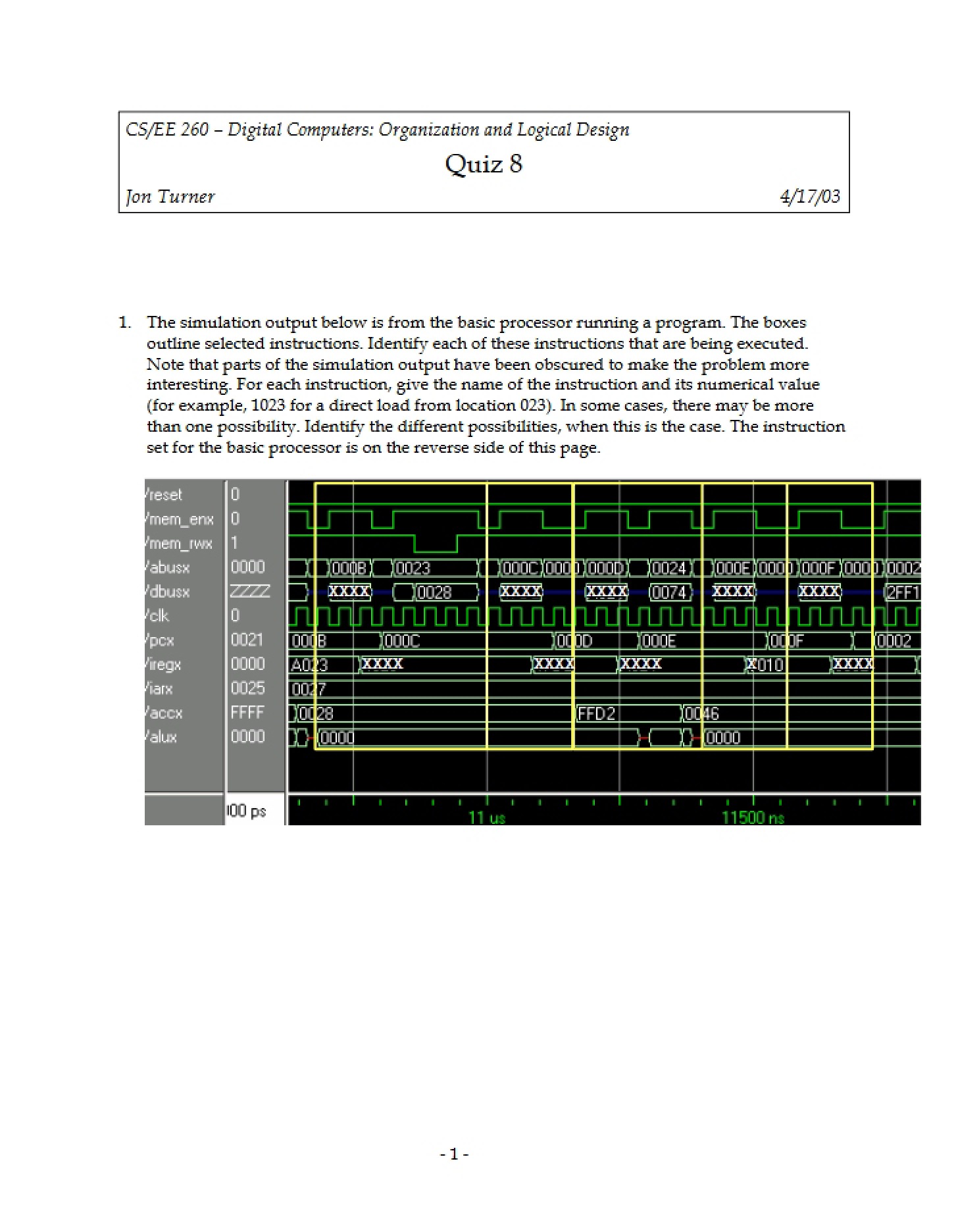
* Exercises focused on tracing the execution of a series of instructions in a basic processor.
* Questions requiring you to determine the state of the accumulator after instruction execution.
* Tasks involving predicting the value of the program counter following instruction sequences.
* A reference list of instructions for a simplified accumulator-based processor.